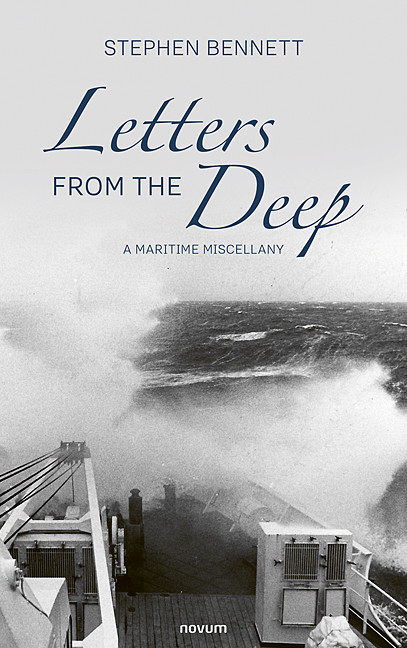
Letters from the Deep
A Maritime Miscellany
USD 27,99
Format: 13.5 x 21.5 cm
Number of Pages: 238
ISBN: 978-3-7116-1702-6
Release Date: 28.07.2026
From Antarctica to Arabian waters, a Royal Navy commander recalls the daring, discipline and dark humour of life at sea between 1967 and 1989. Told through an A–Z of memories, these vivid stories open a lost world of storms, warships, tradition and adventure.
Chapter 1
A is for Andrew
Trencrom Hill in the district of West Penwith, Cornwall, the mythological home of the giant Trecobben, rises some 180 metres above mean sea level between St Ives in the north and Penzance to the south-west. From its windswept summit, one can look 10 kilometres north-eastwards across the great golden sweep of Carbis Bay towards Godrevy Island’s gull-strewn sky, then 6 kilometres due southwards towards St Michael’s Mount, connected by its causeway to the mainland. Trencrom is the final resting place of my twin brother Andrew, who was cruelly and unfairly taken by a brain tumour just before his, and my, sixtieth birthday. He features in the opening and closing chapters of my book Letters from Arabia. I took my grandchildren to visit the site of his scattered ashes a few years ago. They were very unimpressed, expecting perhaps something in the way of a marble mausoleum. But their young minds were moved by the vague outline of the ancient Iron Age hill-fort ramparts and lichen-covered giant granite boulders as I told them a little of my twin’s complicated life, which, from the age of ten, was so different from mine. I return to Trencrom periodically to commune with his soul, smell the gorse and absorb the superb scenery. I hope that my ashes will join his when my time comes. Born at the end of 1949, he was named after our maternal grandfather, Andrew Scott, who died on New Year’s Eve, two days after our first birthday.
After my family had returned from Arabia, Andrew and I grew up in West Penwith and went to school in Penzance, with the sea very much part of our young lives. After he left for London with our soon-to-be-divorced parents, I stayed in Cornwall with my mildly disgruntled grandmother (Andrew Scott’s widow) to complete my prep-school education. I swore in her presence once and she literally washed out my mouth with a bar of carbolic soap. That taught me! But our relationship improved steadily, particularly after I joined the local Sea Cadets in Training Ship Grenville, halfway up Bread Street in Penzance. It was there that I first heard the Royal Navy referred to as the ‘Andrew’.
Andrew is a slang term for the Royal Navy, said to be from an 18th-century press-gang officer named Andrew Miller, who, the Oxford Companion to Ships and the Sea tells us, ‘impressed so many men into naval service during the Revolutionary and Napoleonic Wars, that he was said to own the Royal Navy’. Men impressed were not, as is commonly believed, unfortunate stragglers or drunks taken off to sea, but ‘seamen, seafaring men and persons whose occupations or callings are to work in vessels and boats upon rivers’. This was because the Navy, in time of war, did not want landmen (men with no naval training) but experienced mariners with competencies afloat; otherwise, the complex business of fighting multi-masted vessels against a willing foe could not be achieved. And several of these ships were, like my grandfather and brother, named after the patron saint of Scotland. A late 16th-century galleon taken from the Spanish was perhaps the first to bear that name. This vessel helped to date Shakespeare’s play The Merchant of Venice, as the capture of St Andrew was mentioned in Francis Meres’s 1598 list of The Bard’s comedies. Half a century later, the 42-gun St Andrew had its sainthood rescinded during Cromwell’s Commonwealth when she formed part of Admiral Robert Blake’s fleet in 1652 and then Admiral George Monck’s in 1653 during the 17th-century Dutch Wars. The Commonwealth Navy was also pitted against Royalist strongholds in Cornwall. This included an assault from seaward on Pendennis Castle in Falmouth, which was being supplied by a number of ketches, or ‘dogger’ boats. The master of one of these vessels was a certain Kedgwin of Penzant (Penzance), who was, according to the Andrew’s Parliamentarian captain Sir William Batten, ‘a notable active knave’, a description which could fit many of the officers it has been my pleasure to serve with, some of whom feature in this book.
St Andrew later fought against Algerine pirates off the coast of Tunisia in 1655. The ship’s sainthood was restored after the Restoration in 1660, taking part in a decisive victory over the Dutch at the Battle of Lowestoft in June 1666, but was sadly stranded later that year near Rye, East Sussex, during a storm. Being beyond economical repair, she was broken up. A new 96-gun first-rate ship by the same name was laid down shortly afterwards. She distinguished herself at the battles of Sole Bay (1672), Texel (1673) and Barfleur (1692), and was later renamed HMS Royal Anne. The hospital ship HMS St Andrew formed part of OPERATION DYNAMO – the evacuation of the British Expeditionary Force (including my father) from Dunkirk in late May 1940, a combat role I came to experience myself, as a later chapter will explain.
Whilst surface ships have been commissioned by name since the earliest days of the Royal Navy, submarines (apart from the early experimental vessels) were given an alphabetical prefix and a number (e.g. J2) until the mid-1920s. The first operational class were ‘A’ boats (1902–08), followed, by convention, by the ‘B’, ‘C’ and subsequent classes. In the mid-1980s, the Government announced that a new class of nuclear ballistic missile submarines would be ordered to succeed the ‘V’ class. Because some ‘W’ class nuclear submarines were in service, the next names by convention would start again with the letter A. Rising to the occasion of assisting the Admiralty ship-naming committee to select the most appropriate names, a team of like-minded souls in the bar in HMS Cochrane (Rosyth) proposed that the new Trident missile-carrying boats should be called HMS Apocalypse, HMS Annihilation, HMS Armageddon and HMS Atrocity. Much to our disappointment, the committee chose not to follow our advice.
A new class of A-boat diesel submarines had been built at the end of World War II – the Amphion class. One of these, HMS Andrew, was launched in April 1946 and served for a quarter of a century until being paid off on 31 December 1974, to be sold for scrap three years later. It had had a distinguished service. It was the first conventional submarine to complete a submerged transit of the Atlantic from Bermuda to the English Channel, a distance of 2,500 nautical miles (nm). It surfaced on the eve of the Coronation on 1 June 1953, an achievement which coincided with the British ascent of Everest. HMS Andrew had a starring role in the 1959 film On the Beach, where it purported to be the United States nuclear submarine USS Sawfish. It was fitted with ten 21-inch torpedo tubes and a 4-inch (33-calibre) Mk XXIII deck gun, installed in 1964, to operate from Singapore against blockade-running vessels during the 1963–1966 Indonesian Confrontation. The then Defence Secretary, Denis Healey, described the operation as ‘one of the most efficient uses of military forces in the history of the world’. She sailed from Singapore in 1968 and returned to join the 2nd Submarine Squadron based in Devonport, having called at Australia, Fiji, Tahiti, Pitcairn Island, Cartagena and Barbados en route. Her commanding officer was Lieutenant Toby Frere and the ship’s company numbered sixty-one. It was he who welcomed me on board in July 1969.
The ship in which I had served my year as a midshipman was the ice patrol vessel HMS Endurance (see Chapter 9). She had returned to Portsmouth in May 1969 for several months of maintenance. My final year at Britannia Royal Naval College Dartmouth as an acting sub-lieutenant did not start until September. I had intended after my initial 4-year officer training period to specialise as a submariner. As my perfectly reasonable request for three months’ leave was dismissed out of hand, I volunteered to gain submarine experience and was appointed to join HMS Andrew as a supernumerary ‘fifth hand’. As I walked across the brow (gangway) on my first morning, I was met by the cox’n, who looked at my suitcase with amused disdain.
‘No room for that, Sir,’ he said as he passed me an empty Peek Frean biscuit box.
‘Apart from your best uniform on an ’anger, what you can’t get in that, Sir, you can’t bring on board.’
But his and Toby Frere’s subsequent welcome was as warm as summer. I warmed, too, to watchkeeping duties whilst submerged. Having gained the crew’s confidence and mastered the air and water systems and their myriad valves, I took turns on the periscope, reporting surface shipping to the plot. It was exhilarating to see but not be seen, particularly while acting as a target for trials of a new naval sonar fitted to a distant warship. That and the subsequent six weeks in her sister ship HMS Astute were an extraordinary experience for a six-foot-five, 19-year-old gangly youth; no more so than ‘gun action surface’.
‘Your task today, Steve, is to spot the surface ship from the casing and give me its relative bearing as soon as I arrive on the bridge,’ ordered the captain.
‘You will be the first out of the hatch and will have about ten seconds to get your bearings. Is that clear?’
The hatch in question was in the deckhead of the small wardroom, which had been cleared for action. A large canvas bag was tied below it to catch the torrent of seawater that would surely flood in once I opened the hatch through the casing. A wire-and-rope ladder was suspended from just below the hatch release handle. I clung to it with my legs gripped by the gun-laying sailor below me, who would be the second gun crew member out. The air pressure inside the boat was increased; the engines were ordered full ahead; the fore planes angled up, and the forward air tank – ‘Q’ – was ‘blown’ to give the steepest rate of ascent. Then, as the bow broke the surface, I was ordered to open the hatch. It snapped back onto its lock, aided by the internal pressure as the rush of outbound air blew back most of the inbound seawater. The gun layer released my legs, and I popped up, penguin-like, to land on the casing in a swirling mass of spray, fetid air and adrenaline. I spotted the target and, arm outstretched, shouted:
‘RED FOUR ZERO!’ at the top of my voice towards the top of the fin from where Toby Frere, fresh from the internal conning tower hatch, acknowledged me with:
‘ROGER – got it.’
HMS Andrew subsequently visited Belfast shortly before The Troubles really kicked off and moored close to HMS Maidstone, which was then acting as a troop accommodation vessel. Two years later, she was converted into a prison ship to hold internees, including Gerry Adams. The internees were moved to Long Kesh prison in 1972, two years before HMS Andrew completed the last ‘gun action surface’ ever to be conducted in the Royal Navy. The recorded time from breaking surface to firing the first round was 36 seconds. The gun is now part of the display at the submarine museum in Gosport, Hampshire. The year 1972 was also the year I joined my first survey ship as a qualified basic hydrographic specialist. Sadly, my first choice of submarines had been denied me because, the sawbones told me, the fume-laden atmosphere was aggravating my acne. A month pressed against the reactor in a nuclear submarine would have cured that, surely?
I met Toby Frere many times during my thirty-five-year naval career and could not have been more impressed by his charm, strength of character and intellect. His first submarine appointment in 1961 was aboard HMS Andrew’s sister submarine, HMS Astute, in which I later briefly served. It was based in Halifax, Canada, as part of the 7th Submarine Squadron and on loan to the Royal Canadian Navy. HMS Astute was tasked to participate in the 600-mile patrol line between Newfoundland and the Azores to warn of Soviet submarine activity during the Cuban Missile Crisis. This modest UK defence contribution was, as Max Hastings put it so perfectly in his masterly account of that stand-off, all that public opinion would bear. ‘Had the prime minister (Macmillan) sought to make some conspicuous gesture of military support for the US, it is unlikely that he could have carried the British people with him.’ Subsequent British politicians have reacted similarly to worsening crises, particularly in the Middle East, but perhaps without the sound judgement possessed by Macmillan. Toby Frere’s obituary in The Telegraph summarised him as ‘able and well-informed, and at the same time modest, good-humoured, and taciturn. Behind his understated demeanour, however, lay a shrewd, tough character who knew what he had to achieve and quietly got on with it.’ A brilliant man and a great leader – the very best that HMS Andrew had to offer.
Chapter 2
B is for Beer
When I joined the Royal Navy in September 1967, the consumption of prodigious quantities of beer in an evening was the expected standard. If a cadet did not accept that, the question of why he had not applied to join the Royal Air Force instead would invariably be raised. Cadets, unlike the third-year acting sub-lieutenants, did not have their own mess. Neither did they have the privilege of shore leave, so the public houses down the hill in Dartmouth town were also denied the dubious pleasure of their company. Cadets in that first term – though not me, for I was under 18 – had to visit the NAAFI canteen overlooking the rugby pitches where beer flowed, not always down the throat, and the air was dense with the smoke from cheap, subsidised cigarettes.
Each cadet who declared himself to be a smoker, a fact attested to in their green-covered paybook, was issued with three maroon-coloured tobacco coupons (stamps) per month. These had been introduced to the Fleet in 1951. Each stamp enabled one to buy 100 ‘blue-liner’ cigarettes (or a quarter of a pound of tobacco). Each ciggie carried a printed blue line down the shaft together with the text ‘HM Ships only’. The allowance for ships outside the three (subsequently twelve) nautical-mile customs limit was increased to 600, redeemable at very low prices using light-blue coupons. Nearly everyone in the late 60s smoked. One of my shipmates, who you will meet in Chapter 15, often had a cigarette burning in each of the three ashtrays on the bridge. But all this conspicuous tobacco consumption was to be curtailed. The death knell for blue liners and duty-free regular cigarettes was rung by the Royal Navy’s Defence Council Instruction (DCI/RN) No. 11 of 1989. This announced the cancellation of the issue of duty-free cigarettes and tobacco, it being, in the Admiralty Board’s view, ‘inappropriate for the concession to continue’. That concession ended completely two years later, with a total ban on smoking in ships and submarines being enforced thirty years later.
Before cigarettes were in common use from the late-19th-century, leaf tobacco was sold to sailors onboard by the purser, who acted as a private trader in that regard and benefited modestly on whatever profit he could make from the sale. But it was by no means uncommon for the purser to improve his takings by ‘selling’ tobacco to dead men or deserters whose names were still on the ship’s book. Never trust a Pusser! But while tobacco always carried a charge, beer was free.
From its early origins, sailors of whatever rank did not consume the considerable quantity of barrelled water stored at the bottom of the hold as ballast. More readily accessible water barrels were used for cooking, but even this was both unpalatable and contaminated. Officers had spirits, often in prodigious quantities, whereas the men had beer at an approximate rate of one gallon per day, though its alcohol content was greater than the ‘small beer’ consumed by families, students and labourers ashore. The latter sobriety was captured in William Hogarth’s 1752 engraving Beer Street, as an example of proper behaviour contrasted with its twin, Gin Lane, which portrayed the opposite. Pink gin featured largely in the inter-war years, mostly because it was relatively cheap. This belied Samuel Johnson’s comment: ‘Claret is the liquor for boys; port for men; but he who aspires to be a hero must drink brandy’. How fittingly sad then that the body of my hero, Lord Nelson, was placed in a cask of brandy for the voyage from Trafalgar to Gibraltar. But beer or ale was, as the 19th-century writer and linguist tells us, ‘the true and proper drink of Englishmen. He is not deserving of the name of Englishman who speaketh against [good] ale’.
Hear, hear.
Beer was not readily available on long voyages or on foreign stations. Wine, diluted with eight parts water or even spirits with twice as much water, was provided in its place. Then, from the mid-17th century, sailors were issued with half a pint of neat spirits, mainly rum (the ‘tot’) from the West Indian colonies. Drunkenness afloat was therefore not uncommon, which reduced fighting efficiency and hazarded men working aloft. Admiral Edward Vernon recognised ‘the pernicious custom’ of knocking back neat rum, and in 1740 ordered that the half-pint would be diluted with one quart of water to form grog. Vernon’s nickname ‘Old Grogram’ came from the material from which his distinctive boat cloak was made. Grog is named after him. This was issued twice daily, once in the forenoon and again soon after 1600. The tot was decreased to a quarter-pint in 1823. It was withdrawn from accompanying women and children (!) as late as 1836 and reduced further to an eighth of a pint in 1850. Senior ratings received the tot neat. Ratings were issued with the tot diluted with two parts of water. From 1866, the tot – 95.5 proof or 54.6 % ABV – was issued at noon in a ceremony presided over by an officer, commonly a midshipman. This was called ‘Up Spirits’ which, when piped over a ship’s Tannoy sound system, would be followed by seamen’s cries of ‘Stand fast the Holy Ghost!’ The ‘rum bosun’ from each mess would collect its allocation in a rum ‘fanny’, the latter named after Sweet Fanny Adams, an eight-year-old girl who was dismembered by a solicitor’s clerk in 1867. A sailor serving in the Home Fleet at the time found a button in his portion of tinned meat and said that it must have come from Fanny’s dress. The term ‘fanny’ for a container or mess tin was thereafter adopted throughout the Royal Navy.
There had been attempts in the 19th century to withdraw the tot, and even David Lloyd George in 1915 saw that too much alcohol afloat was damaging to the war effort. In support of a 1915 campaign for prohibition during World War I, he said: ‘We are fighting Germany, Austria and drink, and so far as I can see the greatest of these deadly foes is drink.’ However, the tot, issued to ratings over the age of 21, was not withdrawn for another fifty-five years. Its issue ceased on 31 July 1970 to be replaced by duty-free spirits in senior rates’ messes and three half-pint (280 ml) cans of beer, both categories to be purchased, not issued for free. The positive effect on efficiency in a more technical Navy was offset by a significantly negative effect on morale. Indeed, it was argued at the time that much of the ethos and traditions of the lower deck changed from that date, although several stories in this book suggest that careful ignorance of Queen’s Regulations and delightfully inappropriate behaviour, sometimes fuelled by beer or other stimulants, continued for many years thereafter.
...
A is for Andrew
Trencrom Hill in the district of West Penwith, Cornwall, the mythological home of the giant Trecobben, rises some 180 metres above mean sea level between St Ives in the north and Penzance to the south-west. From its windswept summit, one can look 10 kilometres north-eastwards across the great golden sweep of Carbis Bay towards Godrevy Island’s gull-strewn sky, then 6 kilometres due southwards towards St Michael’s Mount, connected by its causeway to the mainland. Trencrom is the final resting place of my twin brother Andrew, who was cruelly and unfairly taken by a brain tumour just before his, and my, sixtieth birthday. He features in the opening and closing chapters of my book Letters from Arabia. I took my grandchildren to visit the site of his scattered ashes a few years ago. They were very unimpressed, expecting perhaps something in the way of a marble mausoleum. But their young minds were moved by the vague outline of the ancient Iron Age hill-fort ramparts and lichen-covered giant granite boulders as I told them a little of my twin’s complicated life, which, from the age of ten, was so different from mine. I return to Trencrom periodically to commune with his soul, smell the gorse and absorb the superb scenery. I hope that my ashes will join his when my time comes. Born at the end of 1949, he was named after our maternal grandfather, Andrew Scott, who died on New Year’s Eve, two days after our first birthday.
After my family had returned from Arabia, Andrew and I grew up in West Penwith and went to school in Penzance, with the sea very much part of our young lives. After he left for London with our soon-to-be-divorced parents, I stayed in Cornwall with my mildly disgruntled grandmother (Andrew Scott’s widow) to complete my prep-school education. I swore in her presence once and she literally washed out my mouth with a bar of carbolic soap. That taught me! But our relationship improved steadily, particularly after I joined the local Sea Cadets in Training Ship Grenville, halfway up Bread Street in Penzance. It was there that I first heard the Royal Navy referred to as the ‘Andrew’.
Andrew is a slang term for the Royal Navy, said to be from an 18th-century press-gang officer named Andrew Miller, who, the Oxford Companion to Ships and the Sea tells us, ‘impressed so many men into naval service during the Revolutionary and Napoleonic Wars, that he was said to own the Royal Navy’. Men impressed were not, as is commonly believed, unfortunate stragglers or drunks taken off to sea, but ‘seamen, seafaring men and persons whose occupations or callings are to work in vessels and boats upon rivers’. This was because the Navy, in time of war, did not want landmen (men with no naval training) but experienced mariners with competencies afloat; otherwise, the complex business of fighting multi-masted vessels against a willing foe could not be achieved. And several of these ships were, like my grandfather and brother, named after the patron saint of Scotland. A late 16th-century galleon taken from the Spanish was perhaps the first to bear that name. This vessel helped to date Shakespeare’s play The Merchant of Venice, as the capture of St Andrew was mentioned in Francis Meres’s 1598 list of The Bard’s comedies. Half a century later, the 42-gun St Andrew had its sainthood rescinded during Cromwell’s Commonwealth when she formed part of Admiral Robert Blake’s fleet in 1652 and then Admiral George Monck’s in 1653 during the 17th-century Dutch Wars. The Commonwealth Navy was also pitted against Royalist strongholds in Cornwall. This included an assault from seaward on Pendennis Castle in Falmouth, which was being supplied by a number of ketches, or ‘dogger’ boats. The master of one of these vessels was a certain Kedgwin of Penzant (Penzance), who was, according to the Andrew’s Parliamentarian captain Sir William Batten, ‘a notable active knave’, a description which could fit many of the officers it has been my pleasure to serve with, some of whom feature in this book.
St Andrew later fought against Algerine pirates off the coast of Tunisia in 1655. The ship’s sainthood was restored after the Restoration in 1660, taking part in a decisive victory over the Dutch at the Battle of Lowestoft in June 1666, but was sadly stranded later that year near Rye, East Sussex, during a storm. Being beyond economical repair, she was broken up. A new 96-gun first-rate ship by the same name was laid down shortly afterwards. She distinguished herself at the battles of Sole Bay (1672), Texel (1673) and Barfleur (1692), and was later renamed HMS Royal Anne. The hospital ship HMS St Andrew formed part of OPERATION DYNAMO – the evacuation of the British Expeditionary Force (including my father) from Dunkirk in late May 1940, a combat role I came to experience myself, as a later chapter will explain.
Whilst surface ships have been commissioned by name since the earliest days of the Royal Navy, submarines (apart from the early experimental vessels) were given an alphabetical prefix and a number (e.g. J2) until the mid-1920s. The first operational class were ‘A’ boats (1902–08), followed, by convention, by the ‘B’, ‘C’ and subsequent classes. In the mid-1980s, the Government announced that a new class of nuclear ballistic missile submarines would be ordered to succeed the ‘V’ class. Because some ‘W’ class nuclear submarines were in service, the next names by convention would start again with the letter A. Rising to the occasion of assisting the Admiralty ship-naming committee to select the most appropriate names, a team of like-minded souls in the bar in HMS Cochrane (Rosyth) proposed that the new Trident missile-carrying boats should be called HMS Apocalypse, HMS Annihilation, HMS Armageddon and HMS Atrocity. Much to our disappointment, the committee chose not to follow our advice.
A new class of A-boat diesel submarines had been built at the end of World War II – the Amphion class. One of these, HMS Andrew, was launched in April 1946 and served for a quarter of a century until being paid off on 31 December 1974, to be sold for scrap three years later. It had had a distinguished service. It was the first conventional submarine to complete a submerged transit of the Atlantic from Bermuda to the English Channel, a distance of 2,500 nautical miles (nm). It surfaced on the eve of the Coronation on 1 June 1953, an achievement which coincided with the British ascent of Everest. HMS Andrew had a starring role in the 1959 film On the Beach, where it purported to be the United States nuclear submarine USS Sawfish. It was fitted with ten 21-inch torpedo tubes and a 4-inch (33-calibre) Mk XXIII deck gun, installed in 1964, to operate from Singapore against blockade-running vessels during the 1963–1966 Indonesian Confrontation. The then Defence Secretary, Denis Healey, described the operation as ‘one of the most efficient uses of military forces in the history of the world’. She sailed from Singapore in 1968 and returned to join the 2nd Submarine Squadron based in Devonport, having called at Australia, Fiji, Tahiti, Pitcairn Island, Cartagena and Barbados en route. Her commanding officer was Lieutenant Toby Frere and the ship’s company numbered sixty-one. It was he who welcomed me on board in July 1969.
The ship in which I had served my year as a midshipman was the ice patrol vessel HMS Endurance (see Chapter 9). She had returned to Portsmouth in May 1969 for several months of maintenance. My final year at Britannia Royal Naval College Dartmouth as an acting sub-lieutenant did not start until September. I had intended after my initial 4-year officer training period to specialise as a submariner. As my perfectly reasonable request for three months’ leave was dismissed out of hand, I volunteered to gain submarine experience and was appointed to join HMS Andrew as a supernumerary ‘fifth hand’. As I walked across the brow (gangway) on my first morning, I was met by the cox’n, who looked at my suitcase with amused disdain.
‘No room for that, Sir,’ he said as he passed me an empty Peek Frean biscuit box.
‘Apart from your best uniform on an ’anger, what you can’t get in that, Sir, you can’t bring on board.’
But his and Toby Frere’s subsequent welcome was as warm as summer. I warmed, too, to watchkeeping duties whilst submerged. Having gained the crew’s confidence and mastered the air and water systems and their myriad valves, I took turns on the periscope, reporting surface shipping to the plot. It was exhilarating to see but not be seen, particularly while acting as a target for trials of a new naval sonar fitted to a distant warship. That and the subsequent six weeks in her sister ship HMS Astute were an extraordinary experience for a six-foot-five, 19-year-old gangly youth; no more so than ‘gun action surface’.
‘Your task today, Steve, is to spot the surface ship from the casing and give me its relative bearing as soon as I arrive on the bridge,’ ordered the captain.
‘You will be the first out of the hatch and will have about ten seconds to get your bearings. Is that clear?’
The hatch in question was in the deckhead of the small wardroom, which had been cleared for action. A large canvas bag was tied below it to catch the torrent of seawater that would surely flood in once I opened the hatch through the casing. A wire-and-rope ladder was suspended from just below the hatch release handle. I clung to it with my legs gripped by the gun-laying sailor below me, who would be the second gun crew member out. The air pressure inside the boat was increased; the engines were ordered full ahead; the fore planes angled up, and the forward air tank – ‘Q’ – was ‘blown’ to give the steepest rate of ascent. Then, as the bow broke the surface, I was ordered to open the hatch. It snapped back onto its lock, aided by the internal pressure as the rush of outbound air blew back most of the inbound seawater. The gun layer released my legs, and I popped up, penguin-like, to land on the casing in a swirling mass of spray, fetid air and adrenaline. I spotted the target and, arm outstretched, shouted:
‘RED FOUR ZERO!’ at the top of my voice towards the top of the fin from where Toby Frere, fresh from the internal conning tower hatch, acknowledged me with:
‘ROGER – got it.’
HMS Andrew subsequently visited Belfast shortly before The Troubles really kicked off and moored close to HMS Maidstone, which was then acting as a troop accommodation vessel. Two years later, she was converted into a prison ship to hold internees, including Gerry Adams. The internees were moved to Long Kesh prison in 1972, two years before HMS Andrew completed the last ‘gun action surface’ ever to be conducted in the Royal Navy. The recorded time from breaking surface to firing the first round was 36 seconds. The gun is now part of the display at the submarine museum in Gosport, Hampshire. The year 1972 was also the year I joined my first survey ship as a qualified basic hydrographic specialist. Sadly, my first choice of submarines had been denied me because, the sawbones told me, the fume-laden atmosphere was aggravating my acne. A month pressed against the reactor in a nuclear submarine would have cured that, surely?
I met Toby Frere many times during my thirty-five-year naval career and could not have been more impressed by his charm, strength of character and intellect. His first submarine appointment in 1961 was aboard HMS Andrew’s sister submarine, HMS Astute, in which I later briefly served. It was based in Halifax, Canada, as part of the 7th Submarine Squadron and on loan to the Royal Canadian Navy. HMS Astute was tasked to participate in the 600-mile patrol line between Newfoundland and the Azores to warn of Soviet submarine activity during the Cuban Missile Crisis. This modest UK defence contribution was, as Max Hastings put it so perfectly in his masterly account of that stand-off, all that public opinion would bear. ‘Had the prime minister (Macmillan) sought to make some conspicuous gesture of military support for the US, it is unlikely that he could have carried the British people with him.’ Subsequent British politicians have reacted similarly to worsening crises, particularly in the Middle East, but perhaps without the sound judgement possessed by Macmillan. Toby Frere’s obituary in The Telegraph summarised him as ‘able and well-informed, and at the same time modest, good-humoured, and taciturn. Behind his understated demeanour, however, lay a shrewd, tough character who knew what he had to achieve and quietly got on with it.’ A brilliant man and a great leader – the very best that HMS Andrew had to offer.
Chapter 2
B is for Beer
When I joined the Royal Navy in September 1967, the consumption of prodigious quantities of beer in an evening was the expected standard. If a cadet did not accept that, the question of why he had not applied to join the Royal Air Force instead would invariably be raised. Cadets, unlike the third-year acting sub-lieutenants, did not have their own mess. Neither did they have the privilege of shore leave, so the public houses down the hill in Dartmouth town were also denied the dubious pleasure of their company. Cadets in that first term – though not me, for I was under 18 – had to visit the NAAFI canteen overlooking the rugby pitches where beer flowed, not always down the throat, and the air was dense with the smoke from cheap, subsidised cigarettes.
Each cadet who declared himself to be a smoker, a fact attested to in their green-covered paybook, was issued with three maroon-coloured tobacco coupons (stamps) per month. These had been introduced to the Fleet in 1951. Each stamp enabled one to buy 100 ‘blue-liner’ cigarettes (or a quarter of a pound of tobacco). Each ciggie carried a printed blue line down the shaft together with the text ‘HM Ships only’. The allowance for ships outside the three (subsequently twelve) nautical-mile customs limit was increased to 600, redeemable at very low prices using light-blue coupons. Nearly everyone in the late 60s smoked. One of my shipmates, who you will meet in Chapter 15, often had a cigarette burning in each of the three ashtrays on the bridge. But all this conspicuous tobacco consumption was to be curtailed. The death knell for blue liners and duty-free regular cigarettes was rung by the Royal Navy’s Defence Council Instruction (DCI/RN) No. 11 of 1989. This announced the cancellation of the issue of duty-free cigarettes and tobacco, it being, in the Admiralty Board’s view, ‘inappropriate for the concession to continue’. That concession ended completely two years later, with a total ban on smoking in ships and submarines being enforced thirty years later.
Before cigarettes were in common use from the late-19th-century, leaf tobacco was sold to sailors onboard by the purser, who acted as a private trader in that regard and benefited modestly on whatever profit he could make from the sale. But it was by no means uncommon for the purser to improve his takings by ‘selling’ tobacco to dead men or deserters whose names were still on the ship’s book. Never trust a Pusser! But while tobacco always carried a charge, beer was free.
From its early origins, sailors of whatever rank did not consume the considerable quantity of barrelled water stored at the bottom of the hold as ballast. More readily accessible water barrels were used for cooking, but even this was both unpalatable and contaminated. Officers had spirits, often in prodigious quantities, whereas the men had beer at an approximate rate of one gallon per day, though its alcohol content was greater than the ‘small beer’ consumed by families, students and labourers ashore. The latter sobriety was captured in William Hogarth’s 1752 engraving Beer Street, as an example of proper behaviour contrasted with its twin, Gin Lane, which portrayed the opposite. Pink gin featured largely in the inter-war years, mostly because it was relatively cheap. This belied Samuel Johnson’s comment: ‘Claret is the liquor for boys; port for men; but he who aspires to be a hero must drink brandy’. How fittingly sad then that the body of my hero, Lord Nelson, was placed in a cask of brandy for the voyage from Trafalgar to Gibraltar. But beer or ale was, as the 19th-century writer and linguist tells us, ‘the true and proper drink of Englishmen. He is not deserving of the name of Englishman who speaketh against [good] ale’.
Hear, hear.
Beer was not readily available on long voyages or on foreign stations. Wine, diluted with eight parts water or even spirits with twice as much water, was provided in its place. Then, from the mid-17th century, sailors were issued with half a pint of neat spirits, mainly rum (the ‘tot’) from the West Indian colonies. Drunkenness afloat was therefore not uncommon, which reduced fighting efficiency and hazarded men working aloft. Admiral Edward Vernon recognised ‘the pernicious custom’ of knocking back neat rum, and in 1740 ordered that the half-pint would be diluted with one quart of water to form grog. Vernon’s nickname ‘Old Grogram’ came from the material from which his distinctive boat cloak was made. Grog is named after him. This was issued twice daily, once in the forenoon and again soon after 1600. The tot was decreased to a quarter-pint in 1823. It was withdrawn from accompanying women and children (!) as late as 1836 and reduced further to an eighth of a pint in 1850. Senior ratings received the tot neat. Ratings were issued with the tot diluted with two parts of water. From 1866, the tot – 95.5 proof or 54.6 % ABV – was issued at noon in a ceremony presided over by an officer, commonly a midshipman. This was called ‘Up Spirits’ which, when piped over a ship’s Tannoy sound system, would be followed by seamen’s cries of ‘Stand fast the Holy Ghost!’ The ‘rum bosun’ from each mess would collect its allocation in a rum ‘fanny’, the latter named after Sweet Fanny Adams, an eight-year-old girl who was dismembered by a solicitor’s clerk in 1867. A sailor serving in the Home Fleet at the time found a button in his portion of tinned meat and said that it must have come from Fanny’s dress. The term ‘fanny’ for a container or mess tin was thereafter adopted throughout the Royal Navy.
There had been attempts in the 19th century to withdraw the tot, and even David Lloyd George in 1915 saw that too much alcohol afloat was damaging to the war effort. In support of a 1915 campaign for prohibition during World War I, he said: ‘We are fighting Germany, Austria and drink, and so far as I can see the greatest of these deadly foes is drink.’ However, the tot, issued to ratings over the age of 21, was not withdrawn for another fifty-five years. Its issue ceased on 31 July 1970 to be replaced by duty-free spirits in senior rates’ messes and three half-pint (280 ml) cans of beer, both categories to be purchased, not issued for free. The positive effect on efficiency in a more technical Navy was offset by a significantly negative effect on morale. Indeed, it was argued at the time that much of the ethos and traditions of the lower deck changed from that date, although several stories in this book suggest that careful ignorance of Queen’s Regulations and delightfully inappropriate behaviour, sometimes fuelled by beer or other stimulants, continued for many years thereafter.
...

Anyone involved with the Royal Navy during the Cold War is going to be deeply moved by the recognition of old experiences that this book triggers: the humour, the camaraderie, the wisdom, the professionalism, and the leadership. Those familiar with the current state of the Royal Navy will mourn the bygone days. Those not so involved will enjoy the window into life at sea, possibly with raised eyebrows at the sheer joy involved in carrying out one's job at the highest standards whilst surrounded by the best examples of comradeship at all levels. This is both a not-to-be-put-down book, as well as one that will be delved into on many future occasions. Very rewarding.
You might like this too :

Other books by this author