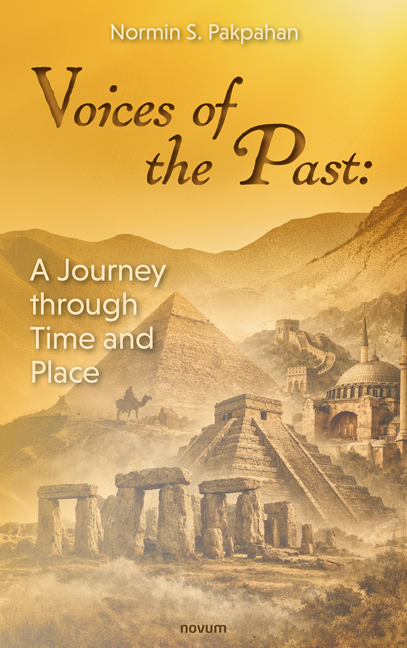
Voices of the Past: A Journey through Time and Place
USD 26,99
Format: 13.5 x 21.5 cm
Number of Pages: 174
ISBN: 978-3-7116-1438-4
Release Date: 12.06.2026
Normin S. Pakpahan is a lawyer, economist, reformer, and author. With decades of service in government and international finance, he has dedicated his life to advancing Indonesia’s development and sharing wisdom through his writings.
CHAPTER 1:
BIG LEAPS TO AMERICA
1. A Night of Uncertainty at Haneda
My journey to the United States began in July 1973, filled with hope and anticipation. I received a scholarship to pursue advanced studies in management. With a heart full of purpose, I boarded a Cathay Pacific flight from Kemayoran Airport in Jakarta to Tokyo, on my way to San Francisco. It was my first time traveling outside Indonesia, and although I was academically and administratively prepared for my studies, I was completely unfamiliar with the complexities of international travel.
After a long flight, we arrived at Haneda Airport late at night. The terminal was quiet as midnight approached, and I was looking forward to resting before my flight the next day. What I didn’t expect was a sudden stop at the immigration counter.
The officer examined my passport, stared at me with a penetrating gaze, and asked sharply, “Where is your Japanese visa?”
I was taken aback. Neither the scholarship agency nor the travel arranger had informed me that I needed a visa to enter Japan, even for a brief overnight stay. With no prior experience traveling abroad, I assumed that transiting through Tokyo would be simple.
I tried to explain. I showed my U.S. student visa, my Pan Am ticket to San Francisco, and the letter of admission from the American university. “I’m only in transit,” I pleaded. “I’ll fly out tomorrow morning.”
But my words had little impact. I was politely and firmly led into a small room next to the immigration area. It was bare and cold, lit by harsh fluorescent lights above. Alone and nervous, I waited as officers whispered among themselves in Japanese. I couldn’t read their expressions, but I picked up on caution and doubt. The fear of being denied entry and sent back to Jakarta haunted me.
Then an officer picked up my passport again and flipped through its pages. He paused, looked up, and asked, “Official Service Passport?”
“Yes,” I replied quickly. “I am an official of the Indonesian Ministry of Finance.”
There was a moment of silence. Then came a change in tone.
The Immigration officers exchanged quiet words. One slipped out, and shortly after, a Customs officer, as shown by his uniform, a man with a gentle demeanor, entered the room. He scrutinized my passport closely. Then he looked at me and asked, “You, a government official? Ministry of Finance?”
“Yes,” I repeated. “I am a Ministry of Finance official.”
His face lit up with recognition. He pointed to his chest and said, smiling, “I’m also from the Ministry of Finance.” Then, in a gesture I will never forget, he extended his hand and said, “No worry. I’ll help you.” He then spoke to the immigration officers, who immediately nodded, and voila, I was granted an entry visa to Japan. The customs officer and his colleagues escorted me and my luggage to their station, where one of them made a few phone calls. They eventually informed me that they had made a hotel reservation for me to stay overnight at the Akasaka Prince Hotel and that their operational car would take me there. He gave me a piece of paper to hand to the hotel receptionist. It was written in Kanji. With complete relief, I felt at ease in my heart. I was saved by the mantra “Ministry of Finance.” The Haneda incident demonstrated to me the power of camaraderie within the Ministry of Finance, and it proved effective at an unexpected time.
2. Set foot on American Soil
The following noon, still in awe of the unexpected hospitality I had received in Tokyo and feeling rested, I checked in at the Pan Am counter at Haneda Airport. There were no complications this time, just a final glance at my documents and a gentle nod from the immigration officer and the ground staff. I boarded the aircraft with a mix of relief and anticipation. After all the preparation and many unknowns, my journey to America finally took flight.
It was a long journey across the vast Pacific, yet I felt at ease. I knew I was heading toward a new phase in life – one of learning, adjustment, and quiet growth.
The plane touched down early in the morning at San Francisco International Airport. The city I had heard so much about – its fog, bridges, and songs – was still asleep beyond the glass walls of the terminal. The immigration process went smoothly, and the officer who checked my passport greeted me with a genuinely welcoming smile. After a brief review, he looked up and said, “Welcome to the United States. You must head to the domestic terminal; your next flight is to Denver.”
I embarked on my long journey with luggage in hand and a heart still learning to navigate foreign airports. The terminals were huge, and the signs initially seemed confusing. I stopped a few times to ask for directions, each time politely greeted by the uniformed airport staff who patiently pointed the way. Eventually, I reached the gate and boarded another Pan Am flight headed for Denver, Colorado. When I looked at my plane ticket to Denver, I was shocked to realize that I had already arrived on American soil the day I left Tokyo. How? Well, I crossed the date line somewhere in the Pacific.
Denver unfolded before me in shades of gold and brown, a city on the plains with the distant Rocky Mountains standing like silent guardians. From the airport, I followed the itinerary prepared in Jakarta: I took a taxi to the Greyhound bus terminal in downtown Denver, where I would begin the final leg of my journey.
By afternoon, I found myself on a Greyhound bus, heading northwest toward a town I had only encountered in writing: Boulder.
The landscape along the way was unfamiliar yet peaceful, with wide highways, expansive blue skies, and occasional farmlands stretching to the horizon. As day turned to dusk, the bus arrived in Boulder, and the silhouette of the Rockies began to loom larger, resembling a promise of new beginnings.
At the Greyhound bus station, a young man, one of the organizers of the Economics Institute, warmly greeted me. He introduced himself, helped with my bags, and drove me to Columbine, where all international program participants were housed.
That summer evening in 1973, I arrived at my new home in Boulder, Colorado. I was far from the archipelago where I had grown up, but I carried with me the hopes of a generation entrusted with our nation’s future. The road had been long – Jakarta to Tokyo, Tokyo to San Francisco, San Francisco to Denver, and finally Boulder – but I felt the journey ahead was beginning.
3. The Economics Institute – A Gateway to Academic Life in America
My formal entry into academic life in the United States began with a two-week orientation program at the Economics Institute, an affiliate of the American Economic Association located at the University of Colorado in Boulder. Nestled at the foot of the Rocky Mountains, the campus exuded a quiet, scholarly charm, and the air felt crisp and invigorating, a refreshing change from the tropical humidity I had left behind in Jakarta.
The program was carefully designed to help international students like me from various developing countries prepare for the intellectual, language, and cultural challenges of graduate study in the United States. It acted as a gateway to academic life and introduced a new world of perspectives.
I found myself among peers from Asia, Africa, and Latin America, each representing their nations’ aspirations. There were economists from Kenya, central bankers from Pakistan, policy analysts from Peru, and civil servants from Thailand. Despite our vastly different backgrounds, we shared a fundamental bond: a sense of purpose. We had not come as tourists, but as scholars and professionals entrusted with the responsibility of returning home equipped with skills, insights, and experiences that could shape our countries’ futures.
During those two weeks, we were introduced to the American academic system, its expectations, freedoms, and demands. We attended lectures on economic theory, engaged in case studies on development, and took part in workshops focused on academic writing. Additionally, we discussed global issues from various perspectives, challenged each other, and enjoyed late-night conversations in the hallways of Columbine.
Outside the classroom, Boulder offered a warm welcome. Tucked in a valley between mountain ridges, this small town felt peaceful and intellectually lively. Cafes, bookstores, and university halls buzzed with a quiet energy, and I spent many evenings walking along the tree-lined paths of the campus, reflecting on the journey that brought me here and the one still ahead.
Those two weeks went beyond just academic preparation. They provided a smooth transition into American life and a rare opportunity to see the developing world through the struggles and hopes of others. I realized that, despite differences in language, faith, or location, we faced similar issues – underdevelopment, inequality, governance – and that economics is not just theory, but a language for understanding the real world.
4. American Highways – The Journey Westward
My orientation program at the Economics Institute in Boulder ended in the first week of August 1973, marking the conclusion of my first structured experience in the United States. The University of Oregon in Eugene was next, where I would pursue my MBA studies. However, there was still some time before the fall term started, and with the open road ahead, a few of us decided to take advantage of the opportunity.
My three fellow Indonesian students and I rented a car and set out on an ambitious trip to explore the vast cinematic wonders of America’s West. None of us had ever gone on a road trip this big before. We weren’t civil servants or graduate students for a while – we were young travelers chasing horizons and driven by curiosity.
Our route led us through Utah, Arizona, and Nevada, eventually taking us toward Oregon. The landscapes changed dramatically with each state line we crossed – from deserts to rugged cliffs, from sprawling open plains to glittering city lights.
One of the most stunning moments of the trip was our visit to the Grand Canyon. No photo or video could have prepared me for its size. Standing at the edge, I was speechless at the wide chasm created by time. The red, orange, and gold layers seemed to tell a story older than countries and deeper than any textbook. We stayed there for a long time, letting the wind wash over us, humbled by nature’s incredible patience and craftsmanship.
We traveled through the deserts of Utah and Arizona, where the road seemed to disappear into the heat. The silence of the desert wasn’t empty; it was a vast, spiritual stillness, broken only by the occasional rock formation or wildlife sighting. It was unlike anything we had ever experienced back home in Indonesia. This land was stark and bold, both beautiful and unforgiving.
Our journey took an incredible turn in Las Vegas, a city that glowed like an illusion brought to life. After days in the desert and canyons, the sudden burst of neon lights, music, and crowds felt unreal. Here, the American dream unfolded in glitter and spectacle. We wandered through casinos and hotels, recognizing scenes we had only seen in Hollywood films. It was entertainment at its most extravagant – artificial but undeniably exhilarating. Seeing the “real thing” – the fountains, the blackjack tables, the impersonators, and performances – felt like stepping into a world that exists in the imagination of millions.
That overland trip became one of the most unforgettable chapters of my early days in America. It was more than just sightseeing; it was a journey of perspective, freedom, connection with the land, my companions, and a wild, proud, and endlessly open side of America. When we arrived in Eugene, we were sunburned and a bit tired but filled with stories, awe, and a renewed eagerness to dive into the serious work of studying and self-growth.
5. A Brief Detour to Berkeley – Between Law and Leadership
Before heading north to Eugene, we stopped briefly but meaningfully at the University of California, Berkeley, specifically at Boalt Hall School of Law, one of America’s most respected law schools. This visit was more than just curiosity; it reminded me of what might have been.
My scholarship was initially awarded for a one-year non-degree program in Law and Economics at Berkeley. The program was intellectually engaging, combining my legal background with a broader view of economics and policy that aligned with my experience and comfort zone.
However, in the weeks leading up to my departure from Indonesia, a decision was made that would ultimately shape my career. After reviewing the national development priorities and internal staffing needs, my supervisor at the Ministry of Finance directed me to switch my field of study to a full MBA program. The goal was clear: Indonesia needed professionals who could understand markets, institutions, and modern management within the framework of development economics and statecraft. In summary, Indonesia needs professionals with MBA degrees to oversee state-owned enterprises.
Although I accepted the decision, I remember standing outside Boalt Hall, reflecting on what might have been if I had taken the original path. As a trained lawyer, I felt the law program was a natural progression. I was confident I could navigate it easily. In contrast, the MBA program was unfamiliar territory, filled with quantitative rigor, business case studies, and frameworks I had not encountered in law school.
Yet, I did not resist the change.
I saw the MBA as an opportunity to go beyond my training and prepare for leadership roles in a rapidly changing Indonesia. While my proficiency with legal reasoning would have helped, I knew that the future belongs to those who can interpret the law, design systems, run institutions, and turn policy into results.
That brief visit to Berkeley, although symbolic, provided me with closure. I took one last look at the grand steps of the law school, quietly acknowledged the path I didn’t choose, and returned to the car with my friends. Along with my MBA journey, the road to Eugene awaited – demanding, uncertain, yet promising.
6. On the Road to Eugene – Between Love and Duty
As the Greyhound bus rumbled north toward Eugene, Oregon, I sat by the window, watching the vast American landscape roll by. My companions whispered or dozed off, but I was somewhere else, my thoughts drifting thousands of miles back to Jakarta, where I had left something more precious than familiarity: my newlywed wife.
We had just started our life together, and now I was on the opposite side of the world, pursuing a future I could only see in pieces. Even then, deciding to separate had not been easy. But we both understood what was at stake. This journey, this education, was about more than just personal growth. It was a step toward building a more stable and meaningful life for myself and the family we hoped to create.
The transition from Berkeley’s original Law and Economics program to the more rigorous MBA track introduced uncertainty. I had no formal background in business, and the path ahead felt unfamiliar. Nonetheless, I accepted the challenge, reassured by one key promise: my scholarship would be extended, my wife would join me in the United States, and her travel and living expenses would be covered under the same terms.
It was that promise that gave me courage. As I gazed out over the endless roads and distant hills, I wasn’t just heading toward a university – I was moving, step by step, toward the future we had imagined together. Yet, a familiar ache lingered in my heart, a pain known to anyone who has left a loved one behind in pursuit of something greater than themselves.
It was a quiet, solemn moment – one of many sacrifices we made out of necessity and hope.
7. Arrival in Eugene – A New Chapter Begins
We arrived in Eugene, Oregon, well past midnight. The bus station was quiet, and the town was wrapped in an early morning stillness. Even at that late hour, someone from the University of Oregon Administration was waiting for us, once again showing how organized and welcoming the academic community can be. His presence gave us both relief and reassurance.
He greeted us warmly and handed us a folder containing several documents and forms to complete and submit soon. Everything was organized clearly: immigration requirements, university orientation schedules, banking arrangements, and health check procedures. Even though I was tired from the long road trip, I appreciated the structure. It made me realize I was no longer in transition; I had arrived.
The university also temporarily housed us at the College Inn, a simple yet comfortable student lodging a few blocks from campus. This was our home for the first three months, serving as a transitional space until we were assigned to units in the university housing designated for married students.
That night, as I settled into my room, I looked out at the unfamiliar streets of Eugene, illuminated by the glow of streetlamps. It was a quiet town; there was no traffic or noise, just the occasional rustling of trees in the breeze. A world away from the hustle of Jakarta or the bright lights of Las Vegas, Eugene seemed to breathe at its own relaxed pace.
Even though I was miles from home, I felt a growing sense of readiness. A long journey brought me here – from Kemayoran to Haneda, from San Francisco to Boulder, and now to this peaceful university town in Oregon. It was from these calm beginnings that a new chapter was about to start.
8. First Impressions of Campus Life
After finally settling into my room at the College Inn, exhaustion washed over me. I slept almost the entire day, my body recovering from days of extensive travel and emotional strain. By the time I woke up, it was already evening, and I headed to the dining room, where the soft hum of voices and the clinking of cutlery filled the air. The room was bustling with incoming students, mostly undergraduates, full of energy and curiosity. In contrast, a few quiet graduate students, like me, were tucked away at various tables, more reserved and lost in thought.
I found a seat and quietly observed, still half adrift in jet lag and reflection. This would be the rhythm of life for a while: meals at the Inn, paperwork, orientation, and settling in. I was worlds away from the Ministry’s formal structures in Jakarta. There was a sense of casualness, youthful energy, and movement here. I felt both older and younger at the same time.
Following the instructions in my orientation folder, I went to the University Administration Building the next morning. It was located in the center of campus, surrounded by an open area that resembled a well-maintained park rather than an institutional complex.
Walking along the straight paths, I felt as though I were in a large, peaceful garden. Towering trees, oak, fir, and maple, lined the walkways, their canopies casting dappled shadows on the grass. Vast green fields between the buildings were neatly trimmed and quiet under the morning sun. Students moved about on bicycles or on foot, with backpacks over their shoulders, creating a gentle rhythm for the day.
The campus was beautiful and radiated a sense of academic dignity without arrogance. It reminded me of a space made not only for studying but also for thinking, for wandering between classes, ideas, and moments of silence beneath the trees. From Jakarta’s concrete density, this environment felt open, bright, and deeply grounding.
That morning walk, as simple as it was, marked the start of my journey at the University of Oregon. I was no longer in transit; I was now part of a new world filled with knowledge, challenges, and growth.
...
BIG LEAPS TO AMERICA
1. A Night of Uncertainty at Haneda
My journey to the United States began in July 1973, filled with hope and anticipation. I received a scholarship to pursue advanced studies in management. With a heart full of purpose, I boarded a Cathay Pacific flight from Kemayoran Airport in Jakarta to Tokyo, on my way to San Francisco. It was my first time traveling outside Indonesia, and although I was academically and administratively prepared for my studies, I was completely unfamiliar with the complexities of international travel.
After a long flight, we arrived at Haneda Airport late at night. The terminal was quiet as midnight approached, and I was looking forward to resting before my flight the next day. What I didn’t expect was a sudden stop at the immigration counter.
The officer examined my passport, stared at me with a penetrating gaze, and asked sharply, “Where is your Japanese visa?”
I was taken aback. Neither the scholarship agency nor the travel arranger had informed me that I needed a visa to enter Japan, even for a brief overnight stay. With no prior experience traveling abroad, I assumed that transiting through Tokyo would be simple.
I tried to explain. I showed my U.S. student visa, my Pan Am ticket to San Francisco, and the letter of admission from the American university. “I’m only in transit,” I pleaded. “I’ll fly out tomorrow morning.”
But my words had little impact. I was politely and firmly led into a small room next to the immigration area. It was bare and cold, lit by harsh fluorescent lights above. Alone and nervous, I waited as officers whispered among themselves in Japanese. I couldn’t read their expressions, but I picked up on caution and doubt. The fear of being denied entry and sent back to Jakarta haunted me.
Then an officer picked up my passport again and flipped through its pages. He paused, looked up, and asked, “Official Service Passport?”
“Yes,” I replied quickly. “I am an official of the Indonesian Ministry of Finance.”
There was a moment of silence. Then came a change in tone.
The Immigration officers exchanged quiet words. One slipped out, and shortly after, a Customs officer, as shown by his uniform, a man with a gentle demeanor, entered the room. He scrutinized my passport closely. Then he looked at me and asked, “You, a government official? Ministry of Finance?”
“Yes,” I repeated. “I am a Ministry of Finance official.”
His face lit up with recognition. He pointed to his chest and said, smiling, “I’m also from the Ministry of Finance.” Then, in a gesture I will never forget, he extended his hand and said, “No worry. I’ll help you.” He then spoke to the immigration officers, who immediately nodded, and voila, I was granted an entry visa to Japan. The customs officer and his colleagues escorted me and my luggage to their station, where one of them made a few phone calls. They eventually informed me that they had made a hotel reservation for me to stay overnight at the Akasaka Prince Hotel and that their operational car would take me there. He gave me a piece of paper to hand to the hotel receptionist. It was written in Kanji. With complete relief, I felt at ease in my heart. I was saved by the mantra “Ministry of Finance.” The Haneda incident demonstrated to me the power of camaraderie within the Ministry of Finance, and it proved effective at an unexpected time.
2. Set foot on American Soil
The following noon, still in awe of the unexpected hospitality I had received in Tokyo and feeling rested, I checked in at the Pan Am counter at Haneda Airport. There were no complications this time, just a final glance at my documents and a gentle nod from the immigration officer and the ground staff. I boarded the aircraft with a mix of relief and anticipation. After all the preparation and many unknowns, my journey to America finally took flight.
It was a long journey across the vast Pacific, yet I felt at ease. I knew I was heading toward a new phase in life – one of learning, adjustment, and quiet growth.
The plane touched down early in the morning at San Francisco International Airport. The city I had heard so much about – its fog, bridges, and songs – was still asleep beyond the glass walls of the terminal. The immigration process went smoothly, and the officer who checked my passport greeted me with a genuinely welcoming smile. After a brief review, he looked up and said, “Welcome to the United States. You must head to the domestic terminal; your next flight is to Denver.”
I embarked on my long journey with luggage in hand and a heart still learning to navigate foreign airports. The terminals were huge, and the signs initially seemed confusing. I stopped a few times to ask for directions, each time politely greeted by the uniformed airport staff who patiently pointed the way. Eventually, I reached the gate and boarded another Pan Am flight headed for Denver, Colorado. When I looked at my plane ticket to Denver, I was shocked to realize that I had already arrived on American soil the day I left Tokyo. How? Well, I crossed the date line somewhere in the Pacific.
Denver unfolded before me in shades of gold and brown, a city on the plains with the distant Rocky Mountains standing like silent guardians. From the airport, I followed the itinerary prepared in Jakarta: I took a taxi to the Greyhound bus terminal in downtown Denver, where I would begin the final leg of my journey.
By afternoon, I found myself on a Greyhound bus, heading northwest toward a town I had only encountered in writing: Boulder.
The landscape along the way was unfamiliar yet peaceful, with wide highways, expansive blue skies, and occasional farmlands stretching to the horizon. As day turned to dusk, the bus arrived in Boulder, and the silhouette of the Rockies began to loom larger, resembling a promise of new beginnings.
At the Greyhound bus station, a young man, one of the organizers of the Economics Institute, warmly greeted me. He introduced himself, helped with my bags, and drove me to Columbine, where all international program participants were housed.
That summer evening in 1973, I arrived at my new home in Boulder, Colorado. I was far from the archipelago where I had grown up, but I carried with me the hopes of a generation entrusted with our nation’s future. The road had been long – Jakarta to Tokyo, Tokyo to San Francisco, San Francisco to Denver, and finally Boulder – but I felt the journey ahead was beginning.
3. The Economics Institute – A Gateway to Academic Life in America
My formal entry into academic life in the United States began with a two-week orientation program at the Economics Institute, an affiliate of the American Economic Association located at the University of Colorado in Boulder. Nestled at the foot of the Rocky Mountains, the campus exuded a quiet, scholarly charm, and the air felt crisp and invigorating, a refreshing change from the tropical humidity I had left behind in Jakarta.
The program was carefully designed to help international students like me from various developing countries prepare for the intellectual, language, and cultural challenges of graduate study in the United States. It acted as a gateway to academic life and introduced a new world of perspectives.
I found myself among peers from Asia, Africa, and Latin America, each representing their nations’ aspirations. There were economists from Kenya, central bankers from Pakistan, policy analysts from Peru, and civil servants from Thailand. Despite our vastly different backgrounds, we shared a fundamental bond: a sense of purpose. We had not come as tourists, but as scholars and professionals entrusted with the responsibility of returning home equipped with skills, insights, and experiences that could shape our countries’ futures.
During those two weeks, we were introduced to the American academic system, its expectations, freedoms, and demands. We attended lectures on economic theory, engaged in case studies on development, and took part in workshops focused on academic writing. Additionally, we discussed global issues from various perspectives, challenged each other, and enjoyed late-night conversations in the hallways of Columbine.
Outside the classroom, Boulder offered a warm welcome. Tucked in a valley between mountain ridges, this small town felt peaceful and intellectually lively. Cafes, bookstores, and university halls buzzed with a quiet energy, and I spent many evenings walking along the tree-lined paths of the campus, reflecting on the journey that brought me here and the one still ahead.
Those two weeks went beyond just academic preparation. They provided a smooth transition into American life and a rare opportunity to see the developing world through the struggles and hopes of others. I realized that, despite differences in language, faith, or location, we faced similar issues – underdevelopment, inequality, governance – and that economics is not just theory, but a language for understanding the real world.
4. American Highways – The Journey Westward
My orientation program at the Economics Institute in Boulder ended in the first week of August 1973, marking the conclusion of my first structured experience in the United States. The University of Oregon in Eugene was next, where I would pursue my MBA studies. However, there was still some time before the fall term started, and with the open road ahead, a few of us decided to take advantage of the opportunity.
My three fellow Indonesian students and I rented a car and set out on an ambitious trip to explore the vast cinematic wonders of America’s West. None of us had ever gone on a road trip this big before. We weren’t civil servants or graduate students for a while – we were young travelers chasing horizons and driven by curiosity.
Our route led us through Utah, Arizona, and Nevada, eventually taking us toward Oregon. The landscapes changed dramatically with each state line we crossed – from deserts to rugged cliffs, from sprawling open plains to glittering city lights.
One of the most stunning moments of the trip was our visit to the Grand Canyon. No photo or video could have prepared me for its size. Standing at the edge, I was speechless at the wide chasm created by time. The red, orange, and gold layers seemed to tell a story older than countries and deeper than any textbook. We stayed there for a long time, letting the wind wash over us, humbled by nature’s incredible patience and craftsmanship.
We traveled through the deserts of Utah and Arizona, where the road seemed to disappear into the heat. The silence of the desert wasn’t empty; it was a vast, spiritual stillness, broken only by the occasional rock formation or wildlife sighting. It was unlike anything we had ever experienced back home in Indonesia. This land was stark and bold, both beautiful and unforgiving.
Our journey took an incredible turn in Las Vegas, a city that glowed like an illusion brought to life. After days in the desert and canyons, the sudden burst of neon lights, music, and crowds felt unreal. Here, the American dream unfolded in glitter and spectacle. We wandered through casinos and hotels, recognizing scenes we had only seen in Hollywood films. It was entertainment at its most extravagant – artificial but undeniably exhilarating. Seeing the “real thing” – the fountains, the blackjack tables, the impersonators, and performances – felt like stepping into a world that exists in the imagination of millions.
That overland trip became one of the most unforgettable chapters of my early days in America. It was more than just sightseeing; it was a journey of perspective, freedom, connection with the land, my companions, and a wild, proud, and endlessly open side of America. When we arrived in Eugene, we were sunburned and a bit tired but filled with stories, awe, and a renewed eagerness to dive into the serious work of studying and self-growth.
5. A Brief Detour to Berkeley – Between Law and Leadership
Before heading north to Eugene, we stopped briefly but meaningfully at the University of California, Berkeley, specifically at Boalt Hall School of Law, one of America’s most respected law schools. This visit was more than just curiosity; it reminded me of what might have been.
My scholarship was initially awarded for a one-year non-degree program in Law and Economics at Berkeley. The program was intellectually engaging, combining my legal background with a broader view of economics and policy that aligned with my experience and comfort zone.
However, in the weeks leading up to my departure from Indonesia, a decision was made that would ultimately shape my career. After reviewing the national development priorities and internal staffing needs, my supervisor at the Ministry of Finance directed me to switch my field of study to a full MBA program. The goal was clear: Indonesia needed professionals who could understand markets, institutions, and modern management within the framework of development economics and statecraft. In summary, Indonesia needs professionals with MBA degrees to oversee state-owned enterprises.
Although I accepted the decision, I remember standing outside Boalt Hall, reflecting on what might have been if I had taken the original path. As a trained lawyer, I felt the law program was a natural progression. I was confident I could navigate it easily. In contrast, the MBA program was unfamiliar territory, filled with quantitative rigor, business case studies, and frameworks I had not encountered in law school.
Yet, I did not resist the change.
I saw the MBA as an opportunity to go beyond my training and prepare for leadership roles in a rapidly changing Indonesia. While my proficiency with legal reasoning would have helped, I knew that the future belongs to those who can interpret the law, design systems, run institutions, and turn policy into results.
That brief visit to Berkeley, although symbolic, provided me with closure. I took one last look at the grand steps of the law school, quietly acknowledged the path I didn’t choose, and returned to the car with my friends. Along with my MBA journey, the road to Eugene awaited – demanding, uncertain, yet promising.
6. On the Road to Eugene – Between Love and Duty
As the Greyhound bus rumbled north toward Eugene, Oregon, I sat by the window, watching the vast American landscape roll by. My companions whispered or dozed off, but I was somewhere else, my thoughts drifting thousands of miles back to Jakarta, where I had left something more precious than familiarity: my newlywed wife.
We had just started our life together, and now I was on the opposite side of the world, pursuing a future I could only see in pieces. Even then, deciding to separate had not been easy. But we both understood what was at stake. This journey, this education, was about more than just personal growth. It was a step toward building a more stable and meaningful life for myself and the family we hoped to create.
The transition from Berkeley’s original Law and Economics program to the more rigorous MBA track introduced uncertainty. I had no formal background in business, and the path ahead felt unfamiliar. Nonetheless, I accepted the challenge, reassured by one key promise: my scholarship would be extended, my wife would join me in the United States, and her travel and living expenses would be covered under the same terms.
It was that promise that gave me courage. As I gazed out over the endless roads and distant hills, I wasn’t just heading toward a university – I was moving, step by step, toward the future we had imagined together. Yet, a familiar ache lingered in my heart, a pain known to anyone who has left a loved one behind in pursuit of something greater than themselves.
It was a quiet, solemn moment – one of many sacrifices we made out of necessity and hope.
7. Arrival in Eugene – A New Chapter Begins
We arrived in Eugene, Oregon, well past midnight. The bus station was quiet, and the town was wrapped in an early morning stillness. Even at that late hour, someone from the University of Oregon Administration was waiting for us, once again showing how organized and welcoming the academic community can be. His presence gave us both relief and reassurance.
He greeted us warmly and handed us a folder containing several documents and forms to complete and submit soon. Everything was organized clearly: immigration requirements, university orientation schedules, banking arrangements, and health check procedures. Even though I was tired from the long road trip, I appreciated the structure. It made me realize I was no longer in transition; I had arrived.
The university also temporarily housed us at the College Inn, a simple yet comfortable student lodging a few blocks from campus. This was our home for the first three months, serving as a transitional space until we were assigned to units in the university housing designated for married students.
That night, as I settled into my room, I looked out at the unfamiliar streets of Eugene, illuminated by the glow of streetlamps. It was a quiet town; there was no traffic or noise, just the occasional rustling of trees in the breeze. A world away from the hustle of Jakarta or the bright lights of Las Vegas, Eugene seemed to breathe at its own relaxed pace.
Even though I was miles from home, I felt a growing sense of readiness. A long journey brought me here – from Kemayoran to Haneda, from San Francisco to Boulder, and now to this peaceful university town in Oregon. It was from these calm beginnings that a new chapter was about to start.
8. First Impressions of Campus Life
After finally settling into my room at the College Inn, exhaustion washed over me. I slept almost the entire day, my body recovering from days of extensive travel and emotional strain. By the time I woke up, it was already evening, and I headed to the dining room, where the soft hum of voices and the clinking of cutlery filled the air. The room was bustling with incoming students, mostly undergraduates, full of energy and curiosity. In contrast, a few quiet graduate students, like me, were tucked away at various tables, more reserved and lost in thought.
I found a seat and quietly observed, still half adrift in jet lag and reflection. This would be the rhythm of life for a while: meals at the Inn, paperwork, orientation, and settling in. I was worlds away from the Ministry’s formal structures in Jakarta. There was a sense of casualness, youthful energy, and movement here. I felt both older and younger at the same time.
Following the instructions in my orientation folder, I went to the University Administration Building the next morning. It was located in the center of campus, surrounded by an open area that resembled a well-maintained park rather than an institutional complex.
Walking along the straight paths, I felt as though I were in a large, peaceful garden. Towering trees, oak, fir, and maple, lined the walkways, their canopies casting dappled shadows on the grass. Vast green fields between the buildings were neatly trimmed and quiet under the morning sun. Students moved about on bicycles or on foot, with backpacks over their shoulders, creating a gentle rhythm for the day.
The campus was beautiful and radiated a sense of academic dignity without arrogance. It reminded me of a space made not only for studying but also for thinking, for wandering between classes, ideas, and moments of silence beneath the trees. From Jakarta’s concrete density, this environment felt open, bright, and deeply grounding.
That morning walk, as simple as it was, marked the start of my journey at the University of Oregon. I was no longer in transit; I was now part of a new world filled with knowledge, challenges, and growth.
...
You might like this too :