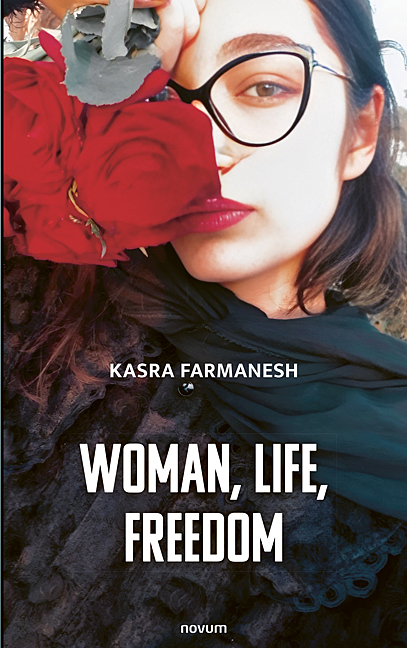
Woman, Life, Freedom
USD 25,99
Format: 13.5x21.5
Number of Pages: 168
ISBN: 978-3-99146-759-5
Release Date: 10.10.2024
Ever hear of “Woman, Life, Freedom”? Well, if not, you’ll know it when you read this book. Check out this book to learn about what is currently going on in Iran. It’ll probably surprise you to learn that Iranians want to be free from their current government.
Preface
Feeling both happiness and sorrow at the same time is one of the strange emotional combinations of humans, as well as being simultaneously happy for achieving a goal and being sad for the price you paid for accomplishing that. To achieve the goals of the “Woman, Life, Freedom” revolution, the best Iranians and the most free-spirited and enlightened people risked their lives and jeopardized everything. Dealing with their story and paying attention to their revolutionary movement fills the hearts of every person with sorrow and enthusiasm.
The purity, genuineness, depth, and glory of the Iranian movement, and forerunners of the “Woman, Life, Freedom” revolution, created a human and social responsibility for all of us because the point and the content of this movement are aimed at all Iranians. This revolution is a process that’ll change one thing – and that is everything. This book, Woman, Life, Freedom, announces a historical and expressive disagreement against the culture of political and religious oppression, which has hindered the growth and development of Iranian society from the past to the present.
The Iranians’ battle is against regressed and petrified devils who have held hostages of their own sect’s and group’s illusions. I believe that to achieve human freedom, freer humans must make sacrifices. So, let me remind you of the eternal hero of the freedom path, Artin Rahmani, the 16-year-old teenager who wrote, “Mother, I’m sorry. I want to take a step in a way that you may not see my youth”, before beginning his fight. He loved living but sacrificed himself for this glorious goal. He passed through his own life and gave life to others. Separating deliberately from his mother, expressed through a feeling of shame, is not even understandable and describable. Artin bid farewell to the best and most important person in his life to achieve the best for Iranians.
In a world where the smallest and least possessions are being protected, the separation of a teenager from his mother means giving up everything he has. Feeling concern and anxiety for someone, who is the most valuable thing in his life, and war, simultaneously, against the Iranian nation’s kidnappers and hostage takers, with the aim of freedom for Iranians, requires a strong motivation and a clear objective. He and the fighters of the path of freedom have translated and interpreted the most valuable and sacrificial states of human beings.
Writing and speaking about the heroes of freedom and democracy path, and then describing their sacrifices and noble ideals, is both heartbreaking and necessary. This article is a theoretical analysis of the “Woman, Life, Freedom” revolution. It is a description of the appearance and content of Iranians’ uprising against a regime that represents ignorance and madness.
A political and religious system that has imprisoned the people of a land within the confines of their sick demarcation based on ideological beliefs describes what the visionary young people were struggling against to make a better future for everyone who made for and came from the future. It is a description of the people who have rebelled against frozen traditions in history and traditional people. It is obvious that such an event has been so immense that every speech and text will refer to a part of it, but our effort is to provide a clear and explicit analysis of the concepts of this movement.
Any efforts that were made toward the greatness and pride of the Iranian nation are really nothing, which is why I’m ashamed to even dedicate this article to the heroes of the “Woman, Life, Freedom” revolution.
I must pay my respects to some people, like Nika, Khodanor, Mahsa, Sarina, Siavash, Majidreza Rahnavard, Toomaj Salehi, and the unnamed, the deceased, and the prisoners, and anyone else that has had to suffer from torture.
Woman, Life, Freedom
By: Kasra Farmanesh
The Theater of Cultural Relativism
A 22-year-old girl named Mahsa Amini was murdered by the Islamic regime’s morality police, also known as the Guidance Patrol, which caused the Iranians’ blood to boil. Mahsa was arrested by the police due to not fully adhering to the mandatory hijab, and, during her arrest and while she was in the detention center, she was insulted, brutally beaten, and subjected to violence, which resulted in her death. What happened to Mahsa caused a national uproar as Iranians saw their own living conditions in the plight of the Iranian girl. She was like a mirror in which every Iranian saw themselves. Her death became a symbol of the suffocating atmosphere experienced by every Iranian. Her death was like a trigger for the outflowing of hatred that Iranians have always carried with them.
Iranians’ disgust of the Islamic regime had existed before Mahsa’s death and continued, like an underlying reality hidden under the skin. But it was always special occasions and incidents that unify the nation. As a result, those cause the roar and action of citizens. The people’s lack of reaction and temporary silence, which is just a consequence of facing weapons and the regime’s military tools, does not imply acceptance or endorsement of imposed conditions in any part of the world. The existence and continuation of governments do not necessarily mean that they have the people’s support. The silence of Iranians in some periods has been strategic rather than supportive. They have just been waiting for an opportunity to express their dissatisfaction and disgust with the Islamic regime.
The political and social silence of individuals can sometimes mean their approval and satisfaction with the conditions, or that it is full of unvoiced protests and discontent in which circumstances and situations don’t allow them to be expressed. Such silence is obligatory and imposed. In the face of imposed silence, there is always the possibility of an explosion of inner feelings and suppressed desires.
The people’s protests, when faced with the tragic death of Mahsa, were a manifestation and explosion of their deep discontent with society’s brutal behavior of the Islamic regime toward Iranians and women. Protests against the horrible death of the Saqqezian girl are not limited to Mahsa but have encompassed many ‘Mahsas’. She was a symbol of oppressed Iranian women and of the population’s oppression, in general, and humiliation of their human dignity.
She represents the Mullahs’ imposed suffocation and the unfree Iranian society. All Iranians saw themselves as victims of the Islamic regime with the slight toward Mahsa and her heartbreaking plight. Mahsa Amini’s character embodied the historical oppression and discrimination experienced by Iranians.
Mahsa was Iran, and Iran was Mahsa.
Thus, Iranians around the country from north to south and east to west, in different ethnic groups, and with different political and ideological attitudes, found a common ground, which let them unite and start an integrated revolution against the totalitarian regime. It was a revolution against the common enemy for a common objective. It was a revolution against the zombies who fed on the lives and possessions of the people.
There was an uprising against the Mullahs, rulers, and Islamic Revolutionary Guard terrorists, who are enemies of every Iranian. It was against the foreigners who destroyed the structure and foundation of society and ruined and pushed a historically proud nation toward decline and destruction every day. It was against the ruling elites that their habit of spreading death and destruction dust on young men’s hopes and futures. The decision to remove the Islamic regime and the guardianship of Islamic jurists as a common enemy of the people was a common desire that united the Iranian nation. The feelings of disgust from the Islamic regime and demands for change were a common desire in the minds and hearts of Iranians. This demand brought people closer to each other and stronger.
On the other hand, having common goals was the second strengthening factor that doubled the cohesion of Iranians. Women’s rights, liberalism, equality, democracy, and human rights were among the central principles and demands of the revolution of “Woman, Life, Freedom”.
Iranians knew exactly what they were denying and fighting for. The starting point and ultimate goal of the Iranian uprising were both clear. The cohesive and freedom-seeking mentality of Iranians also made many cultural and political critics somewhat baffled and shocked.
Those who believed that Iran’s geopolitical and territorial borders in the Middle East justified tyranny were convinced that Iranians, living there, were Islamists and traditionalists whose beliefs contradicted the concept of democracy.
But the surprising intellectual and revolutionary storm of Iranians, especially the younger generation, was so terrible and unexpected that it shocked the enlightened part of Iranian society as well as the global community. Their slogans and demands were different and distinct from what many expected. Some considered their slogans irrelevant to the people of the Middle East and fundamentally denied the existence of such mentalities and goals there.
Some analysts and politicians, using the concept of cultural relativism (also beloved by dictators and oppressors), have ignored the human rights violations in Iran, the Middle East, and some Eastern countries. They used the excuse “We in the West have liberal and democratic values that belong to us, while they are in the East, where misogyny and oppression are part of their culture” to justify their inaction and conservatism.
They claimed that if people in the West enjoy individual and civil rights as a common and popular culture, then it is due to the Western people’s choice; while, if tradition and religion have power in the Middle East, then it is due to their own lifestyle choice. From these beliefs, they concluded that supporting or paying attention to the politics and social situations of countries was not in line with global standards of human values.
I have always believed that those nonsense beliefs and justifications can have just two assumptions: either they live in a layer of wholly wrong and abstract understanding and express incorrect and fallacious views due to ignorance, or they intentionally close their eyes to the truth and correct position to justify their inaction and to deliberately avoid responsibility and duty since admitting the truth is somehow incurring new responsibilities and is a limiting act.
The Iranian people showed the emptiness of these claims quite powerfully and visibly. These kinds of invalidations of ideas are the most explicitly convincing model for rejecting a claim. Iranians expressed in action that many of the theorists and analysts from both the East and the West have a background of fallacies and mistakes because their thoughts and ideas have no connection to the reality outside their minds and have no relevance to the social reality.
Sareena Esmailzadeh, a 16-year-old girl, is a deceased hero of this revolution, who was active on various social media platforms.
In one of her videos, she said:
“Iranian teenagers are aware of world conditions and ask themselves, ‘What do we have less than an American teenager whose concerns are so different?’”
Such a statement’s meaning is the announcement of the end of the theater of cultural relativism.
There is no difference between me and Esmailzadeh. There is no distinction between us and them. We have equal needs and require common answers. The types of border and territorial structures do not determine my imprisonment and her freedom. In the same way, they were not like this and became what we want to be so we will become so. ‘Becomings’ are the same, but there is a difference in time, obstacles, and factors. The goals are the same, but some people respond sooner than others to their needs, rights, and desires, due to special conditions. This process does not deprive anyone and does not give an inherent advantage to others.
However, since many analysts and theorists analyze and think based on an abstract repository of concepts, the Iranian people’s uprising somehow shook their minds and told them that sleepers must wake up from their pseudo-intellectualism and dogmatic dreams. If one is a citizen of the United States, France, or Britain, they are no different from the one who lives in the Middle East.
If all the people of Earth have the same physiological and biological needs, such as for food, health, and medical care, they also have equal cultural and legal needs, like the right to freedom of speech and beliefs, the preservation of human dignity and value, the right to choose their clothes, and the right to choose their desired lifestyle. Some people do not hesitate or doubt the sameness of humans’ biological needs, but they do resist and struggle against cultural and legal rights. This monopoly of the dedication of certain rights to some humans at a specific geographical location and the simultaneous exclusion and deprivation of other groups through pseudo-philosophical justifications at another place on Earth is unjustified discrimination among humans.
No culture or thought is limited within the borders of geographic territories. Negating this relativity does not mean denying the differences. Freedom of expression is not exclusive to Americans, and censorship is not just of Chinese heritage. The political conditions and suffocation imposed by parties and groups can’t mislead the rights and needs of humans, even if citizens feel somewhat self-alienated and consider slavery as their right.
The “Woman, Life, Freedom” revolution is a secular movement, both politically and philosophically. From the heart of a country whose name has been repeated with an Islamic suffix, many questions come to the surface:
Where were these democrats, freedom-seekers, and this generation educated?
Did anyone teach them political and sociological philosophy?
How did they find the distance between themselves from their previous generation so far?
How and with which process do they bravely and consciously say, “NO!” to entrenched traditions?
How was it possible to raise a leading and modern generation within the controlled political and educational system of the Mullahs?
How could the Islamic veil, which had been widely promoted and imposed, burn in the fire of anger and rationality of the young Iranian generation?
How did this level of democracy grow in their minds?
Where did the unique courage and bravery of Iranians against the tyranny of the regime come from?
Countless difficult questions constantly occupied the minds of observers, including outsiders, as other nations have always heard and seen lies or controlled parts of reality about the people and society of Iran, and, somehow, an unreal or incomplete image of Iranian society has been reported to them. The media had inverted or selected facts and realities and depicted them in a certain way. Some people in developed countries thought that a free lifestyle, democracy, and secularism were the only countries with the same features and conditions and that gender equality, secular democracy, and the rules of law were specific to Western societies. In other words, these modern concepts – unspoken and unwritten – were put in the minds of those populations. It was natural that there was no coherence and conformity between the misogynist fanatical Middle Eastern man and men who were shot and tortured in the streets and prisons to defend women’s rights. They assumed that hijab, Islamism, traditionalism, and misogyny were among the accepted Iranian cultures, even though the behavior of governments and rulers did not represent the people’s beliefs and demands. And even in democratic societies, all political behaviors and positions of a government do not reflect the people’s views.
The argument, Because the government is Islamic, therefore the people are also Islamic, or because the government represents Communism, therefore, the people are also Communist, is incorrect and fallacious reasoning. Such a simple conclusion has been accepted by some parts of society. However, in a fully democratic society that adheres to the attributes of democracy, this reasoning is only partially reasonable and is not employed in an authoritarian and controlled society. Furthermore, using such judgments as the basis for determining differences among people and making divisions and inequalities is wholly misguided.
The belief, If you are English, French, or American, then you are modern, and if you are Iranian, Turkish, or Chinese, then you are against modernity, is a collective myth among certain groups of people around the world.
Reality is not a game played by politicians, who, through a mountain of fallacies and propaganda, seek to justify the status quo of countries using populist methods and techniques. The concepts of truth and reality are not determined based on geographical regions such as the East and West or North and South. The truth in the political, decision, and policymaking arena is determined based on the happiness, prosperity, and well-being of the humans and creatures affected by such decisions.
The truth is determined based on how people’s words and beliefs align with reality.
For instance, if it is claimed that people in Eastern countries do not want freedom, democracy, or social ethics, that is not true because it does not align with reality.
Yes, there are cultural differences, but the differences do not mean that that culture is correct and relative. A wrong culture, which is due to the existence of governments, conditions, and suppression situations, has no reason for validity, judgment, and valuation.
All societies have experienced ups and downs and have always experienced positive and negative situations in various fields. Women’s status and human rights in Europe may not have been much better than those in Eastern societies decades and centuries ago.
Have French and British women simply had the right to vote or did they have to achieve it?
Has gender equality always simply existed in Western culture and history, or has it been achieved through years of struggle?
Has the behavior of the Japanese always been like what it is today, being one of the best examples of order, respect, modernity, and civilization? The history of World War II and the horrific events carried out by Japanese soldiers and government forces are the opposite of the current image that people of the world have of this country.
Nowadays, Britain is considered a civilized and modern country, but has there been a more colonialist country like Britain throughout history? Has history witnessed a more imperialist political system like Britain’s? The English have been robbing and looting from New Zealand and Australia to India, Canada, and America. The famous phrase The sun never sets on the British Empire is an expression of the extent of British aggression. In World War I, the Brits even occupied Iran, violating national sovereignty from the south and the Russians from the north. One of the main reasons for the great famine from 1917 to 1919, which killed millions of Iranians due to starvation, was the inhumane behavior of the occupiers.
Therefore, a country can’t be considered to have specific inherent characteristics solely due to its current appropriate political and social situation. People from another country cannot be categorized as hostile and strangers to modern concepts solely due to their current imposed situation. If an Icelandic citizen were born in Saudi Arabia, they were very likely to be a Muslim. But if an Arab person was born in Iceland, they were unlikely to be a Muslim. Most of the features and traits that people see in themselves are the product of environmental factors … an environment that will be determined by society, parents, and the political and economic system. Therefore, both the culture and current situation of an Icelandic or Norwegian person are created under completely fragile and arbitrary circumstances. An appropriate foundation and good educational conditions have been very decisive in determining behaviors and attitudes.
Despite that, if a group identifies these cultural and social traits to be exclusive to themselves and considers others unrelated to modernity and accuses them of being inherently traditional or religious, they have made an unfair judgment and presented an inaccurate description as a large part of their cultural wealth is borrowed or inherited from their environment and social conditions. If someone is in a different geographic location and is in undesirable conditions, they are influenced by the function of the environmental and social situations imposed on them.
…
Feeling both happiness and sorrow at the same time is one of the strange emotional combinations of humans, as well as being simultaneously happy for achieving a goal and being sad for the price you paid for accomplishing that. To achieve the goals of the “Woman, Life, Freedom” revolution, the best Iranians and the most free-spirited and enlightened people risked their lives and jeopardized everything. Dealing with their story and paying attention to their revolutionary movement fills the hearts of every person with sorrow and enthusiasm.
The purity, genuineness, depth, and glory of the Iranian movement, and forerunners of the “Woman, Life, Freedom” revolution, created a human and social responsibility for all of us because the point and the content of this movement are aimed at all Iranians. This revolution is a process that’ll change one thing – and that is everything. This book, Woman, Life, Freedom, announces a historical and expressive disagreement against the culture of political and religious oppression, which has hindered the growth and development of Iranian society from the past to the present.
The Iranians’ battle is against regressed and petrified devils who have held hostages of their own sect’s and group’s illusions. I believe that to achieve human freedom, freer humans must make sacrifices. So, let me remind you of the eternal hero of the freedom path, Artin Rahmani, the 16-year-old teenager who wrote, “Mother, I’m sorry. I want to take a step in a way that you may not see my youth”, before beginning his fight. He loved living but sacrificed himself for this glorious goal. He passed through his own life and gave life to others. Separating deliberately from his mother, expressed through a feeling of shame, is not even understandable and describable. Artin bid farewell to the best and most important person in his life to achieve the best for Iranians.
In a world where the smallest and least possessions are being protected, the separation of a teenager from his mother means giving up everything he has. Feeling concern and anxiety for someone, who is the most valuable thing in his life, and war, simultaneously, against the Iranian nation’s kidnappers and hostage takers, with the aim of freedom for Iranians, requires a strong motivation and a clear objective. He and the fighters of the path of freedom have translated and interpreted the most valuable and sacrificial states of human beings.
Writing and speaking about the heroes of freedom and democracy path, and then describing their sacrifices and noble ideals, is both heartbreaking and necessary. This article is a theoretical analysis of the “Woman, Life, Freedom” revolution. It is a description of the appearance and content of Iranians’ uprising against a regime that represents ignorance and madness.
A political and religious system that has imprisoned the people of a land within the confines of their sick demarcation based on ideological beliefs describes what the visionary young people were struggling against to make a better future for everyone who made for and came from the future. It is a description of the people who have rebelled against frozen traditions in history and traditional people. It is obvious that such an event has been so immense that every speech and text will refer to a part of it, but our effort is to provide a clear and explicit analysis of the concepts of this movement.
Any efforts that were made toward the greatness and pride of the Iranian nation are really nothing, which is why I’m ashamed to even dedicate this article to the heroes of the “Woman, Life, Freedom” revolution.
I must pay my respects to some people, like Nika, Khodanor, Mahsa, Sarina, Siavash, Majidreza Rahnavard, Toomaj Salehi, and the unnamed, the deceased, and the prisoners, and anyone else that has had to suffer from torture.
Woman, Life, Freedom
By: Kasra Farmanesh
The Theater of Cultural Relativism
A 22-year-old girl named Mahsa Amini was murdered by the Islamic regime’s morality police, also known as the Guidance Patrol, which caused the Iranians’ blood to boil. Mahsa was arrested by the police due to not fully adhering to the mandatory hijab, and, during her arrest and while she was in the detention center, she was insulted, brutally beaten, and subjected to violence, which resulted in her death. What happened to Mahsa caused a national uproar as Iranians saw their own living conditions in the plight of the Iranian girl. She was like a mirror in which every Iranian saw themselves. Her death became a symbol of the suffocating atmosphere experienced by every Iranian. Her death was like a trigger for the outflowing of hatred that Iranians have always carried with them.
Iranians’ disgust of the Islamic regime had existed before Mahsa’s death and continued, like an underlying reality hidden under the skin. But it was always special occasions and incidents that unify the nation. As a result, those cause the roar and action of citizens. The people’s lack of reaction and temporary silence, which is just a consequence of facing weapons and the regime’s military tools, does not imply acceptance or endorsement of imposed conditions in any part of the world. The existence and continuation of governments do not necessarily mean that they have the people’s support. The silence of Iranians in some periods has been strategic rather than supportive. They have just been waiting for an opportunity to express their dissatisfaction and disgust with the Islamic regime.
The political and social silence of individuals can sometimes mean their approval and satisfaction with the conditions, or that it is full of unvoiced protests and discontent in which circumstances and situations don’t allow them to be expressed. Such silence is obligatory and imposed. In the face of imposed silence, there is always the possibility of an explosion of inner feelings and suppressed desires.
The people’s protests, when faced with the tragic death of Mahsa, were a manifestation and explosion of their deep discontent with society’s brutal behavior of the Islamic regime toward Iranians and women. Protests against the horrible death of the Saqqezian girl are not limited to Mahsa but have encompassed many ‘Mahsas’. She was a symbol of oppressed Iranian women and of the population’s oppression, in general, and humiliation of their human dignity.
She represents the Mullahs’ imposed suffocation and the unfree Iranian society. All Iranians saw themselves as victims of the Islamic regime with the slight toward Mahsa and her heartbreaking plight. Mahsa Amini’s character embodied the historical oppression and discrimination experienced by Iranians.
Mahsa was Iran, and Iran was Mahsa.
Thus, Iranians around the country from north to south and east to west, in different ethnic groups, and with different political and ideological attitudes, found a common ground, which let them unite and start an integrated revolution against the totalitarian regime. It was a revolution against the common enemy for a common objective. It was a revolution against the zombies who fed on the lives and possessions of the people.
There was an uprising against the Mullahs, rulers, and Islamic Revolutionary Guard terrorists, who are enemies of every Iranian. It was against the foreigners who destroyed the structure and foundation of society and ruined and pushed a historically proud nation toward decline and destruction every day. It was against the ruling elites that their habit of spreading death and destruction dust on young men’s hopes and futures. The decision to remove the Islamic regime and the guardianship of Islamic jurists as a common enemy of the people was a common desire that united the Iranian nation. The feelings of disgust from the Islamic regime and demands for change were a common desire in the minds and hearts of Iranians. This demand brought people closer to each other and stronger.
On the other hand, having common goals was the second strengthening factor that doubled the cohesion of Iranians. Women’s rights, liberalism, equality, democracy, and human rights were among the central principles and demands of the revolution of “Woman, Life, Freedom”.
Iranians knew exactly what they were denying and fighting for. The starting point and ultimate goal of the Iranian uprising were both clear. The cohesive and freedom-seeking mentality of Iranians also made many cultural and political critics somewhat baffled and shocked.
Those who believed that Iran’s geopolitical and territorial borders in the Middle East justified tyranny were convinced that Iranians, living there, were Islamists and traditionalists whose beliefs contradicted the concept of democracy.
But the surprising intellectual and revolutionary storm of Iranians, especially the younger generation, was so terrible and unexpected that it shocked the enlightened part of Iranian society as well as the global community. Their slogans and demands were different and distinct from what many expected. Some considered their slogans irrelevant to the people of the Middle East and fundamentally denied the existence of such mentalities and goals there.
Some analysts and politicians, using the concept of cultural relativism (also beloved by dictators and oppressors), have ignored the human rights violations in Iran, the Middle East, and some Eastern countries. They used the excuse “We in the West have liberal and democratic values that belong to us, while they are in the East, where misogyny and oppression are part of their culture” to justify their inaction and conservatism.
They claimed that if people in the West enjoy individual and civil rights as a common and popular culture, then it is due to the Western people’s choice; while, if tradition and religion have power in the Middle East, then it is due to their own lifestyle choice. From these beliefs, they concluded that supporting or paying attention to the politics and social situations of countries was not in line with global standards of human values.
I have always believed that those nonsense beliefs and justifications can have just two assumptions: either they live in a layer of wholly wrong and abstract understanding and express incorrect and fallacious views due to ignorance, or they intentionally close their eyes to the truth and correct position to justify their inaction and to deliberately avoid responsibility and duty since admitting the truth is somehow incurring new responsibilities and is a limiting act.
The Iranian people showed the emptiness of these claims quite powerfully and visibly. These kinds of invalidations of ideas are the most explicitly convincing model for rejecting a claim. Iranians expressed in action that many of the theorists and analysts from both the East and the West have a background of fallacies and mistakes because their thoughts and ideas have no connection to the reality outside their minds and have no relevance to the social reality.
Sareena Esmailzadeh, a 16-year-old girl, is a deceased hero of this revolution, who was active on various social media platforms.
In one of her videos, she said:
“Iranian teenagers are aware of world conditions and ask themselves, ‘What do we have less than an American teenager whose concerns are so different?’”
Such a statement’s meaning is the announcement of the end of the theater of cultural relativism.
There is no difference between me and Esmailzadeh. There is no distinction between us and them. We have equal needs and require common answers. The types of border and territorial structures do not determine my imprisonment and her freedom. In the same way, they were not like this and became what we want to be so we will become so. ‘Becomings’ are the same, but there is a difference in time, obstacles, and factors. The goals are the same, but some people respond sooner than others to their needs, rights, and desires, due to special conditions. This process does not deprive anyone and does not give an inherent advantage to others.
However, since many analysts and theorists analyze and think based on an abstract repository of concepts, the Iranian people’s uprising somehow shook their minds and told them that sleepers must wake up from their pseudo-intellectualism and dogmatic dreams. If one is a citizen of the United States, France, or Britain, they are no different from the one who lives in the Middle East.
If all the people of Earth have the same physiological and biological needs, such as for food, health, and medical care, they also have equal cultural and legal needs, like the right to freedom of speech and beliefs, the preservation of human dignity and value, the right to choose their clothes, and the right to choose their desired lifestyle. Some people do not hesitate or doubt the sameness of humans’ biological needs, but they do resist and struggle against cultural and legal rights. This monopoly of the dedication of certain rights to some humans at a specific geographical location and the simultaneous exclusion and deprivation of other groups through pseudo-philosophical justifications at another place on Earth is unjustified discrimination among humans.
No culture or thought is limited within the borders of geographic territories. Negating this relativity does not mean denying the differences. Freedom of expression is not exclusive to Americans, and censorship is not just of Chinese heritage. The political conditions and suffocation imposed by parties and groups can’t mislead the rights and needs of humans, even if citizens feel somewhat self-alienated and consider slavery as their right.
The “Woman, Life, Freedom” revolution is a secular movement, both politically and philosophically. From the heart of a country whose name has been repeated with an Islamic suffix, many questions come to the surface:
Where were these democrats, freedom-seekers, and this generation educated?
Did anyone teach them political and sociological philosophy?
How did they find the distance between themselves from their previous generation so far?
How and with which process do they bravely and consciously say, “NO!” to entrenched traditions?
How was it possible to raise a leading and modern generation within the controlled political and educational system of the Mullahs?
How could the Islamic veil, which had been widely promoted and imposed, burn in the fire of anger and rationality of the young Iranian generation?
How did this level of democracy grow in their minds?
Where did the unique courage and bravery of Iranians against the tyranny of the regime come from?
Countless difficult questions constantly occupied the minds of observers, including outsiders, as other nations have always heard and seen lies or controlled parts of reality about the people and society of Iran, and, somehow, an unreal or incomplete image of Iranian society has been reported to them. The media had inverted or selected facts and realities and depicted them in a certain way. Some people in developed countries thought that a free lifestyle, democracy, and secularism were the only countries with the same features and conditions and that gender equality, secular democracy, and the rules of law were specific to Western societies. In other words, these modern concepts – unspoken and unwritten – were put in the minds of those populations. It was natural that there was no coherence and conformity between the misogynist fanatical Middle Eastern man and men who were shot and tortured in the streets and prisons to defend women’s rights. They assumed that hijab, Islamism, traditionalism, and misogyny were among the accepted Iranian cultures, even though the behavior of governments and rulers did not represent the people’s beliefs and demands. And even in democratic societies, all political behaviors and positions of a government do not reflect the people’s views.
The argument, Because the government is Islamic, therefore the people are also Islamic, or because the government represents Communism, therefore, the people are also Communist, is incorrect and fallacious reasoning. Such a simple conclusion has been accepted by some parts of society. However, in a fully democratic society that adheres to the attributes of democracy, this reasoning is only partially reasonable and is not employed in an authoritarian and controlled society. Furthermore, using such judgments as the basis for determining differences among people and making divisions and inequalities is wholly misguided.
The belief, If you are English, French, or American, then you are modern, and if you are Iranian, Turkish, or Chinese, then you are against modernity, is a collective myth among certain groups of people around the world.
Reality is not a game played by politicians, who, through a mountain of fallacies and propaganda, seek to justify the status quo of countries using populist methods and techniques. The concepts of truth and reality are not determined based on geographical regions such as the East and West or North and South. The truth in the political, decision, and policymaking arena is determined based on the happiness, prosperity, and well-being of the humans and creatures affected by such decisions.
The truth is determined based on how people’s words and beliefs align with reality.
For instance, if it is claimed that people in Eastern countries do not want freedom, democracy, or social ethics, that is not true because it does not align with reality.
Yes, there are cultural differences, but the differences do not mean that that culture is correct and relative. A wrong culture, which is due to the existence of governments, conditions, and suppression situations, has no reason for validity, judgment, and valuation.
All societies have experienced ups and downs and have always experienced positive and negative situations in various fields. Women’s status and human rights in Europe may not have been much better than those in Eastern societies decades and centuries ago.
Have French and British women simply had the right to vote or did they have to achieve it?
Has gender equality always simply existed in Western culture and history, or has it been achieved through years of struggle?
Has the behavior of the Japanese always been like what it is today, being one of the best examples of order, respect, modernity, and civilization? The history of World War II and the horrific events carried out by Japanese soldiers and government forces are the opposite of the current image that people of the world have of this country.
Nowadays, Britain is considered a civilized and modern country, but has there been a more colonialist country like Britain throughout history? Has history witnessed a more imperialist political system like Britain’s? The English have been robbing and looting from New Zealand and Australia to India, Canada, and America. The famous phrase The sun never sets on the British Empire is an expression of the extent of British aggression. In World War I, the Brits even occupied Iran, violating national sovereignty from the south and the Russians from the north. One of the main reasons for the great famine from 1917 to 1919, which killed millions of Iranians due to starvation, was the inhumane behavior of the occupiers.
Therefore, a country can’t be considered to have specific inherent characteristics solely due to its current appropriate political and social situation. People from another country cannot be categorized as hostile and strangers to modern concepts solely due to their current imposed situation. If an Icelandic citizen were born in Saudi Arabia, they were very likely to be a Muslim. But if an Arab person was born in Iceland, they were unlikely to be a Muslim. Most of the features and traits that people see in themselves are the product of environmental factors … an environment that will be determined by society, parents, and the political and economic system. Therefore, both the culture and current situation of an Icelandic or Norwegian person are created under completely fragile and arbitrary circumstances. An appropriate foundation and good educational conditions have been very decisive in determining behaviors and attitudes.
Despite that, if a group identifies these cultural and social traits to be exclusive to themselves and considers others unrelated to modernity and accuses them of being inherently traditional or religious, they have made an unfair judgment and presented an inaccurate description as a large part of their cultural wealth is borrowed or inherited from their environment and social conditions. If someone is in a different geographic location and is in undesirable conditions, they are influenced by the function of the environmental and social situations imposed on them.
…
You might like this too :