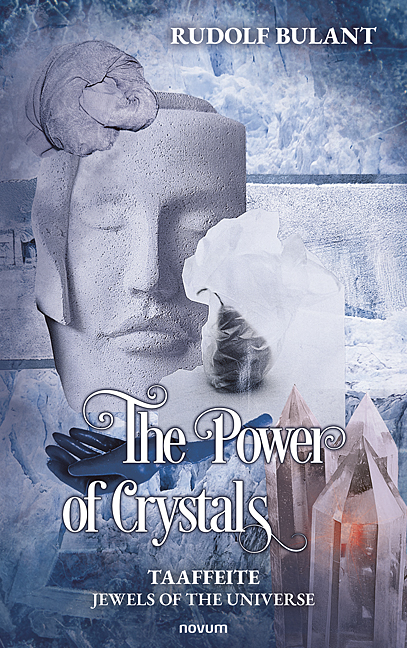
The Power of Crystals
Taaffeite – Jewels of the Universe
USD 31,99
Format: 13.5 x 21.5
Number of Pages: 396
ISBN: 978-3-7116-1728-6
Release Date: 15.10.2026
While conducting experiments with rare taaffeites, Robert makes an incredible discovery—one that captures the attention not only of nations but also of beings whose existence Robert could never have imagined.
PROLOGUE
Taaffeites are gemstones—extremely rare gemstones—that hardly anyone knows about, except for a few mineralogists, or rather, gemologists. Gemologists are experts in gemstones; even Word’s spell checker doesn’t recognize this word, so it’s no wonder that most people have never heard of them. All known taaffeites to date wouldn’t even fill a teacup. By the way, taaffeites are very beautiful, almost magical gemstones, and it’s surprising that despite the fact that they’re a million times rarer than diamonds and just as beautiful, they’ve remained surprisingly affordable so far, with a value of about $ 2,000–$ 5,000 per carat. I say “so far,” because things were already starting to change.
It was really just a matter of chance—which presumably doesn’t exist—before someone would discover the hidden properties of these stones. There are certainly esotericists worth taking seriously—if one is willing to take such people seriously at all—who are convinced that these stones are not of this world. Supposedly, they were brought to this world by the Arcturians, an extraterrestrial race that operates discreetly behind the scenes for the benefit of humanity. A book by Norma Milanovic describes her contact with the Arcturians and their crystal technology.
The fact is, however, that today’s technology—especially communications technology—is based almost entirely on crystal effects. Whether computer chips, laser devices, solar cells, LEDs, or flat-screen displays, all utilize the special properties of various crystals.
So, as with many discoveries, it simply took a fortunate combination of circumstances for the hidden properties of these crystals to come to light. This fortunate combination manifested itself in the person of Robert Wollmann. Robert had been collecting minerals and gemstones since childhood. He studied physics, picked up mineralogy on the side, and eventually, when he realized he wasn’t going to become “the next Einstein,” switched to telecommunications and electronics—at least that was a way to make a living. But collecting minerals and gemstones always remained his passion. Robert had obviously inherited his passion for minerals and gemstones from his mother’s milk. As a teenager, he would sometimes cycle well over a hundred kilometers on weekends to reach any sites where quartz crystals could be found. He knew almost all the mineral sites within his reach. So it seemed only a matter of time—and increasing income—before the first particularly rare gemstone fell into his hands. He was therefore bursting with pride when he suddenly managed to snag two taaffeites online. For a mineralogist, this is something like the Blue Mauritius is for a stamp collector. This stone fascinated him immensely, and eventually he even managed to acquire several more taaffeites. The internet made it possible.
But since apparently very few people know about them and these individuals obviously hadn’t been searching for them online at the time, Robert was able to purchase these two rare specimens relatively cheaply, just above the starting price.
They weren’t large; one piece of taaffeite with a light blue-gray color weighed only 0.44 carats—one carat is 0.2 grams and about the size of a pea. Robert thought it was beautiful. His wife Sylvia, however, thought it was ugly because, in her opinion, the color was actually indefinable. In fact, that is precisely what makes these stones so appealing. They are birefringent, meaning that light is refracted differently depending on the angle of incidence, and that is why its color is indefinable, as it looks different from every viewing angle. The other piece was about twice as large and light pink-violet, depending on the angle from which you viewed it, which she liked a bit better. But you can’t judge collectibles by jewelry standards; it’s like with your own children—they’re always beautiful.
But these gemstones somehow went far beyond rare collectibles; there was something truly magical about them. The unique colors and the almost unreal beauty of their luster had a fascinating effect. They are not human artifacts like stamps, but natural, ancient witnesses to Earth’s history. With their strange gray-blue hue, they reminded Robert of a sorcerer’s hypnotic eyes. Crystals of this kind require immense pressure and extremely high temperatures, as well as a fortunate combination of the right elements in the same place, to form at all. Ultimately, they contain the order of the universe and a vast amount of energy. Like many plants, the properties and effects of many minerals remain completely unexplored, and this is especially true for such rare specimens.
Of course, a collector must first thoroughly examine such a rare piece and, naturally, document it as well. Robert therefore began by taking a few photos of it with his digital camera. Photos of small stones are very difficult to take, and the right background and lighting play a major role. After his first attempts on white cloths all turned out very unsatisfactory, he tried using transparent materials as a background. A large rock crystal, weighing nearly 10 kg and measuring half a meter, seemed to him to be the most suitable background; it made a magnificent eye-catcher in his sunroom
First up was the small gray taaffeite. Unfortunately, it didn’t really stand out on the huge rock crystal, but since it was beautifully cut and also very clear, it still shone quite nicely. Proper lighting remained a problem; experiments with various desk lamps yielded usable results, especially with a very strong halogen lamp, but Robert was still not entirely satisfied. The sunroom faced primarily west, where the entire wall was made of glass and was beautifully warmed by the afternoon and evening sun. Since the sun is still the most beautiful light source, Robert repeated his photo session at three in the afternoon, just as the sun was shining most intensely into the sunroom. At this time of year, that is unfortunately relatively rare, as it only shines really strongly on a few days, and even then not for very long.
On February 3rd, such a beautiful day finally arrived, and the sky was crystal clear, a blue like the most beautiful sapphires. Robert took a pair of tweezers and carefully placed his smaller taaffeite on the rock crystal in the afternoon sun, then positioned the digital camera.
Then something very strange happened. Just as he placed the taaffeite on the rock crystal, a tiny cloud briefly covered the sun, but after a few seconds—with everything already perfectly aligned—it emerged again in all its glory.
At that very moment, before he could even take a picture, the small stone began to glow in a strange light. The light radiated from it in an almost spherical shape, roughly the enlarged form of the gemstone. The strange thing about it was that this light seemed both luminous and opaque at the same time. In any case, he had never seen a light like this before; it glowed in a truly magical way. It could best be compared to the light of his white LED lamp, but much stronger and more intense. The sphere of light was about a meter in diameter, and all objects within that area—primarily the flowers and their pots—had vanished. Robert began to feel afraid. He knew from his profession that crystals can be set into vibration by various energy sources and can also cause very specific effects. Laser beams, for example, are based on this principle—he had even conducted his first experiments with ruby crystals himself during his studies—and rubies are at least related to the Taaffite family.
The entire electronics and computer industry relies on these effects, and all flat-screen displays consist of such crystal elements. But this effect had to be entirely new. The ball of light pulsed slightly and passed unimpeded through the glass and wood of the windows, even obscuring a few objects and plants outside. No sooner had the next cloud arrived than the phenomenon vanished again, and the plants reappeared and even seemed to be alive, but depending on the sunlight, the effect took hold again immediately. At one point, the ball of light even expanded to nearly two meters, so that Robert became afraid of being caught up in it as well, since he could barely dodge it anymore. Willi the cat, who had been peacefully dozing in the warmth, suddenly jumped up when his tail disappeared into the ball of light and fled, growling like a tiger. Apparently, however, his tail, just like the plants, had suffered no harm, for he inspected it very closely and began to groom it thoroughly—though from a safe distance from the ball of light.
Meanwhile, the sun was shining brightly and the ball of light remained stable. Now Robert began experimenting with various objects, which he carefully pushed into the sphere of light. Pieces of iron disappeared just like other objects, and even a raw chicken egg seemed to have suffered no harm. In his enthusiasm, he once—the size of the sphere of light did fluctuate a little—unintentionally slipped his index finger and part of his thumb into the sphere of light. Of course, the finger became invisible immediately; the hand, missing its index finger and with only half a thumb, looked terrible, and he pulled it back right away. Just as he had done with the cat, he examined these body parts thoroughly afterward and made a surprising discovery.
As a child, he had once badly crushed his index finger when he crashed a soapbox car into a wall. Unfortunately, his index finger had been caught between the car and the wall and looked accordingly terrible afterward. The finger healed, but the nail remained permanently damaged and no longer grew straight, but in waves.
In any case, Robert couldn’t believe his eyes when he examined his fingers; not only did they seem to be fine, but the nail was straight again, as if the accident had never happened. This was unexpected; the little finger of his left hand was also slightly damaged—a minor joint inflammation he’d picked up during a neglected bout of the flu still caused mild pain and remained slightly swollen. So he tried it with that finger. He briefly stepped into the sphere and back out, but this time nothing had changed. Everything remained exactly as before. Strange, he thought; obviously, the cause hadn’t been long enough ago. The temptation to step all the way into the sphere of light himself was now very strong, but the sun was already beginning to set again, and the sphere was therefore once more much too small.
It turned into a sleepless night filled with dreams that were both beautiful and terrifying. Everything revolved around the ball of light. He dreamed that by the very next day, a huge crowd had already lined up to heal their old injuries, and then suddenly seven gray-blue aliens emerged from the ball and demanded apricot jam. They simply wouldn’t leave without taking a jar of it with them. He was particularly particular about this jam, because he had the best apricots there are in his garden, and his wife Sylvia always made a particularly delicious jam out of them. Then he dreamed that he went into the sphere and suddenly ended up in a jungle from which he couldn’t find his way out. Then again, he found himself on an endlessly long slide that wound its way around the Milky Way, with a magnificent view of the most incredible night sky, but with no chance of ever getting out again. Anyway, when he woke up drenched in sweat, he felt completely exhausted, but he had a clear plan. He had to get into the ball of light himself, no matter what it took.
Part 1
CHAPTER 1
The Experiment
In the afternoon, when the sun was shining again, though with more clouds in the sky, he repeated the experiment. First with the small taaffeite; the effect remained exactly the same as the day before. This time he tried sticking a toe inside. His long middle toe looked a little bent, which was also due to an accident in his youth when he had broken that toe playing soccer. And sure enough, just like with the fingernail, the toe came out completely undamaged, straight as an arrow. When the sun disappeared once more, he quickly swapped the small taaffeite for the much larger blue-violet stone. As expected, the effect when the sun returned was exactly the same, but the ball of light now appeared much larger and also had a violet tint. Now he didn’t even need to go inside anymore, because the ball of light filled almost the entire room, and for a brief moment it completely engulfed him. But before he could see anything, the sun disappeared again, and with it the light. So he sat down nearby and waited.
When the cloud had cleared again and the sun returned in full, the ball of light began to grow rapidly once more, and Robert was immediately enveloped by it.
At first, everything seemed to be as it had been before. At first glance, the surroundings seemed pretty much unchanged; the objects remained the same, and the flowers, plants, and trees also appeared to be the same. Only the light had a completely different atmosphere. The sun no longer shone, yet it was still bright—more like after a thunderstorm, when a rainbow appears on the horizon. The colors looked the same way, everything bathed in rainbow light and the sky a deep black-blue.
Once he had gotten used to the strange light a little, he did notice a series of strange occurrences. Felix the cat, who had been hit by a car two years ago and was now buried in the garden, suddenly strolled leisurely across the meadow, which was now a blue-green color. At first he thought it was Cenci, but Cenci was still lying on the bench, snoring. So it had to be Felix, without a doubt, who was strolling there—though without casting a shadow. As Felix approached the trees, Robert saw that they were obviously inhabited as well. The trees were beautiful and had leaves in all the colors of the rainbow. In the cherry tree—by far the most beautiful tree—sat, looking quite content, an almost transparent human figure right in the center, clad in a purple robe. He wore a golden crown on his head. Similar figures sat in the other trees as well. In the large apple tree sat a beautiful but elderly woman with long, golden-blonde hair, who was just combing it with relish. The other trees were inhabited by figures of varying beauty, such as in the apricot tree, where a very old woman with many wrinkles on her face sat, reminding Robert of a witch. Not all the shrubs were inhabited; only in one grapevine lived a child-like creature who was apparently chatting with a dwarf in the currant bush, who seemed quite annoyed because he was waving his hands wildly. Apparently, his home, the currant bush, had once again been run over by children on a sled. He couldn’t hear what these creatures were talking about, though, since he was still inside the winter garden, but he would have been very interested to know.
Suddenly, he did hear a voice. Standing next to him was a human-sized being in a light blue cloak, but just as translucent as the figures in the garden, who asked him what he was doing there. Robert was startled for a moment, but quickly composed himself and asked back, “Who are you, anyway?”
“Don’t you know me? We’ve been together since you were born. I’m your guardian angel,” said the creature, “and my name is Max. What you’re doing there isn’t just forbidden—it’s also very dangerous,” Max said rather grumpily. “You’re nothing but trouble. I have to watch over you all the time, even though I’m also responsible for two other adults and two children. I just had my hands full with two girls on a ski vacation, and the slopes were so icy and dangerous that I barely had a break,” Max grumbled. “And right now, of all times, you’re conducting such dangerous experiments.”
Robert seemed deeply impressed. He’d often felt like he had a guardian angel, but being able to actually talk to him came as quite a surprise. He paused to think, wondering if someone was playing a prank on him. He had a few friends, one of whom was a very good actor and had pulled off some particularly successful pranks that way. All of this flashed through his mind as he took a closer look at Max. But the translucent figure seemed real, and not even his friend Biber, the actor he’d suspected first, could make himself transparent. Robert finally mustered all his courage and tried to contradict Max. “Why dangerous? The opposite is true—I’ve been cured of two ailments,” Robert finally said.
“Do you have any idea?” said Max. “You just caused a curvature in the fabric of spacetime and entered a higher universe, something that was previously considered impossible for living beings. Ever since intelligence and consciousness have existed, new branches have continually emerged that humans and other intelligent beings do not even recognize as parallel universes. If, for example, Einstein had died as a young man in an accident or an assassination attempt, there would probably be no atomic bombs in your world, and the world would have taken a completely different course. So you see that life is very important and, of course, should be ended. Also, every intelligent being should make full use of their abilities, since one never knows what effects action or inaction might have. A book, whether written or not, can completely change the world or even create a new one. There are now a very large number of universes with highly diverse characteristics. Your crystal has not only locally warped space but also time, which is what makes it so dangerous and unpredictable. In some universes, life is impossible. Others are populated by monsters and other horrific creatures. In some universes, eternal war reigns. There are just as many bad worlds as there are good ones, and only very few are habitable for humans. I was just able to pull you into my world; otherwise, you would have fallen into a seething volcano—namely, the one from which your strange stones came.”
“What kind of world have I just stumbled into?” asked Robert, now sounding very meek.
“This is an intermediate world; it stands above the parallel worlds. Only people who died in an accident in your world but have earned ascension live in this intermediate world.”
“But why is Felix the cat here too, and why have my accident injuries disappeared?” Robert asked, already feeling a little calmer.
“In this world, there are no more accidents, and therefore no accident injuries, which is why your injuries have disappeared here as well. Felix, by the way, once had human consciousness, but was demoted for a short time for purification. He was once called Sir Felix and therefore had to spend some time as a neutered tomcat because, in his time, he had seduced a maid and then abandoned her. Ultimately, however, he had otherwise led a reasonably decent life and then died in a sort of traffic accident.”
“Did all these beings or humans, like this noble king, die in accidents, and perhaps you did too?” Robert asked.
“Yes, it’s something like that, and they were all lucky, because they were basically all good people, and that’s why they were able to choose where to go until a new life with a real body would be available to them again. But that’s getting harder and harder, because there have been so many people in accidents lately that long waiting lists are forming. Ever since cars and such terrible weapons have existed, we’ve been completely overwhelmed here.”
“Well, the king in the cherry tree must have been here forever—does it really take that long before you’re allowed to live properly again?” Robert asked.
“Not always,” said Max, “That’s King Leopold; he’s been here for over a thousand years and doesn’t want to go back. He’s particularly taken with this cherry tree. He loved cherries more than anything when he was alive, but he’d never seen any as good as these. Besides, he doesn’t like your world at all. In his view, people no longer have time for one another and think only of money and themselves; things were different in his day, when people—and he himself in particular—spent a lot of time with their friends. They constantly pondered how to make the world a better and safer place. There were many brave people, and he was considered one of the bravest, not shying away from risking his own life for a good cause and the people he loved.”
“I learned in school that King Leopold suddenly disappeared, but the books don’t mention anything about an accident.”
“It’s better that way,” said Max, “He loved not only cherries but also the mountains. So they also proved to be his undoing during a solo hike in winter, and he fell; he was found frozen to death a few hours later. But that’s not really a glorious way for a king to go, so his friends made him officially disappear and quietly buried him under a cherry tree. That’s just how history goes—legends and truth simply don’t mix.”
“Didn’t he have a guardian angel?” asked Robert.
...
You might like this too :