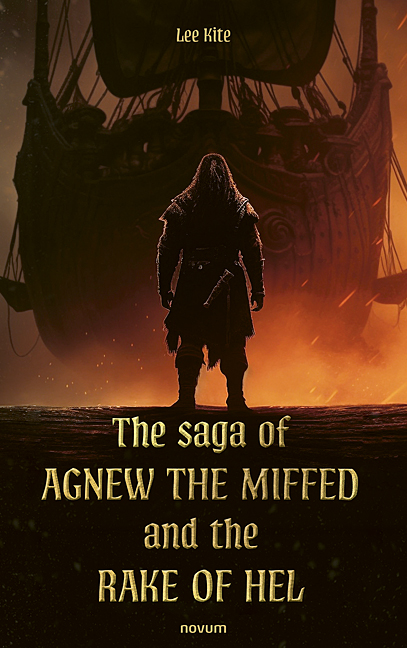
The saga of Agnew the Miffed and the Rake of Hel
Format: 13.5x21.5
Number of Pages: 336
ISBN: 978-3-99146-979-7
Release Date: 01.01.1970
A swarthy crew of battle-hardened Vikings is caught in a raging storm at sea. Their only saviour? Agnew, their inept captain, who brokers a deal with a duplicitous goddess. Will the crew be saved, and has Agnew doomed them all to be playthings of the gods?
Prologue
They came in the night. Heavily armed with murder in mind. At their head Gudrød the Hunter stood at the prow, hand clasping and unclasping the haft of his axe. The dragon boats glided silently under black sails towards the entrance to the fjord. Riding low in the water, even if anyone had been on lookout, they would have struggled to spot the sleek vessels as their forms merged with the dark sky and even darker sea, little more than vague ethereal shapes sweeping closer.
Gudrød’s helmsman guided their boat towards the lights of King Harald Granraude’s great hall and the settlement about. With the other boats forming a loose V behind, they entered the shelter of the fjord, the crews moving quickly to furl the sails and un-ship the oars before straining manfully against them to accelerate towards the settlement, beaching their boats upon the shingle where the fjord met the land.
The men leapt ashore, shields readied, swords, spears, and axes in hand and stormed forward with purpose. The first warning Harald’s people had of the impending doom was of dogs barking. The first to fall to the invaders were those who ventured out to see what was causing the hounds’ distress; unprepared, they were dispatched with ease. With malicious intent the men swarmed towards the great hall. They failed to spot one young boy who had also gone to see what had alarmed the dogs, and on spying the warband he rushed to the King’s Hall to raise the alarm, but it was too little, too late.
King Harald Granraude, his son, Gyrd, and those warriors gathered in the hall grabbed what weapons they could and stood to face the onslaught. They fought hard; they died well. Their heroic stand would earn them places at the fabled hall of the fallen in Valhalla. For the women left behind, no such honour awaited them, only rape, murder, or both as Gudrød’s men cut a vicious swathe through the town, until the prize they had come for was secured – Asa, daughter of King Harald.
Asa was discovered, raped, and bound but went defiantly, cursing Gudrød for his cowardly attack, and the oath breaker he was, beseeching the gods to punish him.
Most of the gods could care less, but one goddess watched the slaughter, witnessed the treachery but more than that saw the part another god played in the brutal raid, missed by all but her, and for that alone she accepted the call of vengeance, a call which would pit men against men and the goddess against the other gods.
Unaware of what he had begun, Gudrød sailed away, leaving the dead behind to rot.
1
There has been many a great heroic tale told of the good, the mad, bad, bloodthirsty, and downright psychotic warriors of the dark ages. Tales such as Beowulf have survived the centuries to delight small boys who like stories of men with swords beating up creatures like Grendel and his mum.
However, as well as the mythology the histories have also recorded the feats of real warriors, adventurers, pirates, and kings – such men as Eric Bloodaxe, Bjorn Ironside, Erik the Red, and Ivar the Boneless. Yes, he really was called Boneless. Why? Well, because he had no bones as such, hence the name, okay? Hey, I am not making this up, you know. Anyway, these men, the giants of their day, blazed a trail across the Dark Age world bringing fear, hero worship, and some unsavoury practices with monks to the rich tapestry which was life.
But there is one man who has been overlooked – a man of stature, a descendent of Siegfried himself, a pagan, a warrior, a man with exceptional hair. This is his saga, the saga of…
Agnew the Miffed
The saga starts on a storm-ravaged sea, aboard Agnew’s dragon ship, a ship which is currently being bounced around like a child on a bouncy castle, leaving most of the crew wishing they had stayed home.
‘Agnew, this is madness. I fear any moment the Midgard Serpent will rise from the ocean and snap us in two. Never have I seen the sea so angry. We must find land.’
Agnew, middling of height, lean, dark-haired, clean-shaven and not at all fitting the archetypal stereotype of a Viking warrior, spared a moment from his position hanging over the side of the ship, where he was diligently throwing up, to face his best friend.
‘Tostig,’ groaned Agnew, ‘this is not a good time right… oh, by Odin’s bea… heugh!’
Tostig, who by contrast was every bit the archetypal Viking warrior – big, strong, heavily bearded – watched his friend with some concern.
‘Sorry, Agnew, I forgot you had a weak stomach.’
‘Weak? I’m throwing it as far as I can… euuuuwh!’
‘Agnew, the men can’t take much more; the ship can’t take much more.’ Tostig’s normally gruff voice broke with worry. ‘This is not a way for a warrior to die.’
With a groan Agnew forced himself away from the side of the ship and stood to his full height, which along with his pasty complexion did not exactly make him look imposing.
‘We can’t head for land, Tostig.’
‘Why not?’
‘Because I don’t know where the nearest land is.’
‘You jest,’ Tostig replied more in hope than conviction.
‘No; I’m lost.’
‘But how? You are a master navigator!’
‘No, not really.’
‘Did you not find the fabled land of Atlantis? And were you not Naddodd’s navigator when he discovered Iceland?’
‘Well, yes,’ said Agnew, who at least had the decency to look guilty, ‘but we just sort of ran into Iceland. I swear, one minute it wasn’t there, just fog, then suddenly CRACK and there we were, run aground on the place. I can’t really say I navigated us there.’
‘And Atlantis?’
‘Ah, yes, Atlantis, a good one, that. I just made it up.’
‘No!’
‘Yes, never existed. I was drunk. Helga, you remember Helga?’
‘Blonde, buxom, eaten by a bear?’
‘Yes, that was the one. Well anyway, she was saying, “Oh you never do anything great; all the other lads are off finding places and bringing back stuff. What have you ever done?” So, I said I had found Atlantis.’
‘But those beads and that exotic pottery you brought back? And what about those slave girls that were all dusky and very accommodating?’
‘Hispania. I had been to Hispania. The girls were just left over from a party and thought it would be cool to see Norway.’
Tostig, for once his indomitable spirit crushed by Agnew’s blithe apology, slumped down into the ship, back against the bulwark, head in his hands. ‘We’re doomed. Your lies have doomed us.’
‘Look, don’t worry, these things usually have a way of sorting themselves out.’
‘You can lie to the rest but not me,’ sniffed Tostig. ‘How long have we known each other?’
‘Since the day we were old enough to get our first axe.’
‘Yet knowing that you have still brought me on a fool’s errand to an angry sea. I shall drown. We shall all drown, Agnew, and it’s your fault,’ Tostig yelled angrily over the roar of the howling tempest.
‘That’s a bit unfair. I can hardly be blamed for the weather,’ Agnew yelled back grumpily.
‘The gods are punishing you for your deceptions and are taking us with you. We should die a heroic warrior’s death in battle, not be pulled to our doom by Ràn’s daughters.’
‘I’ll be honest – I don’t see how this is any worse than a warrior’s death,’ said Agnew with remarkable candour. ‘I mean, if it’s a choice between drowning or having someone shove three feet of cold iron through my guts, well, drowning doesn’t sound so bad.’
‘But we are warriors. It is our birthright to die gloriously in battle, where the Valkyrie will carry us to the fabled halls of Valhalla, there to sing, to quaff ale, to satiate our lusts on the buxom serving wenches during the nights, to fight during the day, ready for the final battle at the time of Ragnarök.’
‘Okay, I get the point,’ snapped Agnew. ‘Glory in battle, wenches, honour, blah, blah, blah…’ Agnew began his tirade only to look down at where his friend was slumped, and apart from wondering where Tostig had learned the word ‘satiate’, his mood softened. It was hard not to be touched by the fervent gleam in Tostig’s eyes when he spoke of Valhalla, especially the bit about the serving girls. In truth, the bit about the wenches was the only part of the afterlife which appealed. You could keep the fighting day in and day out for all he cared. He was also not entirely sure of the validity of the entry criteria for getting into Valhalla. It had always seemed odd to Agnew that the heroes the gods chose to represent them in the final battle against Loki’s brood were those warriors who had not been good enough to survive a battle in this life. Surely the ones you want are those who survived to a ripe old age – you know, the wily, clever ones who had not got hacked to death in some random battle, but hey, who was he, Agnew, son of Grimor the Furious, to question the will of the gods, insane though they most obviously were.
Sighing slightly and still feeling a bit queasy, Agnew hunkered down by his friend. ‘Cheer up, Tostig,’ he said brightly. ‘If it’s a warrior’s death you want then it is a warrior’s death you shall have.’
‘You swear?’
‘Yes.’
‘But the sea? The gods?’
‘Damn them all, I’m not drowning today, and neither are you. If this ship were going to break, she would have by now, yet see how she still rides the waves.’
‘Agnew, we’re sat in a foot of water,’ observed Tostig gloomily.
‘What’s a foot of water?’ Agnew said strongly, his words carrying across the roar of the wind. ‘We can bail. Tostig, get the men bailing, bailing for their lives, and I shall steer this ship. If they keep us afloat, I will get us to land. And then we shall quest to find you an enemy worth fighting, worthy of your warrior’s soul, and should you fall, it will be celebrated by the bards till the end of time.’
As Agnew stood there damning the gods, Tostig felt his spirits lift and with a bellow of defiance he stood steadily against the roll of the ship.
‘You with me?’ demanded Agnew.
‘I’m with you!’ roared Tostig and thumped Agnew on the arm, proof of his belief.
‘Then get these whoresons off their arses and start bailing.’
With a determined grimace Tostig turned away from Agnew and went from man to man, rousing them from their cold seasick terror to turn their hands to saving the ship. Agnew, rubbing his arm where Tostig had just thumped him, damn, that hurt, he thought, stumbled to the steering board, unlashed it, and took a firm grip. He had no idea where he was, no idea where he was going, but if he could steer this thing through the storm, and providing they did not sail off the edge of the world, he was confident they would hit land at some point. Providing he looked confident the men would continue to bail. At least that was the plan.
Watching the men wearily set to their task, Agnew could not help but think this was going to be a very long day.
2
When you joined us, Agnew was taking charge of his storm-ravaged ship with every intention of sailing it to safety. Now, the usual convention at this time would be to flash forward to a calm sea under an azure sky with our battered but happy vessel being rowed smoothly to the sound of raucous song, but alas this is the Dark Ages, so no such luck.
As we look down through a tumultuous sky, we see an angry sea doing everything in its power to swamp a Viking ship as it bravely battles the elements. The ship is clearly not having the best of it, and if this were set in the future you just know there would be a Scottish engineer screaming, ‘She cannae take it, cap’n!’ right about now.
On board, Agnew knew his actions were fruitless. He could feel the ship becoming ever heavier beneath his feet, feel it struggling to respond to his attempts at steering and all the time he felt his own hope being washed away with every cold, salty wave which broke over his head. All in all he was not having a good day.
The men, seeing him standing there seemingly unflustered, were either bailing or rowing gamely, but the hours of strain had taken their toll. Burning shoulders and blistered hands meant their efforts were becoming nothing more than a token effort. Another monstrous wave broke against the side of the ship threatening to capsize it, yet once again it righted, though now Agnew could feel it wallowing even more horribly than before.
One more like that, thought Agnew, and we are done for. And so, for the first time in a long time, Agnew implored the gods for help. It wasn’t that he didn’t believe in the gods, he did, he had been raised a good heathen, but he generally thought it best for man and gods to leave each other alone. The less they poked their noses into his affairs the better, but now, it seemed, they were his only hope. He couldn’t help thinking that coming back to them, contrite and desperate, they were going to have the last laugh, but with a mixture of trepidation and not a little scepticism, Agnew pleaded for the lives of his crew to any god listening, and should any god see fit to save them they would have Agnew as their most gracious servant. In times to come Agnew would wonder if it would not have been better to have stayed quiet and let the sea have him, but the prayer yelled to the sky for any god to hear was out there and there was no taking it back. Little did Agnew and his crew know their real troubles were just about to start.
The ship heaved over as a flash of lightning split the sky accompanied by an almost instantaneous crash of thunder as another wave swept the deck. Agnew braced himself against the tiller, ready for the impact, the cold grey water hitting him with the force of a war hammer, forcing him off his feet. Desperately he reached out to grab at something, anything to stop him being swept overboard, but his hands clasped nothing but air, and with resigned dread he went over the side.
Agnew instinctively screwed up his eyes and gulped in as much air as he could, ready for when he hit the sea, which seemed to take an age, and then he hit… the floor.
What the… he thought as he realised he wasn’t in the sea. Slowly, cautiously, he opened one eye and then the other, and then as his breath began to give out, he remembered to start breathing again. Agnew sat up. Not only was he not in the sea but he was also not on his ship either, which given his recent circumstances was a little bit strange. He wasn’t even laying on a beach or rock with the sea crashing about him. Wherever he was, he was underground.
Agnew stood up carefully and shook the sea from his soaking hair, and if ever a man was made for a L’Oréal advert, it was him. The moment he stopped shaking his head his hair fell back into place in a style which can only be described as windswept and interesting. In years to come, Hollywood leading men would need an army of stylists to achieve the same effect. Agnew, though, being of Viking stock was completely unaware of what a model agency’s dream he would have been and instead put his mind to more practical matters.
‘Where in Thor’s name am I?’ he asked no one in particular.
‘Where do you think?’ said a cold voice behind him.
Startled, Agnew spun round, drawing his sword in one fluid motion only to stumble backwards in fear, his sword wavering at the terrible apparition before him.
‘Lower your sword. It will do you no good here.’
‘I’ll be damned if I will.’ Agnew’s voice quavered even as he toughened his stance.
‘Have it your way,’ said the woman, if woman it was, for she was half ebony black and half pallid white, partially skeletal where her thin, aged, translucent white skin pulled tight across her frame, split in places with bone and sinew breaking through, with a face which was cold, hard, and devoid of compassion. She lifted a bony finger and touched it to the point of Agnew’s sword, which Agnew dropped instantly with a howl as a soul-numbing cold spread down the blade into the haft, burning his hand with its intensity.
‘Who… who are you?’ asked Agnew, cradling his damaged hand.
The woman rolled her eyes in disbelief. ‘Look at me,’ she said angrily. ‘Do you know of anyone else who looks even remotely like me? Your people tell stories of me; they fear me. Think, man, how many half-black half-white girls do you know?’
‘Well, none, but I’ve never been here before. All the girls here may look like you.’
The woman’s eyes narrowed dangerously ‘Choose your next words carefully or they may be your last, Agnew.’
‘You know me?’
‘Of course.’
‘But how?’
‘You called for help; I answered.’
‘But, I mean, I didn’t expect… Then that means…’
‘Go on, you almost got there,’ the partly skeletal creature taunted sarcastically.
‘But that would mean that you’re a…’
‘Are you really this stupid? Who am I!’
Agnew stared at the woman, at her terrifying form, took in the less-than-cheerful surroundings, and as the tales from his childhood came flooding back, he blurted, ‘HEL!’
‘Hurrah! Finally,’ said Hel. ‘How is it no one ever recognises me? I would say I’m pretty distinctive.’
‘Distinctive, yes. I’m not so sure about the pretty…’ began Agnew then backpedalled desperately, ‘though you are a goddess, so the being pretty is not that important, I guess? I mean, you’re a goddess; what does pretty even mean to a goddess? Nothing, I’m sure.’
‘Carry on like that and I will throw you back in the sea, where Ràn will claim you,’ the goddess of the Underworld growled tetchily.
Agnew did not move. He did not speak, though he had a lot of questions – primarily, was he dead?
‘You aren’t dead,’ said Hel as though she had read his mind. ‘I merely plucked you from your ship and brought you here. You are quite alive… for now.’
‘My crew?’
‘Still alive. I think they may be wondering where you have got to.’
...
They came in the night. Heavily armed with murder in mind. At their head Gudrød the Hunter stood at the prow, hand clasping and unclasping the haft of his axe. The dragon boats glided silently under black sails towards the entrance to the fjord. Riding low in the water, even if anyone had been on lookout, they would have struggled to spot the sleek vessels as their forms merged with the dark sky and even darker sea, little more than vague ethereal shapes sweeping closer.
Gudrød’s helmsman guided their boat towards the lights of King Harald Granraude’s great hall and the settlement about. With the other boats forming a loose V behind, they entered the shelter of the fjord, the crews moving quickly to furl the sails and un-ship the oars before straining manfully against them to accelerate towards the settlement, beaching their boats upon the shingle where the fjord met the land.
The men leapt ashore, shields readied, swords, spears, and axes in hand and stormed forward with purpose. The first warning Harald’s people had of the impending doom was of dogs barking. The first to fall to the invaders were those who ventured out to see what was causing the hounds’ distress; unprepared, they were dispatched with ease. With malicious intent the men swarmed towards the great hall. They failed to spot one young boy who had also gone to see what had alarmed the dogs, and on spying the warband he rushed to the King’s Hall to raise the alarm, but it was too little, too late.
King Harald Granraude, his son, Gyrd, and those warriors gathered in the hall grabbed what weapons they could and stood to face the onslaught. They fought hard; they died well. Their heroic stand would earn them places at the fabled hall of the fallen in Valhalla. For the women left behind, no such honour awaited them, only rape, murder, or both as Gudrød’s men cut a vicious swathe through the town, until the prize they had come for was secured – Asa, daughter of King Harald.
Asa was discovered, raped, and bound but went defiantly, cursing Gudrød for his cowardly attack, and the oath breaker he was, beseeching the gods to punish him.
Most of the gods could care less, but one goddess watched the slaughter, witnessed the treachery but more than that saw the part another god played in the brutal raid, missed by all but her, and for that alone she accepted the call of vengeance, a call which would pit men against men and the goddess against the other gods.
Unaware of what he had begun, Gudrød sailed away, leaving the dead behind to rot.
1
There has been many a great heroic tale told of the good, the mad, bad, bloodthirsty, and downright psychotic warriors of the dark ages. Tales such as Beowulf have survived the centuries to delight small boys who like stories of men with swords beating up creatures like Grendel and his mum.
However, as well as the mythology the histories have also recorded the feats of real warriors, adventurers, pirates, and kings – such men as Eric Bloodaxe, Bjorn Ironside, Erik the Red, and Ivar the Boneless. Yes, he really was called Boneless. Why? Well, because he had no bones as such, hence the name, okay? Hey, I am not making this up, you know. Anyway, these men, the giants of their day, blazed a trail across the Dark Age world bringing fear, hero worship, and some unsavoury practices with monks to the rich tapestry which was life.
But there is one man who has been overlooked – a man of stature, a descendent of Siegfried himself, a pagan, a warrior, a man with exceptional hair. This is his saga, the saga of…
Agnew the Miffed
The saga starts on a storm-ravaged sea, aboard Agnew’s dragon ship, a ship which is currently being bounced around like a child on a bouncy castle, leaving most of the crew wishing they had stayed home.
‘Agnew, this is madness. I fear any moment the Midgard Serpent will rise from the ocean and snap us in two. Never have I seen the sea so angry. We must find land.’
Agnew, middling of height, lean, dark-haired, clean-shaven and not at all fitting the archetypal stereotype of a Viking warrior, spared a moment from his position hanging over the side of the ship, where he was diligently throwing up, to face his best friend.
‘Tostig,’ groaned Agnew, ‘this is not a good time right… oh, by Odin’s bea… heugh!’
Tostig, who by contrast was every bit the archetypal Viking warrior – big, strong, heavily bearded – watched his friend with some concern.
‘Sorry, Agnew, I forgot you had a weak stomach.’
‘Weak? I’m throwing it as far as I can… euuuuwh!’
‘Agnew, the men can’t take much more; the ship can’t take much more.’ Tostig’s normally gruff voice broke with worry. ‘This is not a way for a warrior to die.’
With a groan Agnew forced himself away from the side of the ship and stood to his full height, which along with his pasty complexion did not exactly make him look imposing.
‘We can’t head for land, Tostig.’
‘Why not?’
‘Because I don’t know where the nearest land is.’
‘You jest,’ Tostig replied more in hope than conviction.
‘No; I’m lost.’
‘But how? You are a master navigator!’
‘No, not really.’
‘Did you not find the fabled land of Atlantis? And were you not Naddodd’s navigator when he discovered Iceland?’
‘Well, yes,’ said Agnew, who at least had the decency to look guilty, ‘but we just sort of ran into Iceland. I swear, one minute it wasn’t there, just fog, then suddenly CRACK and there we were, run aground on the place. I can’t really say I navigated us there.’
‘And Atlantis?’
‘Ah, yes, Atlantis, a good one, that. I just made it up.’
‘No!’
‘Yes, never existed. I was drunk. Helga, you remember Helga?’
‘Blonde, buxom, eaten by a bear?’
‘Yes, that was the one. Well anyway, she was saying, “Oh you never do anything great; all the other lads are off finding places and bringing back stuff. What have you ever done?” So, I said I had found Atlantis.’
‘But those beads and that exotic pottery you brought back? And what about those slave girls that were all dusky and very accommodating?’
‘Hispania. I had been to Hispania. The girls were just left over from a party and thought it would be cool to see Norway.’
Tostig, for once his indomitable spirit crushed by Agnew’s blithe apology, slumped down into the ship, back against the bulwark, head in his hands. ‘We’re doomed. Your lies have doomed us.’
‘Look, don’t worry, these things usually have a way of sorting themselves out.’
‘You can lie to the rest but not me,’ sniffed Tostig. ‘How long have we known each other?’
‘Since the day we were old enough to get our first axe.’
‘Yet knowing that you have still brought me on a fool’s errand to an angry sea. I shall drown. We shall all drown, Agnew, and it’s your fault,’ Tostig yelled angrily over the roar of the howling tempest.
‘That’s a bit unfair. I can hardly be blamed for the weather,’ Agnew yelled back grumpily.
‘The gods are punishing you for your deceptions and are taking us with you. We should die a heroic warrior’s death in battle, not be pulled to our doom by Ràn’s daughters.’
‘I’ll be honest – I don’t see how this is any worse than a warrior’s death,’ said Agnew with remarkable candour. ‘I mean, if it’s a choice between drowning or having someone shove three feet of cold iron through my guts, well, drowning doesn’t sound so bad.’
‘But we are warriors. It is our birthright to die gloriously in battle, where the Valkyrie will carry us to the fabled halls of Valhalla, there to sing, to quaff ale, to satiate our lusts on the buxom serving wenches during the nights, to fight during the day, ready for the final battle at the time of Ragnarök.’
‘Okay, I get the point,’ snapped Agnew. ‘Glory in battle, wenches, honour, blah, blah, blah…’ Agnew began his tirade only to look down at where his friend was slumped, and apart from wondering where Tostig had learned the word ‘satiate’, his mood softened. It was hard not to be touched by the fervent gleam in Tostig’s eyes when he spoke of Valhalla, especially the bit about the serving girls. In truth, the bit about the wenches was the only part of the afterlife which appealed. You could keep the fighting day in and day out for all he cared. He was also not entirely sure of the validity of the entry criteria for getting into Valhalla. It had always seemed odd to Agnew that the heroes the gods chose to represent them in the final battle against Loki’s brood were those warriors who had not been good enough to survive a battle in this life. Surely the ones you want are those who survived to a ripe old age – you know, the wily, clever ones who had not got hacked to death in some random battle, but hey, who was he, Agnew, son of Grimor the Furious, to question the will of the gods, insane though they most obviously were.
Sighing slightly and still feeling a bit queasy, Agnew hunkered down by his friend. ‘Cheer up, Tostig,’ he said brightly. ‘If it’s a warrior’s death you want then it is a warrior’s death you shall have.’
‘You swear?’
‘Yes.’
‘But the sea? The gods?’
‘Damn them all, I’m not drowning today, and neither are you. If this ship were going to break, she would have by now, yet see how she still rides the waves.’
‘Agnew, we’re sat in a foot of water,’ observed Tostig gloomily.
‘What’s a foot of water?’ Agnew said strongly, his words carrying across the roar of the wind. ‘We can bail. Tostig, get the men bailing, bailing for their lives, and I shall steer this ship. If they keep us afloat, I will get us to land. And then we shall quest to find you an enemy worth fighting, worthy of your warrior’s soul, and should you fall, it will be celebrated by the bards till the end of time.’
As Agnew stood there damning the gods, Tostig felt his spirits lift and with a bellow of defiance he stood steadily against the roll of the ship.
‘You with me?’ demanded Agnew.
‘I’m with you!’ roared Tostig and thumped Agnew on the arm, proof of his belief.
‘Then get these whoresons off their arses and start bailing.’
With a determined grimace Tostig turned away from Agnew and went from man to man, rousing them from their cold seasick terror to turn their hands to saving the ship. Agnew, rubbing his arm where Tostig had just thumped him, damn, that hurt, he thought, stumbled to the steering board, unlashed it, and took a firm grip. He had no idea where he was, no idea where he was going, but if he could steer this thing through the storm, and providing they did not sail off the edge of the world, he was confident they would hit land at some point. Providing he looked confident the men would continue to bail. At least that was the plan.
Watching the men wearily set to their task, Agnew could not help but think this was going to be a very long day.
2
When you joined us, Agnew was taking charge of his storm-ravaged ship with every intention of sailing it to safety. Now, the usual convention at this time would be to flash forward to a calm sea under an azure sky with our battered but happy vessel being rowed smoothly to the sound of raucous song, but alas this is the Dark Ages, so no such luck.
As we look down through a tumultuous sky, we see an angry sea doing everything in its power to swamp a Viking ship as it bravely battles the elements. The ship is clearly not having the best of it, and if this were set in the future you just know there would be a Scottish engineer screaming, ‘She cannae take it, cap’n!’ right about now.
On board, Agnew knew his actions were fruitless. He could feel the ship becoming ever heavier beneath his feet, feel it struggling to respond to his attempts at steering and all the time he felt his own hope being washed away with every cold, salty wave which broke over his head. All in all he was not having a good day.
The men, seeing him standing there seemingly unflustered, were either bailing or rowing gamely, but the hours of strain had taken their toll. Burning shoulders and blistered hands meant their efforts were becoming nothing more than a token effort. Another monstrous wave broke against the side of the ship threatening to capsize it, yet once again it righted, though now Agnew could feel it wallowing even more horribly than before.
One more like that, thought Agnew, and we are done for. And so, for the first time in a long time, Agnew implored the gods for help. It wasn’t that he didn’t believe in the gods, he did, he had been raised a good heathen, but he generally thought it best for man and gods to leave each other alone. The less they poked their noses into his affairs the better, but now, it seemed, they were his only hope. He couldn’t help thinking that coming back to them, contrite and desperate, they were going to have the last laugh, but with a mixture of trepidation and not a little scepticism, Agnew pleaded for the lives of his crew to any god listening, and should any god see fit to save them they would have Agnew as their most gracious servant. In times to come Agnew would wonder if it would not have been better to have stayed quiet and let the sea have him, but the prayer yelled to the sky for any god to hear was out there and there was no taking it back. Little did Agnew and his crew know their real troubles were just about to start.
The ship heaved over as a flash of lightning split the sky accompanied by an almost instantaneous crash of thunder as another wave swept the deck. Agnew braced himself against the tiller, ready for the impact, the cold grey water hitting him with the force of a war hammer, forcing him off his feet. Desperately he reached out to grab at something, anything to stop him being swept overboard, but his hands clasped nothing but air, and with resigned dread he went over the side.
Agnew instinctively screwed up his eyes and gulped in as much air as he could, ready for when he hit the sea, which seemed to take an age, and then he hit… the floor.
What the… he thought as he realised he wasn’t in the sea. Slowly, cautiously, he opened one eye and then the other, and then as his breath began to give out, he remembered to start breathing again. Agnew sat up. Not only was he not in the sea but he was also not on his ship either, which given his recent circumstances was a little bit strange. He wasn’t even laying on a beach or rock with the sea crashing about him. Wherever he was, he was underground.
Agnew stood up carefully and shook the sea from his soaking hair, and if ever a man was made for a L’Oréal advert, it was him. The moment he stopped shaking his head his hair fell back into place in a style which can only be described as windswept and interesting. In years to come, Hollywood leading men would need an army of stylists to achieve the same effect. Agnew, though, being of Viking stock was completely unaware of what a model agency’s dream he would have been and instead put his mind to more practical matters.
‘Where in Thor’s name am I?’ he asked no one in particular.
‘Where do you think?’ said a cold voice behind him.
Startled, Agnew spun round, drawing his sword in one fluid motion only to stumble backwards in fear, his sword wavering at the terrible apparition before him.
‘Lower your sword. It will do you no good here.’
‘I’ll be damned if I will.’ Agnew’s voice quavered even as he toughened his stance.
‘Have it your way,’ said the woman, if woman it was, for she was half ebony black and half pallid white, partially skeletal where her thin, aged, translucent white skin pulled tight across her frame, split in places with bone and sinew breaking through, with a face which was cold, hard, and devoid of compassion. She lifted a bony finger and touched it to the point of Agnew’s sword, which Agnew dropped instantly with a howl as a soul-numbing cold spread down the blade into the haft, burning his hand with its intensity.
‘Who… who are you?’ asked Agnew, cradling his damaged hand.
The woman rolled her eyes in disbelief. ‘Look at me,’ she said angrily. ‘Do you know of anyone else who looks even remotely like me? Your people tell stories of me; they fear me. Think, man, how many half-black half-white girls do you know?’
‘Well, none, but I’ve never been here before. All the girls here may look like you.’
The woman’s eyes narrowed dangerously ‘Choose your next words carefully or they may be your last, Agnew.’
‘You know me?’
‘Of course.’
‘But how?’
‘You called for help; I answered.’
‘But, I mean, I didn’t expect… Then that means…’
‘Go on, you almost got there,’ the partly skeletal creature taunted sarcastically.
‘But that would mean that you’re a…’
‘Are you really this stupid? Who am I!’
Agnew stared at the woman, at her terrifying form, took in the less-than-cheerful surroundings, and as the tales from his childhood came flooding back, he blurted, ‘HEL!’
‘Hurrah! Finally,’ said Hel. ‘How is it no one ever recognises me? I would say I’m pretty distinctive.’
‘Distinctive, yes. I’m not so sure about the pretty…’ began Agnew then backpedalled desperately, ‘though you are a goddess, so the being pretty is not that important, I guess? I mean, you’re a goddess; what does pretty even mean to a goddess? Nothing, I’m sure.’
‘Carry on like that and I will throw you back in the sea, where Ràn will claim you,’ the goddess of the Underworld growled tetchily.
Agnew did not move. He did not speak, though he had a lot of questions – primarily, was he dead?
‘You aren’t dead,’ said Hel as though she had read his mind. ‘I merely plucked you from your ship and brought you here. You are quite alive… for now.’
‘My crew?’
‘Still alive. I think they may be wondering where you have got to.’
...
You might like this too :