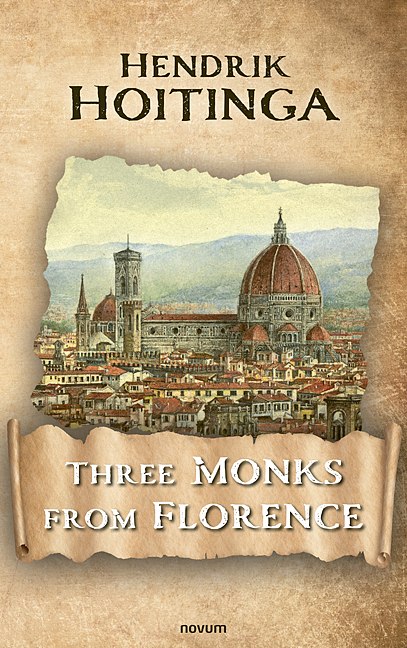
Three Monks from Florence
USD 26,99
Format: 13.5x21.5
Number of Pages: 306
ISBN: 978-3-99146-597-3
Release Date: 07.05.2024
An old painting. Three monks. A mystery spanning over four centuries. Will the past be revealed in the present? Clues are followed. Will the riddles be solved? Will a treasure be found? Follow Sophie and her friends on this journey.
BOOK 1
Three keys. Three clues.
Dedication page for
Three Monks from Florence;
For Gilly
In New Zealand we met and wed
Our children were born there too,
We travelled far and wide,
Now in the North of Scotland reside.
Thank you for who you are and all you do,
Know this, my poppet, that I love you.
Also, for my mum Jitske and my sisters Ann & Dieuwke
Author’s favourite passage of Scripture;
‘Trust in the Lord with all your heart,
And lean not on your own understanding.
In all your ways acknowledge Him,
And He shall direct your paths’.
Proverbs 3; 5-6
PROLOGUE
Cannes, Southern France 1963
The white open-topped Mercedes 230sl Pagoda drove at high speed along the coast road from Nice, heading for Cannes.
Despite the weather being overcast and several dark clouds threatening to deposit rain any time soon, the female driver wore large round dark sunshades. The scarf she had tied over her hair and fastened under her chin was billowing and struggled to contain her long red hair.
It was a little before one o’clock in the afternoon and though driving at speed, she had control of the vehicle, regularly checking in the rear-view mirror.
Her face was set in full concentration, her red lips almost a grimace.
With ease she passed two cars in succession, checked her rear-view mirror again and began to relax a little.
Cannes was not far away now.
Roberto Solari finished his lunch in the harbour-front cafe, nodded goodbye to the owner and left the premises. He walked along the waterfront and looked out to sea.
He took in the fresh air, looked at the dark clouds above and figured he had better get a move on if he didn’t want to get wet.
It was the first week of May and posters were up on fences and in shop windows – the film festival was coming, commencing on the 9th.
Roberto reflected as he followed a path away from the seafront leading to an apartment building. He had moved from Monaco, where in Monte Carlo he had previously lived and worked after a few sizeable commissions had afforded him to do so.
This had been in the year 1948, after the film festival had relaunched the previous year, Roberto having a sense that there could be good business to be had.
His apartment was on the top, the fifth floor, and comprised of a large room which he had transformed into his studio, then a further four rooms, made up from a small dining room that opened into the kitchen, then two good-sized bedrooms, one of which had an ensuite, and a further bathroom. Already over fifteen years ago, he mused, since he moved here, getting ready to cross the road.
The sound of a car approaching accompanied by several beeps on the horn stopped him in his tracks.
The white Mercedes braked, skidded a little, then stopped, the woman behind the wheel calling out.
‘Roberto!’She switched off the engine and got out. She was very slim, Roberto noted, and wore a tight-fitting pencil skirt which hampered her a bit as she got out of the car. Her shoes, white, had sharply pointed toes and heels that were surely three inches or more. The blouse was white, partly tucked into the skirt, partly out.
He didn’t recognise her, but she obviously knew him. Crossing the road, after letting another car pass, he walked towards the woman, who was now leaning back against the car awaiting his arrival. As he drew near, she took off those big sunglasses and her green eyes focusing on him said, ‘Natalie Umbrego.’
Then he remembered her; the red hair tucked under the scarf prompted his recollection.
‘Ah, yes, what, two weeks ago, the party on the yacht?’ he asked, stopping several feet away and recalling a redhead in a black evening dress, though he had only briefly seen her, noticing that on those heels she was taller than he.
‘Si, yes. I need you to do something for me; I will pay well…’ she began, then anxiously looked past him down the road.
He sensed her tenseness, in the body language, in the voice, speaking French with an Italian accent, which was somewhat rushed. Then, looking in the car he noticed it tucked behind the passenger seat.
‘I know, somebody tell me,’ she said, ‘tell me where you live, tell you lunch at the same time,’ then reaching in and drawing out the parcel, wrapped in a large beach towel, she continued, ‘tell me you paint, make copies, but, no, I don’t want that. I need you to clean and fix, is very dirty and ripped in places. You can do this?’
She handed him the wrapped painting, then looking past him again she said,’I have to go; can’t explain. I’ll be back, in a week or so!’
Then she manoeuvred herself with that tight skirt back into the car, turned on the ignition and sped away.
Roberto stepped onto the pavement, clutching the painting, watching her disappear. Then, as he walked up the path which led to the foyer of his apartment building, he heard another car, heard the loud engine, turned and watched as a dark-brown coloured car, what looked to him to be a Jaguar, sped past.
He frowned, then shook his head and turned to enter the building, thinking about what she had said. Lunch at the same time? Was he that habitual?
Stepping into the old elevator, the blanket-wrapped painting under his arm, he figured that he must be, thinking that he ought to perhaps vary his routine. Pressing the button for the fifth floor, he then wondered what might be revealed when he took the blanket off.
THE PRESENT
Thursday 23rd April 2020 – Paris
Hospitals were struggling to cope. The death toll was rising in vast numbers every day around the world. The COVID-19 virus was spreading throughout nations, affecting rich and poor, making no distinction of race or colour or creed.
It was the elderly that were at most risk, as were those with lung-related illnesses. Travel was now severely restricted, cities were in lockdown, people were urged to work from home where they could, wear masks everywhere and wash hands, keep distance and drink fluids.
Sophie Pontiac was home. The Paris Fine Arts Auction House, where she was the manager, was closed. The director, Emmanuel Sauvonne, had caught the virus, thankfully just bedridden and not in hospital.
Sophie had just got off the phone with his wife when there was a ring on the doorbell.
Donning her mask she went to the hallway and tentatively opened the door leading into the foyer area.
‘Special delivery, ma’am,’ the courier, a female, also wearing a mask, said. ‘No need for a signature; have a good day,’ and with that she left, leaving the parcel standing against the wall.
Sophie sized up the package, wrapped in cardboard, taped securely. It was around sixty centimetres in height and close to forty-five centimetres wide. It was less than four centimetres in depth.
‘Merci,’ Sophie called out then leant to pick up the parcel.
It was not heavy.
After having taken the cardboard wrapping apart, leaving just what Sophie assumed to be a painting inside a plastic sleeve lined with tissue paper, she then disposed of the cardboard, washed her hands thoroughly and proceeded to uncover what it was that had been sent to her.
There had been no return address, no inkling, yet, as to who it was from.
Slicing the Cellotape loose, Sophie slid the painting out from the sleeve. A sealed envelope fell out along with it. Ignoring the letter for a moment, she studied the piece. It was an oil painted on wood. It was old, she was sure of that, very old.
It wasn’t a masterpiece – in some places it was almost naive, a little crudely painted.
It was a monk, in a typical monk’s attire. The clothing, the staff he had in his hands, the cross and some sort of key that hung around his neck, these were all rather nicely detailed. The hands and face of the monk were less refined. This puzzled Sophie. As she carefully studied the piece, it was as if the monk himself wasn’t important. After scrutinising it for some time, she was sure of several things.
First, it was old. Judging by the style, the composition, the wood upon which it had been painted, which was likely poplar, she figured it to be mid-sixteenth century and Italian.
Secondly, it was on a panel, and she was sure, looking at the edges, that it had been a triptych – it was one of three panels. Moreover, she was certain that she held the centre piece. At the top and bottom of the painting, ever so faintly, in the centre, she noticed lines where the other two side panels would have closed upon it.
And lastly, she felt sure that the important aspect of this painting was not the monk himself but the attire he wore, the staff he held and the items that hung around his neck.
Time to read the letter.
It was from Roberto Solari.
‘Dearest Sophie,’ the letter, typewritten in French, began. ‘It was very nice to see you last year when you and your English friend, Victoria, came to visit.
It was afterwards that I made up my mind that it was to you that this painting should go. Let me tell you, Sophie, this is not a forgery. I cleaned and mended several gashes it had. This was some time ago. I believe it to have been painted in the mid to late fifteen hundreds, most likely. Having a long time ago done some research on it, it was done in Italy, probably Rome, but there is no signature or date. Let me tell you the story of how I came to have it…’
THE PAST
Period 1
The year 1578 – Florence, Italy
In what was once a formal dining room, Father Dominic had set himself up, using the long polished oak dining table as a desk. Here he had sat and scribed the detailed letters; here he had scribed the instructions for the three monks he had chosen. Here he had scribed the letter for the woman.
He had chosen her with care. She was young, merely two decades, but she came from a good family, a loyal family.
Whilst the plague which had wiped out half the city’s population was already some two hundred years behind them, a current illness was sweeping through the land.
It was this virus, this disease, which had been the cause of the difficulty Father Dominic now faced. He had to think fast, to think clearly and to make sure that everything was in place, that everything was accounted for, everything was protected. And the first thing, was to make sure the baby was safe.
A little girl.
The young woman he had chosen, he felt, could be fully relied upon, also knowing she had a feisty nature. Even though she had just entered a convent, she wasn’t afraid to speak up and would not be easily intimidated. He had organised for her to come and see him, nearly two weeks ago.
She had been wary at first, had stood in front of the table that he was now using as a desk, having not taken up the offer to be seated. She stood straight and her eyes were totally focused on him. In that moment he knew he had chosen well.
He began to explain then handed her the letter.
She took it, looked at him, and decided to sit down.
When he had looked at her, and she had looked up after reading the letter, questioning with his eyes, she had merely nodded.
His next object was twofold: find a painter, good, but not established, not well known, and secondly, a master craftsman who knew about locks.
Then his last task was to select three men. Three monks who could be totally trusted, could read and write and be physically fit enough to travel a long distance.
It was early evening. Father Dominic sat at his makeshift desk. One table lamp was already lit and glowing on the polished surface. Nearly time to move; nearly time to leave. Everything was in place. The last part of his plan had been the painted triptych. This was now ready and he himself would take it with him.
He praised the Lord that it had all been accomplished in time, for he knew that trouble would come knocking. Finishing up, tidying up and taking himself off to the room in which he had slept for the past seven weeks now, he was ready.
They came the following morning.
If they thought they might surprise him at this time of day, the sun having only just made an appearance, they were mistaken. He had been up for hours already.
Someone, a man Father Dominic recognised as a local tradesman, usually seen sharpening knives and tools in the town, unlocked the front door and let them in, a woman and a man.
‘Well, figured you would be here, Father. Where is she?’ the woman asked, noticing him, standing ever so still, in the large foyer as she entered the house.
‘Who?’ he asked.
The woman, glaring at him, said, ‘You know very well who.’
‘Very well, follow me,’ he said then turned and headed for a door which led from the main foyer of the large house. Opening it, he said, ‘One moment; I need to get a lantern.’ There was one on a small shelf just inside the door and Father Dominic fetched it out. It was already lit. Then, looking at the woman, he said, ‘Careful down these steps,’ then turned and led the way, thinking that although he shouldn’t feel this way, he secretly had no wish for her to be careful on these steps.
The tradesman, who had opened the front door, receiving a nod from the woman, turned and left, closing the front door behind him.
There were some twenty stone steps. At the bottom, making sure to hold the lantern up to see the floor clearly, Father Dominic turned left, then, taking a moment, he lit another lantern, placing it on the floor.
They were in a small crypt. There were three coffins, two normal sized, one small.
‘She died,’ Father Dominic said. His voice was calm and without emotion.
He made sure they could see the child’s coffin, in particular the name on the copper plate he had engraved. Anna Kastanje 1575–1578.
The woman and the younger man beside her stood for a moment, then the woman said, her voice hard and with a tone of menace, ‘How can we be sure they are actually in there, especially the girl…?’ Turning, she noticed that Father Dominic had gone. ‘Father?’
She looked up the long steps, was sure he hadn’t gone up there. Where was he?
The lantern he had held was on the bottom step. In the dim light the man and woman looked at each other.
Using the lantern, the woman walked around the small crypt, but there was no sign of him, no sign of any other doorway.
‘Come on’ she said to the man, ‘we’ll check through the house,’ then, having already moved back up the stone staircase, the man picking up the other lantern and following, she continued, ‘and have someone check those coffins – all of them!’
Three keys. Three clues.
Dedication page for
Three Monks from Florence;
For Gilly
In New Zealand we met and wed
Our children were born there too,
We travelled far and wide,
Now in the North of Scotland reside.
Thank you for who you are and all you do,
Know this, my poppet, that I love you.
Also, for my mum Jitske and my sisters Ann & Dieuwke
Author’s favourite passage of Scripture;
‘Trust in the Lord with all your heart,
And lean not on your own understanding.
In all your ways acknowledge Him,
And He shall direct your paths’.
Proverbs 3; 5-6
PROLOGUE
Cannes, Southern France 1963
The white open-topped Mercedes 230sl Pagoda drove at high speed along the coast road from Nice, heading for Cannes.
Despite the weather being overcast and several dark clouds threatening to deposit rain any time soon, the female driver wore large round dark sunshades. The scarf she had tied over her hair and fastened under her chin was billowing and struggled to contain her long red hair.
It was a little before one o’clock in the afternoon and though driving at speed, she had control of the vehicle, regularly checking in the rear-view mirror.
Her face was set in full concentration, her red lips almost a grimace.
With ease she passed two cars in succession, checked her rear-view mirror again and began to relax a little.
Cannes was not far away now.
Roberto Solari finished his lunch in the harbour-front cafe, nodded goodbye to the owner and left the premises. He walked along the waterfront and looked out to sea.
He took in the fresh air, looked at the dark clouds above and figured he had better get a move on if he didn’t want to get wet.
It was the first week of May and posters were up on fences and in shop windows – the film festival was coming, commencing on the 9th.
Roberto reflected as he followed a path away from the seafront leading to an apartment building. He had moved from Monaco, where in Monte Carlo he had previously lived and worked after a few sizeable commissions had afforded him to do so.
This had been in the year 1948, after the film festival had relaunched the previous year, Roberto having a sense that there could be good business to be had.
His apartment was on the top, the fifth floor, and comprised of a large room which he had transformed into his studio, then a further four rooms, made up from a small dining room that opened into the kitchen, then two good-sized bedrooms, one of which had an ensuite, and a further bathroom. Already over fifteen years ago, he mused, since he moved here, getting ready to cross the road.
The sound of a car approaching accompanied by several beeps on the horn stopped him in his tracks.
The white Mercedes braked, skidded a little, then stopped, the woman behind the wheel calling out.
‘Roberto!’She switched off the engine and got out. She was very slim, Roberto noted, and wore a tight-fitting pencil skirt which hampered her a bit as she got out of the car. Her shoes, white, had sharply pointed toes and heels that were surely three inches or more. The blouse was white, partly tucked into the skirt, partly out.
He didn’t recognise her, but she obviously knew him. Crossing the road, after letting another car pass, he walked towards the woman, who was now leaning back against the car awaiting his arrival. As he drew near, she took off those big sunglasses and her green eyes focusing on him said, ‘Natalie Umbrego.’
Then he remembered her; the red hair tucked under the scarf prompted his recollection.
‘Ah, yes, what, two weeks ago, the party on the yacht?’ he asked, stopping several feet away and recalling a redhead in a black evening dress, though he had only briefly seen her, noticing that on those heels she was taller than he.
‘Si, yes. I need you to do something for me; I will pay well…’ she began, then anxiously looked past him down the road.
He sensed her tenseness, in the body language, in the voice, speaking French with an Italian accent, which was somewhat rushed. Then, looking in the car he noticed it tucked behind the passenger seat.
‘I know, somebody tell me,’ she said, ‘tell me where you live, tell you lunch at the same time,’ then reaching in and drawing out the parcel, wrapped in a large beach towel, she continued, ‘tell me you paint, make copies, but, no, I don’t want that. I need you to clean and fix, is very dirty and ripped in places. You can do this?’
She handed him the wrapped painting, then looking past him again she said,’I have to go; can’t explain. I’ll be back, in a week or so!’
Then she manoeuvred herself with that tight skirt back into the car, turned on the ignition and sped away.
Roberto stepped onto the pavement, clutching the painting, watching her disappear. Then, as he walked up the path which led to the foyer of his apartment building, he heard another car, heard the loud engine, turned and watched as a dark-brown coloured car, what looked to him to be a Jaguar, sped past.
He frowned, then shook his head and turned to enter the building, thinking about what she had said. Lunch at the same time? Was he that habitual?
Stepping into the old elevator, the blanket-wrapped painting under his arm, he figured that he must be, thinking that he ought to perhaps vary his routine. Pressing the button for the fifth floor, he then wondered what might be revealed when he took the blanket off.
THE PRESENT
Thursday 23rd April 2020 – Paris
Hospitals were struggling to cope. The death toll was rising in vast numbers every day around the world. The COVID-19 virus was spreading throughout nations, affecting rich and poor, making no distinction of race or colour or creed.
It was the elderly that were at most risk, as were those with lung-related illnesses. Travel was now severely restricted, cities were in lockdown, people were urged to work from home where they could, wear masks everywhere and wash hands, keep distance and drink fluids.
Sophie Pontiac was home. The Paris Fine Arts Auction House, where she was the manager, was closed. The director, Emmanuel Sauvonne, had caught the virus, thankfully just bedridden and not in hospital.
Sophie had just got off the phone with his wife when there was a ring on the doorbell.
Donning her mask she went to the hallway and tentatively opened the door leading into the foyer area.
‘Special delivery, ma’am,’ the courier, a female, also wearing a mask, said. ‘No need for a signature; have a good day,’ and with that she left, leaving the parcel standing against the wall.
Sophie sized up the package, wrapped in cardboard, taped securely. It was around sixty centimetres in height and close to forty-five centimetres wide. It was less than four centimetres in depth.
‘Merci,’ Sophie called out then leant to pick up the parcel.
It was not heavy.
After having taken the cardboard wrapping apart, leaving just what Sophie assumed to be a painting inside a plastic sleeve lined with tissue paper, she then disposed of the cardboard, washed her hands thoroughly and proceeded to uncover what it was that had been sent to her.
There had been no return address, no inkling, yet, as to who it was from.
Slicing the Cellotape loose, Sophie slid the painting out from the sleeve. A sealed envelope fell out along with it. Ignoring the letter for a moment, she studied the piece. It was an oil painted on wood. It was old, she was sure of that, very old.
It wasn’t a masterpiece – in some places it was almost naive, a little crudely painted.
It was a monk, in a typical monk’s attire. The clothing, the staff he had in his hands, the cross and some sort of key that hung around his neck, these were all rather nicely detailed. The hands and face of the monk were less refined. This puzzled Sophie. As she carefully studied the piece, it was as if the monk himself wasn’t important. After scrutinising it for some time, she was sure of several things.
First, it was old. Judging by the style, the composition, the wood upon which it had been painted, which was likely poplar, she figured it to be mid-sixteenth century and Italian.
Secondly, it was on a panel, and she was sure, looking at the edges, that it had been a triptych – it was one of three panels. Moreover, she was certain that she held the centre piece. At the top and bottom of the painting, ever so faintly, in the centre, she noticed lines where the other two side panels would have closed upon it.
And lastly, she felt sure that the important aspect of this painting was not the monk himself but the attire he wore, the staff he held and the items that hung around his neck.
Time to read the letter.
It was from Roberto Solari.
‘Dearest Sophie,’ the letter, typewritten in French, began. ‘It was very nice to see you last year when you and your English friend, Victoria, came to visit.
It was afterwards that I made up my mind that it was to you that this painting should go. Let me tell you, Sophie, this is not a forgery. I cleaned and mended several gashes it had. This was some time ago. I believe it to have been painted in the mid to late fifteen hundreds, most likely. Having a long time ago done some research on it, it was done in Italy, probably Rome, but there is no signature or date. Let me tell you the story of how I came to have it…’
THE PAST
Period 1
The year 1578 – Florence, Italy
In what was once a formal dining room, Father Dominic had set himself up, using the long polished oak dining table as a desk. Here he had sat and scribed the detailed letters; here he had scribed the instructions for the three monks he had chosen. Here he had scribed the letter for the woman.
He had chosen her with care. She was young, merely two decades, but she came from a good family, a loyal family.
Whilst the plague which had wiped out half the city’s population was already some two hundred years behind them, a current illness was sweeping through the land.
It was this virus, this disease, which had been the cause of the difficulty Father Dominic now faced. He had to think fast, to think clearly and to make sure that everything was in place, that everything was accounted for, everything was protected. And the first thing, was to make sure the baby was safe.
A little girl.
The young woman he had chosen, he felt, could be fully relied upon, also knowing she had a feisty nature. Even though she had just entered a convent, she wasn’t afraid to speak up and would not be easily intimidated. He had organised for her to come and see him, nearly two weeks ago.
She had been wary at first, had stood in front of the table that he was now using as a desk, having not taken up the offer to be seated. She stood straight and her eyes were totally focused on him. In that moment he knew he had chosen well.
He began to explain then handed her the letter.
She took it, looked at him, and decided to sit down.
When he had looked at her, and she had looked up after reading the letter, questioning with his eyes, she had merely nodded.
His next object was twofold: find a painter, good, but not established, not well known, and secondly, a master craftsman who knew about locks.
Then his last task was to select three men. Three monks who could be totally trusted, could read and write and be physically fit enough to travel a long distance.
It was early evening. Father Dominic sat at his makeshift desk. One table lamp was already lit and glowing on the polished surface. Nearly time to move; nearly time to leave. Everything was in place. The last part of his plan had been the painted triptych. This was now ready and he himself would take it with him.
He praised the Lord that it had all been accomplished in time, for he knew that trouble would come knocking. Finishing up, tidying up and taking himself off to the room in which he had slept for the past seven weeks now, he was ready.
They came the following morning.
If they thought they might surprise him at this time of day, the sun having only just made an appearance, they were mistaken. He had been up for hours already.
Someone, a man Father Dominic recognised as a local tradesman, usually seen sharpening knives and tools in the town, unlocked the front door and let them in, a woman and a man.
‘Well, figured you would be here, Father. Where is she?’ the woman asked, noticing him, standing ever so still, in the large foyer as she entered the house.
‘Who?’ he asked.
The woman, glaring at him, said, ‘You know very well who.’
‘Very well, follow me,’ he said then turned and headed for a door which led from the main foyer of the large house. Opening it, he said, ‘One moment; I need to get a lantern.’ There was one on a small shelf just inside the door and Father Dominic fetched it out. It was already lit. Then, looking at the woman, he said, ‘Careful down these steps,’ then turned and led the way, thinking that although he shouldn’t feel this way, he secretly had no wish for her to be careful on these steps.
The tradesman, who had opened the front door, receiving a nod from the woman, turned and left, closing the front door behind him.
There were some twenty stone steps. At the bottom, making sure to hold the lantern up to see the floor clearly, Father Dominic turned left, then, taking a moment, he lit another lantern, placing it on the floor.
They were in a small crypt. There were three coffins, two normal sized, one small.
‘She died,’ Father Dominic said. His voice was calm and without emotion.
He made sure they could see the child’s coffin, in particular the name on the copper plate he had engraved. Anna Kastanje 1575–1578.
The woman and the younger man beside her stood for a moment, then the woman said, her voice hard and with a tone of menace, ‘How can we be sure they are actually in there, especially the girl…?’ Turning, she noticed that Father Dominic had gone. ‘Father?’
She looked up the long steps, was sure he hadn’t gone up there. Where was he?
The lantern he had held was on the bottom step. In the dim light the man and woman looked at each other.
Using the lantern, the woman walked around the small crypt, but there was no sign of him, no sign of any other doorway.
‘Come on’ she said to the man, ‘we’ll check through the house,’ then, having already moved back up the stone staircase, the man picking up the other lantern and following, she continued, ‘and have someone check those coffins – all of them!’
You might like this too :

Other books by this author