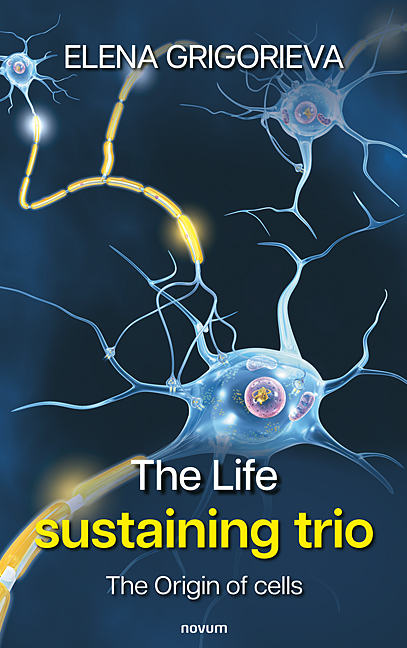
The Life sustaining trio
The Origin of cells
USD 24,99
Format: 13.5 X 21.5
Number of Pages: 46
ISBN: 978-3-99146-663-5
Release Date: 03.05.2024
Have you ever wondered when and how the very first organisms came to be on Earth? There has been much research on this, which is currently ongoing, and now we do have some answers about the theory of life. Find out what they are when you read this short book!
Foreword
The aim of this book is to give an easy-to-understand explanation of a very complex and difficult question of biology: When and how did the very first living organisms appear on Earth? This question has puzzled the curious minds of human beings for many centuries, and a great number of different suggestions and theories have been proposed and investigated. The ideas and answers have been progressing, together with the development of human civilisation. By the beginning of the 21st century, this knowledge has crystalised into a theory of evolution of life on Earth.
The scientific research of biological processes continues at the present time and gives more and more detailed answers but also creates more and more interesting questions. This is a fascinating process.
This book is addressed to those who would like to get a quick acquaintance with the whole theory of life, which is summarised in a few pages containing simple pictures and short descriptions.
Earth Before Life
For many of us living on Earth, the meaning of life is associated with the words communication, attraction and reproduction. Whereas reproduction is often associated with such words as competition, fight and sacrifice. It seems that such assumptions have been true for as long as life itself.
If we look back in time, about 4 billion years ago, we would probably have seen that similar associations could be applied to the interactions between different molecules appearing on Earth. At that time, our planet was a lifeless hot rock exposed to high-level ionising radiations, electrical discharges, mechanical pressure and heat coming from the erupting volcanos. Under those conditions, different chemical elements, mainly hydrogen (H), oxygen (O), carbon (C), nitrogen (N), phosphorus (P) and sulphur (S), joined together in different variations and formed molecules, such as dihydrogen oxide (H2O), carbon dioxide (CO2), methane (CH4), dinitrogen (N2), ammonia (NH3), hydrogen cyanide (HCN), phosphorus dioxide (PO2) and hydrogen sulfide (H2S). These small molecules joined together in different variations and formed carbon-based compounds, some of which have become the founders and essential constituents of all forms of life on Earth.
Among such founders were amino acids, which combined into polypeptide chains and more complex compounds and proteins, with important physical and chemical properties.
Other important molecules were nucleotides, which formed long chains (polymers) of nucleic acids. Nucleotides such as adenine, guanine, cytosine and uracil, combined into a polynucleotide chain called ribonucleic acid (RNA).
RNA had several important properties. First, each of its nucleotides could establish a pair with another nucleotide. In particular, adenine could pair with uracil, and guanine with cytosine. Subsequently, a new polynucleotide chain (or strand) of RNA could be built up parallel to the original one and then separated, thereby producing a new RNA molecule. This process is called replication. Second, some RNA molecules folded into a specific shape. One part of such molecules could attach to a certain amino acid, whereas another part had a sequence of three adjacent nucleotides, which could bind to a matching sequence in a different nucleic acid. Such RNAs are called transfer RNAs, or tRNAs. Altogether, 20 different amino acids have an ability to attach to tRNAs.
Over time, some RNAs and proteins became able to facilitate (or catalyse) certain chemical reactions (such molecules are called enzymes), whereas some compounds, such as adenosine triphosphate (ATP), became able to store and carry energy required for chemical reactions. Importantly, the enzymes and energy carriers emerged at the time when the planet’s cataclysms were cooling down, and environmental energy sources were less available. Earth began to accumulate water on its surface and be surrounded by a layer of gaseous atmosphere composed mainly of dinitrogen, hydrogen sulfide, methane, carbon dioxide and water vapours.
The Beginning of Life
Mutual relationships between nucleotides, RNAs, amino acids and proteins led to the formation of special RNA-protein complexes, or communities, which existed and multiplied in water. Moreover, molecules of water were essential for such communities.
But the real life processes began later, when a different type of nucleic acid appeared in the vicinity of the RNA-protein community. It was a deoxyribonucleic acid (DNA), which was composed of two intertwisted chains, or strands, formed by nucleotides.
The double-stranded molecule of DNA attracted the members of the RNA-protein community. Some of the protein enzymes approached the DNA and started to break down the bonds between its nucleotide base pairs and form connections between the unbound nucleotides and their own community nucleotides. It was not so easy because not all nucleotides in the DNA were the same as in the RNA. Instead of uracil, the DNA had thymine. Eventually, adenine could base-pair with thymine, and a new polynucleotide chain of RNA was formed on a part of the DNA strand. Then, this RNA was separated from the DNA and delivered to the RNA-protein complex.
The novel RNA molecule, called messenger RNA, or mRNA, was surrounded and explored by the members of the RNA-protein complex (now it can be called a ribosome), including amino-acid-carrying transfer RNAs (tRNAs). Specific nucleotide triplets in the tRNAs made connections with matching nucleotide triplets in the messenger RNA. At the same time, the amino acids, which were attached to the tRNAs, united and formed a polypeptide chain. Thus, the collective action of protein enzymes, RNAs and amino acids led to the formation of a new polypeptide, or protein. The newly synthesised protein was retained for the benefit of the community, while the messenger RNA was quickly destroyed (sacrificed).
The nucleotide triplets in the mRNA (these triplets are called codons) to which the tRNAs with attached amino acids connected were complementary to the nucleotide triplets in the part of the DNA strand where the mRNA was formed. This means that the amino acid sequence in the newly synthesised protein was determined (or encoded) by the nucleotide sequences in the DNA strand. That was a remarkable achievement. The DNA remained in the RNA-protein community for good and was allowed to make copies of its nucleotide sequences for the mRNA and protein synthesis.
The DNA became a central member of the RNA-protein community, thereby creating a life-sustaining trio.
The DNA had two important properties. First, it could be transformed by adding or deleting certain nucleotides, or by changing the sequence of nucleotides in its strands, and since its appearance in the RNA-protein community (now it can be called a cell), the DNA was undergoing various modifications. This led to more varieties of nucleotide sequences (triplet codes) that could be transcribed into RNAs and translated into the synthesis of proteins with novel properties and functions. Second, the DNA preserved all the nucleotide sequences that were beneficial for the cell, or, at least, did not harm it. Moreover, the way and order in which the triplet codes were transcribed under certain conditions, in general, were conserved, too.
The DNA sequence that encodes a functional RNA molecule is called a gene. The whole number of genes comprised in DNA is a genome. Gene transcription, or RNA production, is carried out by specific protein enzymes, called RNA polymerases. Another special group of proteins, called transcription factors, regulate what kind of genes should be transcribed and when, in response to the signals from the cell’s external and internal environments, or, in other words, they control gene expression.
The Progression of Life
The cell comprising the life-sustaining trio started to undergo significant changes. First of all, the trio became separated from the environment by a special lipid membrane – the plasma membrane, or cell membrane, and an outermost, protective layer – the cell wall composed of carbohydrates. Numerous biochemical reactions catalysed by enzymes were carried out in the cell’s cytosol, which was a mixture of molecules dissolved in water and these reactions maintained the cell’s living state, or metabolism. The number of ribosomes was increasing, and the plasma membrane, which was holding various proteins, began to grow and make invaginations inside the cell.
Special molecules, such as chlorophyll, allowed the cell to carry out the process of photosynthesis, during which it produced ATP, sugars and oxygen by using water, carbon dioxide and the energy of light. Oxygen, in turn, became a vital reagent in oxidation reactions, during which the chemical breakdown of the sugar glucose produced ATP, water and carbon dioxide (this process is called respiration). The cell utilised nitrogen gas from the atmosphere to produce ammonia, which was used for the synthesis of amino acids and nucleotides. The cell also began to synthesise and store different carbohydrates and lipids as fuels, providing the energy for various biochemical reactions.
What happened next should be considered as the continuity and progression of life on Earth. This can be described as follows.
When the cell was in its satisfactory metabolic condition, and at the time when most of the community members were inactive (likely at night), a group of proteins became engaged in the process of DNA replication and cell division. Those proteins carefully separated the DNA strands and made copies of both of them.
Then, they dragged the DNA copies apart and built up new membranes, which divided the cell into two parts. Thus, the proteins fulfilled their task: They produced two new cells with identical DNAs.
However, as soon as the community members became active again, the organisers of DNA replication and cell division were inhibited, and some of them were destroyed.
The two young cells grew and developed as normal, but when they gained the size of the previous cell, and when there were appropriate conditions and enough energy supply, they underwent the same kind of DNA replication and cell division because they both retained the genes’ encoding proteins responsible for these processes. Both cells could produce two competing groups of proteins: those that engage in DNA replication and cell division and those that provide cell growth and survival.
So, DNA replication and cell division led to the formation of two daughter cells, which had DNA with the same (or nearly the same) characteristics as DNA in the previous (or parent) cell. This process is called cell reproduction.
Now, it is conceivable to suggest that the progression (or evolution) of life on Earth has begun at the time when the first cell became able to reproduce itself.
In a dividing cell, the DNA with attached proteins is called a chromosome and represents a hereditary material that is passed on to the daughter cells (or offspring). In some cases, DNA replication can occur without cell division, thereby resulting in the increased number of chromosomes in the cell.
There are two different types of cell reproduction: asexual and sexual. The ways of asexual reproduction are fission (the splitting of the cell), budding (the outgrowth of a daughter cell from the surface of a parent cell) and the formation of spores. Sexual reproduction involves the formation of daughter cells that have only half of the parental chromosomes. Such cells are called haploid cells (gametes, or male and female sex cells). When the two different haploid cells of opposite sex fuse together, they form a new diploid cell (a zygote), which can further undergo the process of reproduction involving cell growth, DNA replication and cell division. Importantly, sexual reproduction, followed by natural selection, has become a major driving force of evolution of life on Earth.
The aim of this book is to give an easy-to-understand explanation of a very complex and difficult question of biology: When and how did the very first living organisms appear on Earth? This question has puzzled the curious minds of human beings for many centuries, and a great number of different suggestions and theories have been proposed and investigated. The ideas and answers have been progressing, together with the development of human civilisation. By the beginning of the 21st century, this knowledge has crystalised into a theory of evolution of life on Earth.
The scientific research of biological processes continues at the present time and gives more and more detailed answers but also creates more and more interesting questions. This is a fascinating process.
This book is addressed to those who would like to get a quick acquaintance with the whole theory of life, which is summarised in a few pages containing simple pictures and short descriptions.
Earth Before Life
For many of us living on Earth, the meaning of life is associated with the words communication, attraction and reproduction. Whereas reproduction is often associated with such words as competition, fight and sacrifice. It seems that such assumptions have been true for as long as life itself.
If we look back in time, about 4 billion years ago, we would probably have seen that similar associations could be applied to the interactions between different molecules appearing on Earth. At that time, our planet was a lifeless hot rock exposed to high-level ionising radiations, electrical discharges, mechanical pressure and heat coming from the erupting volcanos. Under those conditions, different chemical elements, mainly hydrogen (H), oxygen (O), carbon (C), nitrogen (N), phosphorus (P) and sulphur (S), joined together in different variations and formed molecules, such as dihydrogen oxide (H2O), carbon dioxide (CO2), methane (CH4), dinitrogen (N2), ammonia (NH3), hydrogen cyanide (HCN), phosphorus dioxide (PO2) and hydrogen sulfide (H2S). These small molecules joined together in different variations and formed carbon-based compounds, some of which have become the founders and essential constituents of all forms of life on Earth.
Among such founders were amino acids, which combined into polypeptide chains and more complex compounds and proteins, with important physical and chemical properties.
Other important molecules were nucleotides, which formed long chains (polymers) of nucleic acids. Nucleotides such as adenine, guanine, cytosine and uracil, combined into a polynucleotide chain called ribonucleic acid (RNA).
RNA had several important properties. First, each of its nucleotides could establish a pair with another nucleotide. In particular, adenine could pair with uracil, and guanine with cytosine. Subsequently, a new polynucleotide chain (or strand) of RNA could be built up parallel to the original one and then separated, thereby producing a new RNA molecule. This process is called replication. Second, some RNA molecules folded into a specific shape. One part of such molecules could attach to a certain amino acid, whereas another part had a sequence of three adjacent nucleotides, which could bind to a matching sequence in a different nucleic acid. Such RNAs are called transfer RNAs, or tRNAs. Altogether, 20 different amino acids have an ability to attach to tRNAs.
Over time, some RNAs and proteins became able to facilitate (or catalyse) certain chemical reactions (such molecules are called enzymes), whereas some compounds, such as adenosine triphosphate (ATP), became able to store and carry energy required for chemical reactions. Importantly, the enzymes and energy carriers emerged at the time when the planet’s cataclysms were cooling down, and environmental energy sources were less available. Earth began to accumulate water on its surface and be surrounded by a layer of gaseous atmosphere composed mainly of dinitrogen, hydrogen sulfide, methane, carbon dioxide and water vapours.
The Beginning of Life
Mutual relationships between nucleotides, RNAs, amino acids and proteins led to the formation of special RNA-protein complexes, or communities, which existed and multiplied in water. Moreover, molecules of water were essential for such communities.
But the real life processes began later, when a different type of nucleic acid appeared in the vicinity of the RNA-protein community. It was a deoxyribonucleic acid (DNA), which was composed of two intertwisted chains, or strands, formed by nucleotides.
The double-stranded molecule of DNA attracted the members of the RNA-protein community. Some of the protein enzymes approached the DNA and started to break down the bonds between its nucleotide base pairs and form connections between the unbound nucleotides and their own community nucleotides. It was not so easy because not all nucleotides in the DNA were the same as in the RNA. Instead of uracil, the DNA had thymine. Eventually, adenine could base-pair with thymine, and a new polynucleotide chain of RNA was formed on a part of the DNA strand. Then, this RNA was separated from the DNA and delivered to the RNA-protein complex.
The novel RNA molecule, called messenger RNA, or mRNA, was surrounded and explored by the members of the RNA-protein complex (now it can be called a ribosome), including amino-acid-carrying transfer RNAs (tRNAs). Specific nucleotide triplets in the tRNAs made connections with matching nucleotide triplets in the messenger RNA. At the same time, the amino acids, which were attached to the tRNAs, united and formed a polypeptide chain. Thus, the collective action of protein enzymes, RNAs and amino acids led to the formation of a new polypeptide, or protein. The newly synthesised protein was retained for the benefit of the community, while the messenger RNA was quickly destroyed (sacrificed).
The nucleotide triplets in the mRNA (these triplets are called codons) to which the tRNAs with attached amino acids connected were complementary to the nucleotide triplets in the part of the DNA strand where the mRNA was formed. This means that the amino acid sequence in the newly synthesised protein was determined (or encoded) by the nucleotide sequences in the DNA strand. That was a remarkable achievement. The DNA remained in the RNA-protein community for good and was allowed to make copies of its nucleotide sequences for the mRNA and protein synthesis.
The DNA became a central member of the RNA-protein community, thereby creating a life-sustaining trio.
The DNA had two important properties. First, it could be transformed by adding or deleting certain nucleotides, or by changing the sequence of nucleotides in its strands, and since its appearance in the RNA-protein community (now it can be called a cell), the DNA was undergoing various modifications. This led to more varieties of nucleotide sequences (triplet codes) that could be transcribed into RNAs and translated into the synthesis of proteins with novel properties and functions. Second, the DNA preserved all the nucleotide sequences that were beneficial for the cell, or, at least, did not harm it. Moreover, the way and order in which the triplet codes were transcribed under certain conditions, in general, were conserved, too.
The DNA sequence that encodes a functional RNA molecule is called a gene. The whole number of genes comprised in DNA is a genome. Gene transcription, or RNA production, is carried out by specific protein enzymes, called RNA polymerases. Another special group of proteins, called transcription factors, regulate what kind of genes should be transcribed and when, in response to the signals from the cell’s external and internal environments, or, in other words, they control gene expression.
The Progression of Life
The cell comprising the life-sustaining trio started to undergo significant changes. First of all, the trio became separated from the environment by a special lipid membrane – the plasma membrane, or cell membrane, and an outermost, protective layer – the cell wall composed of carbohydrates. Numerous biochemical reactions catalysed by enzymes were carried out in the cell’s cytosol, which was a mixture of molecules dissolved in water and these reactions maintained the cell’s living state, or metabolism. The number of ribosomes was increasing, and the plasma membrane, which was holding various proteins, began to grow and make invaginations inside the cell.
Special molecules, such as chlorophyll, allowed the cell to carry out the process of photosynthesis, during which it produced ATP, sugars and oxygen by using water, carbon dioxide and the energy of light. Oxygen, in turn, became a vital reagent in oxidation reactions, during which the chemical breakdown of the sugar glucose produced ATP, water and carbon dioxide (this process is called respiration). The cell utilised nitrogen gas from the atmosphere to produce ammonia, which was used for the synthesis of amino acids and nucleotides. The cell also began to synthesise and store different carbohydrates and lipids as fuels, providing the energy for various biochemical reactions.
What happened next should be considered as the continuity and progression of life on Earth. This can be described as follows.
When the cell was in its satisfactory metabolic condition, and at the time when most of the community members were inactive (likely at night), a group of proteins became engaged in the process of DNA replication and cell division. Those proteins carefully separated the DNA strands and made copies of both of them.
Then, they dragged the DNA copies apart and built up new membranes, which divided the cell into two parts. Thus, the proteins fulfilled their task: They produced two new cells with identical DNAs.
However, as soon as the community members became active again, the organisers of DNA replication and cell division were inhibited, and some of them were destroyed.
The two young cells grew and developed as normal, but when they gained the size of the previous cell, and when there were appropriate conditions and enough energy supply, they underwent the same kind of DNA replication and cell division because they both retained the genes’ encoding proteins responsible for these processes. Both cells could produce two competing groups of proteins: those that engage in DNA replication and cell division and those that provide cell growth and survival.
So, DNA replication and cell division led to the formation of two daughter cells, which had DNA with the same (or nearly the same) characteristics as DNA in the previous (or parent) cell. This process is called cell reproduction.
Now, it is conceivable to suggest that the progression (or evolution) of life on Earth has begun at the time when the first cell became able to reproduce itself.
In a dividing cell, the DNA with attached proteins is called a chromosome and represents a hereditary material that is passed on to the daughter cells (or offspring). In some cases, DNA replication can occur without cell division, thereby resulting in the increased number of chromosomes in the cell.
There are two different types of cell reproduction: asexual and sexual. The ways of asexual reproduction are fission (the splitting of the cell), budding (the outgrowth of a daughter cell from the surface of a parent cell) and the formation of spores. Sexual reproduction involves the formation of daughter cells that have only half of the parental chromosomes. Such cells are called haploid cells (gametes, or male and female sex cells). When the two different haploid cells of opposite sex fuse together, they form a new diploid cell (a zygote), which can further undergo the process of reproduction involving cell growth, DNA replication and cell division. Importantly, sexual reproduction, followed by natural selection, has become a major driving force of evolution of life on Earth.
You might like this too :

Other books by this author