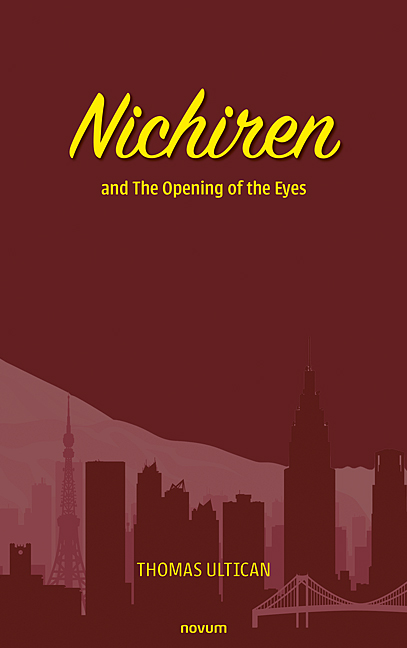
Nichiren
and The Opening of the Eyes
USD 34,99
Format: 13.5 x 21.5 cm
Number of Pages: 282
ISBN: 978-3-99130-609-2
Release Date: 29.04.2025
This fascinating biography recounts the life and work of Nichiren, a Japanese Buddhist priest and philosopher born in the thirteenth century, whose inspirational teachings on Buddhism transformed spiritualism in Southeast Asia and ultimately the world beyond.
Introduction
In February 1969, I was walking down Broadway in San Diego, California when a Japanese woman approached me. She spoke almost no English, but I understood her to say, “World Tribune; Buddhist discussion meeting; you go.” That was my first encounter with Nichiren and his declaration that chanting Nam-myoho-renge-kyo opened the path to Buddhahood, personal happiness, and world harmony.
My ignorance of Nichiren was not so unusual. It seems that his thinking had a wider distribution than his name. I discovered that a Vietnamese friend of mine chants Nam-myoho-renge-kyo every day but had never heard of Nichiren. Scholar Daniel Montgomery reported that in the 1930s, a Japanese monk chanted Nam-myoho-renge-kyo while his new friend Gandhi beat a chanting drum. Many self-help and new-age religious movements teach ideas that originated with Nichiren, but they often do not know the source.
Another friend told me that in the 1960s, he became a follower of Werner Erhard and went through his EST training. After learning about Nichiren, he became convinced that the best principles taught by Erhard came from Nichiren.
It was at about this time that many scholars started to become aware of Nichiren. In 1968, the Swiss philosopher Jean Hersch directed the United Nations Education Scientific and Cultural Organization’s publication of Birthright of Man: An Anthology of Texts on Human Rights. Included in the more-than-one-thousand quotes was Nichiren’s statement, “Even if it seems that, because I was born in the ruler’s domain, I follow him in my actions, I will never follow him in my heart.”
In thirteenth-century Japan, Nichiren joined Esai, Hōnen, Shinran, and Dōgen as founders of new sectarian movements. Esai and Dōgen established respectively Rinzan Zen and Sōtō Zen. Hōnen founded the Pure Land Sect and Shinran the True Pure Land Sect. The schools founded by these five Buddhist monks, known as the “Kamakura reformers”, have survived throughout the past eight hundred years. Of these five, it is Nichiren’s teachings that have moved past just surviving to stunning worldwide growth.
Nichiren was a forward-thinking man with surprisingly modern views. It is a happy discovery to find that many of this Dark Ages Japanese monk’s most important disciples were females. He viewed the equality of the sexes as basic. It seems that in a time when women were treated like lesser beings, he accorded them with a respect similar to that which he gave his male followers. In a letter to the lay nun Senichiama, Nichiren wrote: “Since I have realized that only the Lotus Sutra teaches the attainment of Buddhahood by women, and that only the Lotus is the sutra of true requital for repaying the kindness of our mother, in order to repay my debt to my mother, I have vowed to enable all women to chant the daimoku [Nam-myoho-renge-kyo] of this sutra.”
To another woman, Nichigen-nyo, he declared, “Only in the Lotus Sutra do we read that a woman who embraces this sutra not only excels all other women, but also surpasses all men.”
Even though Nichiren wrote extensively, as of 1969, almost none of this material was translated into English. Fortunately, through the work of researchers like Philip Yampolsky and Burton Watson of Columbia University, Jacqueline Stone of Princeton University, and many others, almost the entire existing Nichiren production is now reliably translated into English.
Professor Stone informed readers in her doctoral thesis:
“Nichiren wrote prolifically; his collected works comprise more than five hundred writings. These represent a variety of forms, including essays of varying lengths, personal letters and recorded oral teachings and ranging from learned doctrinal expositions in literary Chinese to sermons for lay people in the vernacular language – all developing Nichiren’s doctrine of salvation through exclusive devotion to the Lotus Sûtra and the direct accessibility of Buddhahood for anyone, man and woman, foolish or wise, who takes faith in the sutra and chants its daimoku or title in the formula, Namu-myôhô-renge-kyô.”
The Buddhist lay organization Soka Gakkai International (SGI) has gathered four hundred and six of Nichiren’s works into two English language volumes, The Writings of Nichiren Daishonin (1999), and The Writings of Nichiren Daishonin Volume II (2006). The four hundred and six translated works are the foundational references for this book.
“Nichiren” literally means “Sun Lotus”, which is the name he gave himself in 1253 after he publically declared his teaching. “Daishonin” is an honorific title meaning “Great Sage”.
With this large amount of thirteenth-century material available, a rather detailed look at the life of Nichiren is possible, and for historians it is a trove of information documenting Dark Ages Japan. Because Nichiren wrote so many letters to his followers addressing their personal issues, a picture of their lives also comes into focus.
Nichiren used the Chinese lunar calendar to reference dates. The dates given here are according to that lunar form accompanied by their Gregorian calendar equivalents in the form (G – MM/DD/YYYY). The correlated calendar dates were developed using Dr. Herong Yang’s calendar rules and the table of new moons of the thirteenth century based on Jean Meeus’ work and published by Fred Espenak of Astropixels.The lunar calendar also requires identifying the date of the twelve principal terms which are based on the sun’s position. Data derived from the Stellafane Equinox and Solstice calculator were used to identify these dates.
Hopefully, the date conversions give the twenty-first-century reader a more accurate feel for the time and environment. For example, on the eleventh day of the eleventh month in 1264, Nichiren was attacked by a group under the control of village steward Tōjō Kagenobu. Nichiren is sometimes criticized as having provoked the attack when at five p.m. he brazenly threw caution to the wind and had his party ride across Kagenobu’s realm. However, that date correlates to (G – 12/07/1264), which means in a country more than 33 ° north latitude, it was nearing the shortest day of the year, implying he waited until dark was falling to begin his trip.
A context for the political and cultural life Nichiren encountered is addressed in Chapter One. Beginning with Imperial Japan’s 660 BCE founding by legendary Emperor Jimmu Tenno, a brief historical background is presented. It is a history that witnessed the imperial system becoming established and then slowly falling under the control of powerful clans and their samurai armies.
At the start of Japan’s second millennium, the indigenous Shinto religion found itself competing with the imported foreign religion, Buddhism. The common person and some clan leaders remained loyal to the Shinto, while the imperial family and other social elites adopted Buddhism.
At the beginning of the thirteenth century, for the first time, a Japanese Shogenate achieved predominance over the country. Just proceeding Nichiren’s 1222 birth, the Hōjō clan consummated total control over Japan when they dealt the imperial family a devastating final blow in 1221. Hōjō Yosutoki led an army that routed Kyoto-based efforts by three former emperors to throw off the yoke of samurai control. The Hōjō family would maintain an unchallenged rule over Japan for the next one hundred years, which covered the entirety of Nichiren’s life.
Chapter One also shares some history of Nichiren’s early life, from his birth in 1222 until he presented his new teaching in 1253. It is the story of a Buddhist savant appearing who was destined to disrupt the existing class system. The narrative follows his sixteen years of study at various secular and Buddhist centers until he was ready to begin sharing insights. It tells the story of an obscure fisherman’s son determining to become the wisest person in all of Japan. Of all the famous Buddhist teachers and reformers of thirteenth-century Japan, he alone came from humble origins. On the twenty-eighth day of the fourth month, 1253 (G – 06/02/1253), Nichiren gave his first public lecture on Buddhism. He declared that the Lotus Sutra was the apex teaching of Shakyamuni Buddha, the historical Buddha of India, and that Myoho-renge-kyo was not only its title but its essence. It was the first time he publically advocated chanting Nam-myoho-renge-kyo.
Chapter Two, “Declaring the Correct Teaching”, starts with that first lecture in which he evidently disparaged the True Word School, enraging the village steward, Tojo Kagenobu, who ordered Nichiren’s arrest. However, priest friends at the temple spirited him out of harm’s way to his family home.
At his parent’s home, Nichiren converted both his mother and father to his teaching, bestowed Buddhist names on them, and renamed himself Nichiren. Later the senior priest friends who saved him would declare themselves his disciples.
Nichiren soon left for Japan’s center of governmental power, Kamakura, where he quickly gathered adherents.
Coincident with his expanding support, great suffering stalked Japan. In the five years from 1256 to 1261 the name of the era was changed five times. Era names were traditionally only changed during the succession of a new emperor or if a natural disaster of severe proportion occurred. During these five years, there was a monster earthquake, torrential rains, violent winds, crop failures, and famine. All the while epidemics raged. This prompted Nichiren to search in the Buddhist scriptures for the underlying causes of these disasters. He presented the conclusions in his famous thesis On Establishing the Correct Teaching for the Peace of the Land, a writing widely viewed as one of his three most important works.
Its fallout has extended all the way into the twentieth century. In the late nineteenth century, so-called “Nichirenists” used distorted interpretations of Establishing the Correct Teaching and the Lotus Sutra to justify imperialism and military conquest. They claimed Japan was destined to rule the world. The Nichirenist movement only came to an end when Japan suffered defeat in World War Two.
In Nichiren’s time, his conclusions were quite controversial, which opened him up to suffering almost two decades of unrelenting persecution.
In his longest, and in many circles, most revered writing, The Opening of the Eyes, Nichiren remarked on the persecutions he had faced. “Minor persecutions and annoyances are too numerous even to be counted, but the major persecutions number four.”
Chapter Three, The Period of Great Tribulation, recounts the first three of these four major persecutions and to some extent the negative effects suffered by his persecutors. It is fascinating that those most responsible for perpetrating acts of oppression and victimization against Nichiren suffered odd deaths and mental issues.
Details of Nichiren being burned out of his home in 1260 begin the chapter. How he escaped is unknown, but some evidence points to women playing a primary role. He returned to Kamakura in 1261 only to be exiled to the Izu peninsula by a regent decision made outside of normal legal processes. Two years later, he was given a reprieve.
In 1264, while traveling near Komatsubara in the Awa province, Nichiren was attacked by a large group of samurai soldiers. Two disciples were killed and Nichiren was injured in the melee. These three events that Nichiren labeled major persecutions are detailed in Chapter Three.
Chapter Four, “The Tatsunokuchi Persecution”, details events between 1265 and 1271 culminating in Nichiren’s failed execution and exile to Sado Island. Exile was tantamount to a death sentence, especially when it was to a remote place like this weather-beaten island in the Sea of Japan.
The attempted execution is one of the most famous occurrences in Japanese history known as the “Tatsunokuchi Persecution”. In 1271, Nichiren was taken to Tatsunokuchi Beach in the early morning hours to be executed. It was dark when an astronomical event took place, which Nichiren described; “The radiant object clearly illuminated everyone like bright moonlight.” The soldiers became too frightened to carry out their grisly duty.
Chapters Five through Seven deal with core theories underlying Nichiren Buddhism.
The theory of Three Thousand Realms in a Thought Moment is the theoretical foundation for the development of Nichiren’s teaching. To comprehend Nichiren even at a shallow level, some familiarization with this theory is required. He utilizes it to explain the nature of cause and effect, which bolsters his claim to be the “teacher of the Latter Day of the Law”, who is the “sovereign, teacher, and father and mother to all the people of Japan.” This theory led to his denial of effects with no causes or miracles.
Nichiren also uses Three Thousand Realms in a Thought Moment to justify the object of devotion he invented called “Gohonzon”. It is common for modern practitioners of Nichiren Buddhism to have a family Gohonzon enshrined in their home and use it as a focal point for chanting. The name Gohonzon is derived from two characters, “go”, being an honorific title, and “honzon”, meaning “object of veneration”.
Chapter Five, which is titled “Three Thousand Realms in a Thought Moment”, provides a description of the theory, including how it applies to each individual’s life. It is a theory that the sixth-century Buddhist teacher T’ien-t’ai derived from his reading of the Lotus Sutra.
The Opening of the Eyes may be Nichiren’s most important work. There is widespread agreement that it is certainly one of his three most significant writings. In the first half of the discourse, Nichiren declares that the true teacher must embody the three qualities of sovereign, teacher, and parent. The true teacher must have the compassion of a parent for all people, the capacity to protect them, and the correct understanding of cause and effect, or how life functions over the three existences of past, present, and future.
Chapter Six “The Opening of the Eyes Part I: Identifying the ‘Correct Teaching’ and Teacher” delves into Nichiren’s reasoning used to identify the correct teacher from the “Former Day of the Law” (a time before the Christian era when Shakyamuni Buddha of India was teaching). In the opening half of the thesis, Nichiren provides an in-depth discussion of all the known philosophies existing in thirteenth-century Japan. He recounts their origins and the depth of understanding they have regarding the nature of cause and effect. He contends that all these philosophies other than Buddhism have an incomplete understanding of cause and effect. Based on that observation, Nichiren eliminates all but Shakyamuni Buddha as embodying the required qualities of sovereign, teacher, and parent.
His arguments amount to a treatise on comparative religion in which Nichiren demonstrates his enormous knowledge and arrives at thoroughly argued conclusions. The Opening of the Eyes is his most lengthy document, which is written very much like a modern scholar. Once he establishes Shakyamuni as the correct teacher of antiquity and Buddhism to be the superior philosophy, he turns to himself and his own true identity.
In Chapter Seven, “The Opening of the Eyes Part II: Awaken to the True Votary – Awaken to Nichiren”, Nichiren implicitly indicates that he is the Buddha of the “Latter Day of the Law”. He based this conclusion on his conviction that he had read the Lotus Sutra with his life and had perfectly fulfilled the predictions concerning the teacher forecast to arise in the “evil age”. Professor Burton Watson wrote in introductory remarks for his translation of the The Record of the Orally Transmitted Teachings:
“In his ‘On Persecutions Befalling the Sage,’ written in 1279, Nichiren declared that he had fulfilled the purpose of his advent in the world. He had already propagated the Lotus Sutra, which he defined as ‘the Buddha’s will,’ and had undergone the persecutions that the sutra predicts will befall its votary. The phrase ‘the purpose of one’s advent’ refers to the reason for a Buddha’s appearance in the world,
which is to lead all people to Buddhahood.”
As the year 1272 began, Nichiren was once again an exile. This time he was on Sado Island, a forbidding island province in the Sea of Japan. In absolutely horrible conditions, which included exposure and deprivation, Nichiren continued forging ahead by writing The Opening of the Eyes.
His life on Sado Island was under constant threat, but in his two and half years there, Nichiren completed many of his most important works. He finished both The Opening of the Eyes and The Heritage of the Ultimate Law of Life in the second month of 1272. In 1273, he wrote The Object of Devotion for Observing the Mind, a thesis that along with Establishing the Correct Teaching for the Peace of the Land and The Opening of the Eyes constitutes the writings widely considered his three most important works.
Significantly, The Object of Devotion for Observing the Mind contains the justification for the Gohonzon. Based on the theory of Three Thousand Realms in a Thought Moment, Nichiren states that “even insentient beings are endowed with the ten factors of life, and that they are endowed with both material and spiritual aspects”. From this starting point, he created the physical object of devotion, which he theorized as embodying the Law of the Universe, or Nam-myoho-renge-kyo.
Chapter Eight, “Sado Island”, provides analysis of these impressive works and a narrative of some of the rather amazing occurrences on Sado Island, including Nichiren having his exile reversed. While traveling back to Kamakura, he was escorted by a military company which, as it turned out, probably saved his life one more time.
Chapter Nine, “Minobu”, tells the story of his arriving back in Kamakura and almost immediately having the head of police and military affairs summon him. Hei no Saemon had previously attempted to have Nichiren executed at Tatsunokuchi Beach, but this time he was soliciting Nichiren’s opinion about when Kublai Khan’s armies would attack. It turns out that Nichiren correctly predicted that it would be within the year.
At that same meeting, Nichiren once again remonstrated with the government for supporting Buddhist schools that he saw as slandering the Law. It was Nichiren’s long-term conviction that these schools were creating the causes for the unceasing series of epidemics, famine, killer earthquakes, internal turmoil, and the coming foreign invasions.
Nichiren’s strict interpretation of dharma slander and his belief that he must address it caused much of the negative reaction he incurred. These persecutions were brought on by venerated priests, influential women, and governing officials. Nichiren firmly believed that failure to have faith in the Lotus Sutra, which had a multiple-century history of having been widely distributed in Japan, was the fundamental dharma slander bringing on karmic retribution. He pointed to the “Simile and Parable” chapter of the Lotus Sutra, which states:
“If a person fails to have faith
but instead slanders this sutra,
immediately he will destroy all the seeds
for becoming a Buddha in any world.
…
When his life comes to an end
he will enter the Avichi hell,
be confined there for a whole kalpa,
and when the kalpa ends, be born there again.”
Avichi hell indicates a hell of incessant suffering. A kalpa is an extremely long period of time that is described in Buddhist sutras with analogies such as “longer than the time required to wear away a cube of rock forty ri (one ri being about four hundred and fifty meters) on a side, by brushing it with a piece of cloth once every hundred years.” For Nichiren, this meant that if he did not speak out about the fate of dharma slander he would be lacking in compassion.
He addressed this point in The Opening of the Eyes. Written in dialog format, the questioner asks Nichiren if his berating of Nembutsu teachers and those of other sects means he has a “contentious heart”. Nichiren says he does not and shares why he is doing it:
“The Nirvana Sutra says: ‘If even a good monk sees someone destroying the teaching and disregards him, failing to reproach him, to oust him, or to punish him for his offense, then you should realize that that monk is betraying the Buddha’s teaching. But if he ousts the destroyer of the Law, reproaches him, or punishes him, then he is my disciple and a true voice-hearer.’”
...
In February 1969, I was walking down Broadway in San Diego, California when a Japanese woman approached me. She spoke almost no English, but I understood her to say, “World Tribune; Buddhist discussion meeting; you go.” That was my first encounter with Nichiren and his declaration that chanting Nam-myoho-renge-kyo opened the path to Buddhahood, personal happiness, and world harmony.
My ignorance of Nichiren was not so unusual. It seems that his thinking had a wider distribution than his name. I discovered that a Vietnamese friend of mine chants Nam-myoho-renge-kyo every day but had never heard of Nichiren. Scholar Daniel Montgomery reported that in the 1930s, a Japanese monk chanted Nam-myoho-renge-kyo while his new friend Gandhi beat a chanting drum. Many self-help and new-age religious movements teach ideas that originated with Nichiren, but they often do not know the source.
Another friend told me that in the 1960s, he became a follower of Werner Erhard and went through his EST training. After learning about Nichiren, he became convinced that the best principles taught by Erhard came from Nichiren.
It was at about this time that many scholars started to become aware of Nichiren. In 1968, the Swiss philosopher Jean Hersch directed the United Nations Education Scientific and Cultural Organization’s publication of Birthright of Man: An Anthology of Texts on Human Rights. Included in the more-than-one-thousand quotes was Nichiren’s statement, “Even if it seems that, because I was born in the ruler’s domain, I follow him in my actions, I will never follow him in my heart.”
In thirteenth-century Japan, Nichiren joined Esai, Hōnen, Shinran, and Dōgen as founders of new sectarian movements. Esai and Dōgen established respectively Rinzan Zen and Sōtō Zen. Hōnen founded the Pure Land Sect and Shinran the True Pure Land Sect. The schools founded by these five Buddhist monks, known as the “Kamakura reformers”, have survived throughout the past eight hundred years. Of these five, it is Nichiren’s teachings that have moved past just surviving to stunning worldwide growth.
Nichiren was a forward-thinking man with surprisingly modern views. It is a happy discovery to find that many of this Dark Ages Japanese monk’s most important disciples were females. He viewed the equality of the sexes as basic. It seems that in a time when women were treated like lesser beings, he accorded them with a respect similar to that which he gave his male followers. In a letter to the lay nun Senichiama, Nichiren wrote: “Since I have realized that only the Lotus Sutra teaches the attainment of Buddhahood by women, and that only the Lotus is the sutra of true requital for repaying the kindness of our mother, in order to repay my debt to my mother, I have vowed to enable all women to chant the daimoku [Nam-myoho-renge-kyo] of this sutra.”
To another woman, Nichigen-nyo, he declared, “Only in the Lotus Sutra do we read that a woman who embraces this sutra not only excels all other women, but also surpasses all men.”
Even though Nichiren wrote extensively, as of 1969, almost none of this material was translated into English. Fortunately, through the work of researchers like Philip Yampolsky and Burton Watson of Columbia University, Jacqueline Stone of Princeton University, and many others, almost the entire existing Nichiren production is now reliably translated into English.
Professor Stone informed readers in her doctoral thesis:
“Nichiren wrote prolifically; his collected works comprise more than five hundred writings. These represent a variety of forms, including essays of varying lengths, personal letters and recorded oral teachings and ranging from learned doctrinal expositions in literary Chinese to sermons for lay people in the vernacular language – all developing Nichiren’s doctrine of salvation through exclusive devotion to the Lotus Sûtra and the direct accessibility of Buddhahood for anyone, man and woman, foolish or wise, who takes faith in the sutra and chants its daimoku or title in the formula, Namu-myôhô-renge-kyô.”
The Buddhist lay organization Soka Gakkai International (SGI) has gathered four hundred and six of Nichiren’s works into two English language volumes, The Writings of Nichiren Daishonin (1999), and The Writings of Nichiren Daishonin Volume II (2006). The four hundred and six translated works are the foundational references for this book.
“Nichiren” literally means “Sun Lotus”, which is the name he gave himself in 1253 after he publically declared his teaching. “Daishonin” is an honorific title meaning “Great Sage”.
With this large amount of thirteenth-century material available, a rather detailed look at the life of Nichiren is possible, and for historians it is a trove of information documenting Dark Ages Japan. Because Nichiren wrote so many letters to his followers addressing their personal issues, a picture of their lives also comes into focus.
Nichiren used the Chinese lunar calendar to reference dates. The dates given here are according to that lunar form accompanied by their Gregorian calendar equivalents in the form (G – MM/DD/YYYY). The correlated calendar dates were developed using Dr. Herong Yang’s calendar rules and the table of new moons of the thirteenth century based on Jean Meeus’ work and published by Fred Espenak of Astropixels.The lunar calendar also requires identifying the date of the twelve principal terms which are based on the sun’s position. Data derived from the Stellafane Equinox and Solstice calculator were used to identify these dates.
Hopefully, the date conversions give the twenty-first-century reader a more accurate feel for the time and environment. For example, on the eleventh day of the eleventh month in 1264, Nichiren was attacked by a group under the control of village steward Tōjō Kagenobu. Nichiren is sometimes criticized as having provoked the attack when at five p.m. he brazenly threw caution to the wind and had his party ride across Kagenobu’s realm. However, that date correlates to (G – 12/07/1264), which means in a country more than 33 ° north latitude, it was nearing the shortest day of the year, implying he waited until dark was falling to begin his trip.
A context for the political and cultural life Nichiren encountered is addressed in Chapter One. Beginning with Imperial Japan’s 660 BCE founding by legendary Emperor Jimmu Tenno, a brief historical background is presented. It is a history that witnessed the imperial system becoming established and then slowly falling under the control of powerful clans and their samurai armies.
At the start of Japan’s second millennium, the indigenous Shinto religion found itself competing with the imported foreign religion, Buddhism. The common person and some clan leaders remained loyal to the Shinto, while the imperial family and other social elites adopted Buddhism.
At the beginning of the thirteenth century, for the first time, a Japanese Shogenate achieved predominance over the country. Just proceeding Nichiren’s 1222 birth, the Hōjō clan consummated total control over Japan when they dealt the imperial family a devastating final blow in 1221. Hōjō Yosutoki led an army that routed Kyoto-based efforts by three former emperors to throw off the yoke of samurai control. The Hōjō family would maintain an unchallenged rule over Japan for the next one hundred years, which covered the entirety of Nichiren’s life.
Chapter One also shares some history of Nichiren’s early life, from his birth in 1222 until he presented his new teaching in 1253. It is the story of a Buddhist savant appearing who was destined to disrupt the existing class system. The narrative follows his sixteen years of study at various secular and Buddhist centers until he was ready to begin sharing insights. It tells the story of an obscure fisherman’s son determining to become the wisest person in all of Japan. Of all the famous Buddhist teachers and reformers of thirteenth-century Japan, he alone came from humble origins. On the twenty-eighth day of the fourth month, 1253 (G – 06/02/1253), Nichiren gave his first public lecture on Buddhism. He declared that the Lotus Sutra was the apex teaching of Shakyamuni Buddha, the historical Buddha of India, and that Myoho-renge-kyo was not only its title but its essence. It was the first time he publically advocated chanting Nam-myoho-renge-kyo.
Chapter Two, “Declaring the Correct Teaching”, starts with that first lecture in which he evidently disparaged the True Word School, enraging the village steward, Tojo Kagenobu, who ordered Nichiren’s arrest. However, priest friends at the temple spirited him out of harm’s way to his family home.
At his parent’s home, Nichiren converted both his mother and father to his teaching, bestowed Buddhist names on them, and renamed himself Nichiren. Later the senior priest friends who saved him would declare themselves his disciples.
Nichiren soon left for Japan’s center of governmental power, Kamakura, where he quickly gathered adherents.
Coincident with his expanding support, great suffering stalked Japan. In the five years from 1256 to 1261 the name of the era was changed five times. Era names were traditionally only changed during the succession of a new emperor or if a natural disaster of severe proportion occurred. During these five years, there was a monster earthquake, torrential rains, violent winds, crop failures, and famine. All the while epidemics raged. This prompted Nichiren to search in the Buddhist scriptures for the underlying causes of these disasters. He presented the conclusions in his famous thesis On Establishing the Correct Teaching for the Peace of the Land, a writing widely viewed as one of his three most important works.
Its fallout has extended all the way into the twentieth century. In the late nineteenth century, so-called “Nichirenists” used distorted interpretations of Establishing the Correct Teaching and the Lotus Sutra to justify imperialism and military conquest. They claimed Japan was destined to rule the world. The Nichirenist movement only came to an end when Japan suffered defeat in World War Two.
In Nichiren’s time, his conclusions were quite controversial, which opened him up to suffering almost two decades of unrelenting persecution.
In his longest, and in many circles, most revered writing, The Opening of the Eyes, Nichiren remarked on the persecutions he had faced. “Minor persecutions and annoyances are too numerous even to be counted, but the major persecutions number four.”
Chapter Three, The Period of Great Tribulation, recounts the first three of these four major persecutions and to some extent the negative effects suffered by his persecutors. It is fascinating that those most responsible for perpetrating acts of oppression and victimization against Nichiren suffered odd deaths and mental issues.
Details of Nichiren being burned out of his home in 1260 begin the chapter. How he escaped is unknown, but some evidence points to women playing a primary role. He returned to Kamakura in 1261 only to be exiled to the Izu peninsula by a regent decision made outside of normal legal processes. Two years later, he was given a reprieve.
In 1264, while traveling near Komatsubara in the Awa province, Nichiren was attacked by a large group of samurai soldiers. Two disciples were killed and Nichiren was injured in the melee. These three events that Nichiren labeled major persecutions are detailed in Chapter Three.
Chapter Four, “The Tatsunokuchi Persecution”, details events between 1265 and 1271 culminating in Nichiren’s failed execution and exile to Sado Island. Exile was tantamount to a death sentence, especially when it was to a remote place like this weather-beaten island in the Sea of Japan.
The attempted execution is one of the most famous occurrences in Japanese history known as the “Tatsunokuchi Persecution”. In 1271, Nichiren was taken to Tatsunokuchi Beach in the early morning hours to be executed. It was dark when an astronomical event took place, which Nichiren described; “The radiant object clearly illuminated everyone like bright moonlight.” The soldiers became too frightened to carry out their grisly duty.
Chapters Five through Seven deal with core theories underlying Nichiren Buddhism.
The theory of Three Thousand Realms in a Thought Moment is the theoretical foundation for the development of Nichiren’s teaching. To comprehend Nichiren even at a shallow level, some familiarization with this theory is required. He utilizes it to explain the nature of cause and effect, which bolsters his claim to be the “teacher of the Latter Day of the Law”, who is the “sovereign, teacher, and father and mother to all the people of Japan.” This theory led to his denial of effects with no causes or miracles.
Nichiren also uses Three Thousand Realms in a Thought Moment to justify the object of devotion he invented called “Gohonzon”. It is common for modern practitioners of Nichiren Buddhism to have a family Gohonzon enshrined in their home and use it as a focal point for chanting. The name Gohonzon is derived from two characters, “go”, being an honorific title, and “honzon”, meaning “object of veneration”.
Chapter Five, which is titled “Three Thousand Realms in a Thought Moment”, provides a description of the theory, including how it applies to each individual’s life. It is a theory that the sixth-century Buddhist teacher T’ien-t’ai derived from his reading of the Lotus Sutra.
The Opening of the Eyes may be Nichiren’s most important work. There is widespread agreement that it is certainly one of his three most significant writings. In the first half of the discourse, Nichiren declares that the true teacher must embody the three qualities of sovereign, teacher, and parent. The true teacher must have the compassion of a parent for all people, the capacity to protect them, and the correct understanding of cause and effect, or how life functions over the three existences of past, present, and future.
Chapter Six “The Opening of the Eyes Part I: Identifying the ‘Correct Teaching’ and Teacher” delves into Nichiren’s reasoning used to identify the correct teacher from the “Former Day of the Law” (a time before the Christian era when Shakyamuni Buddha of India was teaching). In the opening half of the thesis, Nichiren provides an in-depth discussion of all the known philosophies existing in thirteenth-century Japan. He recounts their origins and the depth of understanding they have regarding the nature of cause and effect. He contends that all these philosophies other than Buddhism have an incomplete understanding of cause and effect. Based on that observation, Nichiren eliminates all but Shakyamuni Buddha as embodying the required qualities of sovereign, teacher, and parent.
His arguments amount to a treatise on comparative religion in which Nichiren demonstrates his enormous knowledge and arrives at thoroughly argued conclusions. The Opening of the Eyes is his most lengthy document, which is written very much like a modern scholar. Once he establishes Shakyamuni as the correct teacher of antiquity and Buddhism to be the superior philosophy, he turns to himself and his own true identity.
In Chapter Seven, “The Opening of the Eyes Part II: Awaken to the True Votary – Awaken to Nichiren”, Nichiren implicitly indicates that he is the Buddha of the “Latter Day of the Law”. He based this conclusion on his conviction that he had read the Lotus Sutra with his life and had perfectly fulfilled the predictions concerning the teacher forecast to arise in the “evil age”. Professor Burton Watson wrote in introductory remarks for his translation of the The Record of the Orally Transmitted Teachings:
“In his ‘On Persecutions Befalling the Sage,’ written in 1279, Nichiren declared that he had fulfilled the purpose of his advent in the world. He had already propagated the Lotus Sutra, which he defined as ‘the Buddha’s will,’ and had undergone the persecutions that the sutra predicts will befall its votary. The phrase ‘the purpose of one’s advent’ refers to the reason for a Buddha’s appearance in the world,
which is to lead all people to Buddhahood.”
As the year 1272 began, Nichiren was once again an exile. This time he was on Sado Island, a forbidding island province in the Sea of Japan. In absolutely horrible conditions, which included exposure and deprivation, Nichiren continued forging ahead by writing The Opening of the Eyes.
His life on Sado Island was under constant threat, but in his two and half years there, Nichiren completed many of his most important works. He finished both The Opening of the Eyes and The Heritage of the Ultimate Law of Life in the second month of 1272. In 1273, he wrote The Object of Devotion for Observing the Mind, a thesis that along with Establishing the Correct Teaching for the Peace of the Land and The Opening of the Eyes constitutes the writings widely considered his three most important works.
Significantly, The Object of Devotion for Observing the Mind contains the justification for the Gohonzon. Based on the theory of Three Thousand Realms in a Thought Moment, Nichiren states that “even insentient beings are endowed with the ten factors of life, and that they are endowed with both material and spiritual aspects”. From this starting point, he created the physical object of devotion, which he theorized as embodying the Law of the Universe, or Nam-myoho-renge-kyo.
Chapter Eight, “Sado Island”, provides analysis of these impressive works and a narrative of some of the rather amazing occurrences on Sado Island, including Nichiren having his exile reversed. While traveling back to Kamakura, he was escorted by a military company which, as it turned out, probably saved his life one more time.
Chapter Nine, “Minobu”, tells the story of his arriving back in Kamakura and almost immediately having the head of police and military affairs summon him. Hei no Saemon had previously attempted to have Nichiren executed at Tatsunokuchi Beach, but this time he was soliciting Nichiren’s opinion about when Kublai Khan’s armies would attack. It turns out that Nichiren correctly predicted that it would be within the year.
At that same meeting, Nichiren once again remonstrated with the government for supporting Buddhist schools that he saw as slandering the Law. It was Nichiren’s long-term conviction that these schools were creating the causes for the unceasing series of epidemics, famine, killer earthquakes, internal turmoil, and the coming foreign invasions.
Nichiren’s strict interpretation of dharma slander and his belief that he must address it caused much of the negative reaction he incurred. These persecutions were brought on by venerated priests, influential women, and governing officials. Nichiren firmly believed that failure to have faith in the Lotus Sutra, which had a multiple-century history of having been widely distributed in Japan, was the fundamental dharma slander bringing on karmic retribution. He pointed to the “Simile and Parable” chapter of the Lotus Sutra, which states:
“If a person fails to have faith
but instead slanders this sutra,
immediately he will destroy all the seeds
for becoming a Buddha in any world.
…
When his life comes to an end
he will enter the Avichi hell,
be confined there for a whole kalpa,
and when the kalpa ends, be born there again.”
Avichi hell indicates a hell of incessant suffering. A kalpa is an extremely long period of time that is described in Buddhist sutras with analogies such as “longer than the time required to wear away a cube of rock forty ri (one ri being about four hundred and fifty meters) on a side, by brushing it with a piece of cloth once every hundred years.” For Nichiren, this meant that if he did not speak out about the fate of dharma slander he would be lacking in compassion.
He addressed this point in The Opening of the Eyes. Written in dialog format, the questioner asks Nichiren if his berating of Nembutsu teachers and those of other sects means he has a “contentious heart”. Nichiren says he does not and shares why he is doing it:
“The Nirvana Sutra says: ‘If even a good monk sees someone destroying the teaching and disregards him, failing to reproach him, to oust him, or to punish him for his offense, then you should realize that that monk is betraying the Buddha’s teaching. But if he ousts the destroyer of the Law, reproaches him, or punishes him, then he is my disciple and a true voice-hearer.’”
...

This is the first biography of Nichiren I have ever seen. This book is a deeply documented history of the 13th century Buddhist reformer Nichiren that shares many of his most important concepts. The descriptions of his many death defying encounters are vivid.
You might like this too :