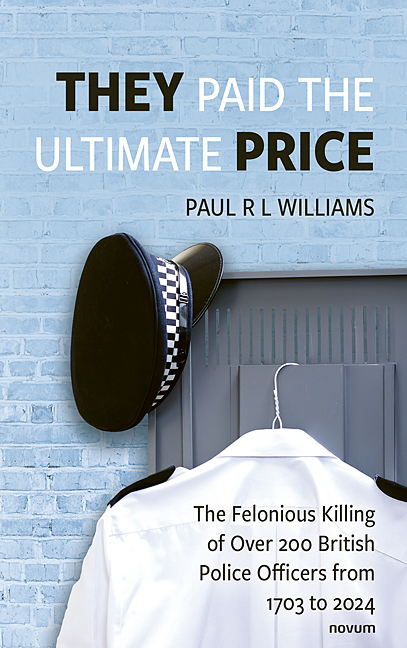
They Paid the Ultimate Price
The Felonious Killing of Over 200 British Police Officers from 1703 to 2024
USD 28,99
Format: 13.5 x 21.5 cm
Number of Pages: 340
ISBN: 978-3-7116-1366-0
Release Date: 06.02.2026
A tribute to officers killed on duty, this book lists over 200 British police murders since 1703. Compiled by a former member of the Metropolitan Police, it’s a sobering, meticulously researched record of courage, sacrifice, and the cost of keeping the peace.
They Paid the Ultimate Price
Constable Cooper
Mayfair, London
May 1703
Today’s fashionable residential area of Mayfair in London’s City of Westminster is a far cry from what it was in the 1700s. Its name is derived from the May Fair that was held annually from the sixteenth century up until 1809. The Fair was an event of merry-making which naturally led to drinking and debauchery. It was also an event much frequented by thieves and prostitutes.
The May Fair gained such a bad reputation that Queen Anne issued her proclamation for the clearing up of this and similar ports of London. It was here in 1703 that the first recorded murder of a police or ‘peace’ officer took place.
Constable Cooper and some of his colleagues had been instructed by the Justices to suppress the event. As they made their way to the scene about thirty men stood defiantly ahead of them. The officers tried in vain to restore law and order but the fighting was getting out of hand and soon bricks and stones were being hurled at them. Some of the officers were injured and in the skirmish that followed Constable Cooper was stabbed in the stomach with a sword by a man named Thomas Cook. The Constable died from his wounds four days later.
Thomas Cook, a prize-fighter, managed to escape from the scene and fled to Ireland. Cook had started his working life as an apprentice butcher in London. He never liked the job and after a couple of years ran away. He then worked for a gentleman named Needham who was Page of Honour to King William III. Cook’s mother wanted him to return to Gloucester to his father’s shop and resume his career as a butcher, which he did, remaining for some time. He next turned his hand to running an inn but again found it a career he did not like. He became a grazier (a feeder of cattle for the market) but history soon repeated itself and he moved to London to be a prize-fighter.
If Cook had not boasted of his crime whilst in Ireland he might have got away with the Constable’s murder. However, his bragging was overheard in a public house and several heard how he had killed the officer at the May Fair. He was arrested and taken into custody at Chester from where he was transferred by writ of habeas corpus to London. Tried at the Old Bailey, he was convicted of murder and sentenced to death. On 21 July 1703, Cook was taken from Newgate Prison to the Tyburn. On the journey there, however, at High Holborn, a reprieve arrived for him until the following Friday so he was returned to Newgate. A further reprieve was delivered the following Friday but, on 11 August 1703, justice was done and Thomas Cook was executed at Tyburn.
***
Constable George Linnel
Northampton
1789
Mr Gordon, a surgeon and apothecary, decided to move his business and family from London to the Parish of Pattishall in Northamptonshire. Although successful at his work he was frowned upon and resented by his neighbours, mainly because he was still regarded as a foreigner and not a native of those parts. He often found himself involved in quarrels, and soon a Justice’s warrant was taken out on him on a framed charge of assault. When Constable Linnel went to Mr Gordon’s home to arrest him, the door was opened by Mrs Gordon and her son Thomas. Mrs Gordon told the officer her husband was not at home and this the son confirmed. The Constable didn’t believe them but decided to retire from the scene and seek assistance. He returned soon afterwards with some neighbours and tried a forced entry. Their way was barred by Mrs Gordon and Thomas, who had now armed himself with a gun.
When the crowd, which had now gathered to witness the arrest, started to throw stones at the windows, Mrs Gordon shouted to her son to fire, which he did, immediately killing the Constable. Mrs Gordon and son Thomas were then apprehended by the crowd. They were both later tried and found guilty of the Constable’s murder. Baron Thompson, however, who had presided on the bench, noticed that the mother had been indicted as accessory before the fact. With the evidence turning out that she was the principal, he had doubts as to whether Mrs Gordon had been correctly convicted and decided to reserve the case for the opinion of the twelve Judges who, after great debate, confirmed the son’s sentence but judged the indictment against the mother wrong. Mrs Gordon was released but Thomas was sentenced to death.
Thomas Gordon was to be reprieved three times, and popular opinion was that his pardon would not be long in coming. It never came and on 17 August 1789 he was hanged at Northampton.
***
Constable David Price
Bow Street, London
1795
The routes into and out of London were frequent haunts for highwaymen seeking rich pickings from travellers. One such highwayman was Lewis Jeremiah Abershaw, known also as Jerry Avershaw. Born in Kingston upon Thames, Surrey, Abershaw, originally a postillion, became a highwayman at the age of seventeen. His hunting ground was around the area of Putney Heath and Wimbledon Common. An informer ‘shopped’ Abershaw to the Authorities and told them he could be found at the Three Brewers Public House in Southwark.
When Constables David Price and Bernard Turner, both Bow Street Runners, entered the inn, Abershaw drew his pistol and fired as they advanced towards him. Price died straight away; Turner received a bullet to the head but was not fatally injured.
Abershaw was caught soon after the incident and stood trial in Croydon on 30 July 1795. Turner had recovered sufficiently from his wound to give evidence against Abershaw. Unfortunately there was a flaw in the murder indictment and the charge was declared invalid. Nevertheless Abershaw was sentenced to death for the attempted murder of Constable Turner. When the Judge, Mr Baron Perryn, had donned his black cap to pass the sentence of death, Abershaw mimicked him by putting on his own hat. Back in his cell he painted scenes on the walls of some of his robberies.
Abershaw, just twenty-two years of age, was hanged at Kennington Common on Monday, 3 August 1795 together with another murderer, John Little. At his execution he held a flower between his teeth and kicked off his boots, apparently wishing to disprove his mother’s prophecy that he would die with them on. He acted the fool from the time of his imprisonment right up to his execution, and appeared totally unrepentant. His body was put on a gibbet at Putney Common. Such was his reputation that thousands came to view his body and it was necessary for a Bow Street Runner to guard the body overnight.
***
Master Lumper Gabriel Franks
Marine Police, Wapping, London
16 October 1798
Whilst highwaymen and footpads were causing a threat to travellers’ safety on the roads, looting abounded on the River Thames. As soon as barges and sailing ships tied up alongside London’s wharves, most of their crews started to systematically pilfer the goods as they were lowered from the boats onto the quay. Silks, tobacco, and coal, all disappeared en-route to their rightful owners.
In 1798, Dr Patrick Colquhoun, a Magistrate at Queen’s Square, Westminster, with the assistance of John Harriott J.P., submitted a plan to the Government for the formation of a body of men to bring these law-breakers to justice and law and order back on the River. These plans for a Marine Police Force were accepted and on 2 July 1798 the first Thames Police Office was opened at Wapping, with Dr Colquhoun as a non-stipendiary Superintending Magistrate and Harriott as a Resident Magistrate.
These police were made up of a Superintending Surveyor, Surveyors or Inspectors, whip and quay guards and watermen or Constables. The Press was informed of its existence and notices were placed along the wharves. Crime had for so long been a part of life on the Thames that the public regarded the new Marine Police Force as an intrusion into their liberties.
The first struggle between the Marine Police and the public occurred during the afternoon of its first day in existence. Some labourers were seen carrying sacks of coal ashore from one of the ships. The Marine Police told them to take them back or face the consequences. The labourers pointed out it was their ‘right’ to carry as much coal ashore as they could. It was, they said, a prerequisite of their job. Harriott was adamant however and a fight ensued resulting in several of the coal humpers being dealt with later by the magistrate in the new Police Office. These soon made their feelings known to their friends, and for some time there were many skirmishes between police and crews.
There is little doubt that appalling poverty and bad housing conditions were the reason for many of these River thefts. The two magistrates dealt with many cases each day and crime decreased drastically during the initial weeks of the Marine Police Force. But hatred for them reached a peak on 16 October 1798. At about 8.30p.m. a crowd of several hundred many of them drunk and armed with sticks descended on the courtroom. Hurriedly the magistrates and about six police officers barred the windows and doors. Unable to gain access, the mob threw stones and pulled up the pavement stones, which they also threw at the shuttered windows. It was an ugly scene and the officers inside knew that if the mob were to gain entry, it would be the end of them.
Harriott gave instructions for the police firearms to be loaded and ordered the officers to fire on the crowd. It was only when one of the ringleaders, a coal heaver, was shot dead that the mob retreated away from the Office. Colquhoun then opened the door and he and his officers moved into the street where he read the Riot Act. The crowd responded by shooting one of the officers, wounding him in the palm of his hand. Another officer, who was nearer to the rioters then ran back to his colleagues saying he had been shot. He was Gabriel Franks, a Master Lumper, recruited to deal with organising the labour. Although not technically a police officer, he had stood by his colleagues when under attack. Taken to hospital he died soon afterwards.
Several shots from the police forced the crowd to disperse and, with the aid of the Wapping and Union Volunteer Corps, peace returned to the neighbourhood. It was reported that had it not been for the intervention of the Volunteers the outcome might have been quite different.
A reward of £100 was offered by the London Gazette but the officer’s murderer was never discovered. However, one of the ringleaders, James Eyers, was deemed to have been one of those who instigated the riot, and therefore responsible for Frank’s death. He was executed, whilst others were sentenced to terms of hard labour or transportation.
***
Parish Constable Henry Trigg
Berden, Essex
25 March 1814
Henry Trigg was, by trade, a shoemaker. He lived next to Berden Hall. At night he slept on the ground floor of his shop whilst his elderly parents slept upstairs. He was also given the job of being a Parish Constable, a non-fulltime job but, when required, would have had to go on duty.
Just before midnight of 25 March, Trigg thought he could hear someone rummaging around in his shop. Notifying his parents, he and his father then went down into the shop where they found two men. Trigg tackled the smaller of the two men hitting him with his staff. The other man then attacked the father, firing a gun. The bullet missed but caused the Trigg to move back. This gave enough time for the smaller man to get to his feet. At the same time the second man fired another shot. This time the bullet found its mark, going into the Constable’s heart. He died immediately.
The two men were Thomas Turner and William Pratt, both from Stortford. Whilst visiting the village they had noticed the large amount of leather in Trigg’s shop. Both pleaded guilty to the Hertford magistrate. Both tried to blame the other for the Constable’s murder. They were hanged for their crime.
It was difficult to decide whether Trigg had acted as a Constable or was simply protecting his own property. The fact that he used his staff suggests that he did put himself on duty.
Parish Constable Trigg was buried in Berden Churchyard.
***
Runner Smithers
Bow Street Runners, London
23 February 1820
In the early 1800’s, many people in the lower classes of Britain were experiencing extreme poverty and hunger, despite the Industrial Revolution which was starting to put the country on its feet. It was natural, therefore, that most of the opposition to the Government would come from this area.
Arthur Thistlewood came from a lower class background and set himself the task in life of bringing down the Government. In February 1820 he decided on a way to achieve his aim and form a new Government with himself as its head. Thistlewood’s determination was such that he had already previously been charged with High Treason, had stood trial, but been acquitted.
Thistlewood discovered that, on 23 February 1820, the entire Cabinet had been invited to dinner with Lord Harrowby at his home in Grosvenor Square, London. This was his theme, therefore, for him to kill them all in one go. His plan was that, during the dinner, one of his trusty accomplices would deliver a parcel to the main door of Lord Harrowby’s home. As soon as the door opened his gang would burst in, make their way to the dining room and murder them all. If that was not bad enough in itself, Thistlewood had also given them a bag in which to put the heads of Lord Casterleigh and Lord Sidmouth.
Had it not been for a man named Edwards informing on the gang, Thistlewood might well have succeeded with his plan. Possibly it was the horrendous outcry that such action would have brought that made Edwards tell the Bow Street Runners, London’s forerunner to the present Metropolitan Police. Immediately Sir Richard Binnie, the magistrate, together with the Bow Street Patrol and some Guards, went to Cato Street where it was known the conspirators were meeting prior to their attack. As the Guards broke down the main doors the Runners gained entry to a hayloft above a disused stable, via a narrow trap door. Runner Rutheven was the first to reach the loft, followed immediately by Runner Smithers. Smithers rushed forward to arrest Thistlewood but, as he did so, the latter drew his sword and plunged it into Smithers’ chest. Smithers fell to his knees clutching his wound and was dead within seconds.
As more Guards arrived on the scene, Thistlewood ordered his colleagues to dowse the lights. In the darkness the Runners and conspirators clashed. Nine of the gang were arrested, but Thistlewood, Edwards and several others managed to escape.
The following day Edwards was able to tell the Runners that Thistlewood was at No. 8, White Street, Moorsfield. A large group of Runners went to the address where he was arrested without too much of a struggle and imprisoned in the Tower of London.
On Monday, 17 April 1820, he was found guilty of High Treason and to murdering Runner Smithers. He and four of his fellow conspirators were executed at the Old Bailey on Monday, 1 May 1820.
***
Parish Constable James Grange
Shenley, Hertfordshire
31 December 1823
Dr Connelly had been in a successful Brighton practice but had left after being sued for defamation by a Mr Andrews and ordered by the court to pay substantial damages. As a result he left the area and moved into Rabley House near South Mimms in the parish of Ridge.
Damages being unpaid, a London attorney by the name of Stephens, accompanied by Thomas Watson, a Sheriff’s officer, and his assistant, Mr Dignam, tried to enter Rabley House to serve a summons on Mr Connelly for failing to pay the £500 compensation. On gaining entry, Watson was immediately wounded by Connolly with a pitchfork.
The officers immediately withdrew, and Stephens went to the local magistrate to obtain a warrant for Connolly’s arrest on the charge of assault. Constables Thomas Lock and Parish Constable James Grange were detached to serve the warrant.
By now Connolly had instructed his servant, Hugh Moran, to borrow a gun and some powder from neighbours, and when Grange tried to gain entry to the house to serve the warrant, Connelly shot him in the arm. Prior to the shooting it was alleged that Connolly had said, “If you attempt to take me, by Heaven, I will shoot you”. Grange had replied, “If you will not open I must break the door down.” Connolly’s reply was, “By Heaven, if you do I will shoot you dead.”
Grange died the following day due to loss of blood after the arm needed to be amputated.
Connolly and Moran were promptly arrested. The inquest was held three days later on 3 January 1824 in the White Horse Public House. Information was heard of the attempts to save Grange and one witness, an Edward Tinsley, spoke of a second shot being fired at a man named Waiston after Grange had been wounded.
Connolly and Moran were charged with murder, and at the Hertfordshire Assizes Mr Justice Best reminded the Grand Jury of the charges and further charges of Manslaughter against Connolly and Moran, which were the ones to be proved. The jury later pronounced both guilty of manslaughter.
Connolly was to be transported for life and Moran was sentenced to six months in the House of Correction, with hard labour. Connolly appealed to the King that transportation was too harsh for a manslaughter charge. This was rejected and Connolly was transported to Van Diemen’s Land on 29 March 1824 on board the ‘Phoenix’. He died thirty years later aged seventy.
Grange was buried in St Botolph’s Church, Shenley. He was aged forty-four and left a wife and four infant children. A collection raised £340 for the widow and orphans, as well as £333 from the magistrates.
***
Constable Joseph Grantham
Metropolitan Police, London
29 June 1830
The success of the Bow Street Runners led to the formation of today’s Metropolitan Police on 29 September 1829. The Police Bill, brought in by Sir Robert Peel, the Home Secretary, gave London a proper police force controlled by the Government and run from a central office at Scotland Yard in Whitehall Place.
There was great public resentment to this new Police force, which probably accounts for why the next three police murders occurred in London. The first was on 29 June 1830. Records are sparse but it would appear that PC Joseph Grantham had been posted to patrol in Somers Town.
Records do not show what time of the day it was when the murder took place, but it is probably safe to assume it was late evening or night time. The officer had seen two very drunken Irish men quarrelling over a woman. Whether the woman was a prostitute or not, we do not know, although, it is probably again safe to assume so. We do know however that Grantham would have been trained to look after himself when dealing with drunks and, prostitutes or not, she still had to be protected. The officer was obviously unprepared for the reaction of all three as he approached them. Not only did the two men knock him to the ground and kick him, but the woman, whom he had gone to protect, joined in as well. Repeatedly kicked about the head and body, PC Grantham died shortly afterwards.
His three assailants were never caught. Public feeling at the time was reflected in the coroner’s verdict that suggested PC Grantham had ‘over exerted himself in discharging his duty’ and his death was therefore recorded as ‘justifiable homicide’.
...
Constable Cooper
Mayfair, London
May 1703
Today’s fashionable residential area of Mayfair in London’s City of Westminster is a far cry from what it was in the 1700s. Its name is derived from the May Fair that was held annually from the sixteenth century up until 1809. The Fair was an event of merry-making which naturally led to drinking and debauchery. It was also an event much frequented by thieves and prostitutes.
The May Fair gained such a bad reputation that Queen Anne issued her proclamation for the clearing up of this and similar ports of London. It was here in 1703 that the first recorded murder of a police or ‘peace’ officer took place.
Constable Cooper and some of his colleagues had been instructed by the Justices to suppress the event. As they made their way to the scene about thirty men stood defiantly ahead of them. The officers tried in vain to restore law and order but the fighting was getting out of hand and soon bricks and stones were being hurled at them. Some of the officers were injured and in the skirmish that followed Constable Cooper was stabbed in the stomach with a sword by a man named Thomas Cook. The Constable died from his wounds four days later.
Thomas Cook, a prize-fighter, managed to escape from the scene and fled to Ireland. Cook had started his working life as an apprentice butcher in London. He never liked the job and after a couple of years ran away. He then worked for a gentleman named Needham who was Page of Honour to King William III. Cook’s mother wanted him to return to Gloucester to his father’s shop and resume his career as a butcher, which he did, remaining for some time. He next turned his hand to running an inn but again found it a career he did not like. He became a grazier (a feeder of cattle for the market) but history soon repeated itself and he moved to London to be a prize-fighter.
If Cook had not boasted of his crime whilst in Ireland he might have got away with the Constable’s murder. However, his bragging was overheard in a public house and several heard how he had killed the officer at the May Fair. He was arrested and taken into custody at Chester from where he was transferred by writ of habeas corpus to London. Tried at the Old Bailey, he was convicted of murder and sentenced to death. On 21 July 1703, Cook was taken from Newgate Prison to the Tyburn. On the journey there, however, at High Holborn, a reprieve arrived for him until the following Friday so he was returned to Newgate. A further reprieve was delivered the following Friday but, on 11 August 1703, justice was done and Thomas Cook was executed at Tyburn.
***
Constable George Linnel
Northampton
1789
Mr Gordon, a surgeon and apothecary, decided to move his business and family from London to the Parish of Pattishall in Northamptonshire. Although successful at his work he was frowned upon and resented by his neighbours, mainly because he was still regarded as a foreigner and not a native of those parts. He often found himself involved in quarrels, and soon a Justice’s warrant was taken out on him on a framed charge of assault. When Constable Linnel went to Mr Gordon’s home to arrest him, the door was opened by Mrs Gordon and her son Thomas. Mrs Gordon told the officer her husband was not at home and this the son confirmed. The Constable didn’t believe them but decided to retire from the scene and seek assistance. He returned soon afterwards with some neighbours and tried a forced entry. Their way was barred by Mrs Gordon and Thomas, who had now armed himself with a gun.
When the crowd, which had now gathered to witness the arrest, started to throw stones at the windows, Mrs Gordon shouted to her son to fire, which he did, immediately killing the Constable. Mrs Gordon and son Thomas were then apprehended by the crowd. They were both later tried and found guilty of the Constable’s murder. Baron Thompson, however, who had presided on the bench, noticed that the mother had been indicted as accessory before the fact. With the evidence turning out that she was the principal, he had doubts as to whether Mrs Gordon had been correctly convicted and decided to reserve the case for the opinion of the twelve Judges who, after great debate, confirmed the son’s sentence but judged the indictment against the mother wrong. Mrs Gordon was released but Thomas was sentenced to death.
Thomas Gordon was to be reprieved three times, and popular opinion was that his pardon would not be long in coming. It never came and on 17 August 1789 he was hanged at Northampton.
***
Constable David Price
Bow Street, London
1795
The routes into and out of London were frequent haunts for highwaymen seeking rich pickings from travellers. One such highwayman was Lewis Jeremiah Abershaw, known also as Jerry Avershaw. Born in Kingston upon Thames, Surrey, Abershaw, originally a postillion, became a highwayman at the age of seventeen. His hunting ground was around the area of Putney Heath and Wimbledon Common. An informer ‘shopped’ Abershaw to the Authorities and told them he could be found at the Three Brewers Public House in Southwark.
When Constables David Price and Bernard Turner, both Bow Street Runners, entered the inn, Abershaw drew his pistol and fired as they advanced towards him. Price died straight away; Turner received a bullet to the head but was not fatally injured.
Abershaw was caught soon after the incident and stood trial in Croydon on 30 July 1795. Turner had recovered sufficiently from his wound to give evidence against Abershaw. Unfortunately there was a flaw in the murder indictment and the charge was declared invalid. Nevertheless Abershaw was sentenced to death for the attempted murder of Constable Turner. When the Judge, Mr Baron Perryn, had donned his black cap to pass the sentence of death, Abershaw mimicked him by putting on his own hat. Back in his cell he painted scenes on the walls of some of his robberies.
Abershaw, just twenty-two years of age, was hanged at Kennington Common on Monday, 3 August 1795 together with another murderer, John Little. At his execution he held a flower between his teeth and kicked off his boots, apparently wishing to disprove his mother’s prophecy that he would die with them on. He acted the fool from the time of his imprisonment right up to his execution, and appeared totally unrepentant. His body was put on a gibbet at Putney Common. Such was his reputation that thousands came to view his body and it was necessary for a Bow Street Runner to guard the body overnight.
***
Master Lumper Gabriel Franks
Marine Police, Wapping, London
16 October 1798
Whilst highwaymen and footpads were causing a threat to travellers’ safety on the roads, looting abounded on the River Thames. As soon as barges and sailing ships tied up alongside London’s wharves, most of their crews started to systematically pilfer the goods as they were lowered from the boats onto the quay. Silks, tobacco, and coal, all disappeared en-route to their rightful owners.
In 1798, Dr Patrick Colquhoun, a Magistrate at Queen’s Square, Westminster, with the assistance of John Harriott J.P., submitted a plan to the Government for the formation of a body of men to bring these law-breakers to justice and law and order back on the River. These plans for a Marine Police Force were accepted and on 2 July 1798 the first Thames Police Office was opened at Wapping, with Dr Colquhoun as a non-stipendiary Superintending Magistrate and Harriott as a Resident Magistrate.
These police were made up of a Superintending Surveyor, Surveyors or Inspectors, whip and quay guards and watermen or Constables. The Press was informed of its existence and notices were placed along the wharves. Crime had for so long been a part of life on the Thames that the public regarded the new Marine Police Force as an intrusion into their liberties.
The first struggle between the Marine Police and the public occurred during the afternoon of its first day in existence. Some labourers were seen carrying sacks of coal ashore from one of the ships. The Marine Police told them to take them back or face the consequences. The labourers pointed out it was their ‘right’ to carry as much coal ashore as they could. It was, they said, a prerequisite of their job. Harriott was adamant however and a fight ensued resulting in several of the coal humpers being dealt with later by the magistrate in the new Police Office. These soon made their feelings known to their friends, and for some time there were many skirmishes between police and crews.
There is little doubt that appalling poverty and bad housing conditions were the reason for many of these River thefts. The two magistrates dealt with many cases each day and crime decreased drastically during the initial weeks of the Marine Police Force. But hatred for them reached a peak on 16 October 1798. At about 8.30p.m. a crowd of several hundred many of them drunk and armed with sticks descended on the courtroom. Hurriedly the magistrates and about six police officers barred the windows and doors. Unable to gain access, the mob threw stones and pulled up the pavement stones, which they also threw at the shuttered windows. It was an ugly scene and the officers inside knew that if the mob were to gain entry, it would be the end of them.
Harriott gave instructions for the police firearms to be loaded and ordered the officers to fire on the crowd. It was only when one of the ringleaders, a coal heaver, was shot dead that the mob retreated away from the Office. Colquhoun then opened the door and he and his officers moved into the street where he read the Riot Act. The crowd responded by shooting one of the officers, wounding him in the palm of his hand. Another officer, who was nearer to the rioters then ran back to his colleagues saying he had been shot. He was Gabriel Franks, a Master Lumper, recruited to deal with organising the labour. Although not technically a police officer, he had stood by his colleagues when under attack. Taken to hospital he died soon afterwards.
Several shots from the police forced the crowd to disperse and, with the aid of the Wapping and Union Volunteer Corps, peace returned to the neighbourhood. It was reported that had it not been for the intervention of the Volunteers the outcome might have been quite different.
A reward of £100 was offered by the London Gazette but the officer’s murderer was never discovered. However, one of the ringleaders, James Eyers, was deemed to have been one of those who instigated the riot, and therefore responsible for Frank’s death. He was executed, whilst others were sentenced to terms of hard labour or transportation.
***
Parish Constable Henry Trigg
Berden, Essex
25 March 1814
Henry Trigg was, by trade, a shoemaker. He lived next to Berden Hall. At night he slept on the ground floor of his shop whilst his elderly parents slept upstairs. He was also given the job of being a Parish Constable, a non-fulltime job but, when required, would have had to go on duty.
Just before midnight of 25 March, Trigg thought he could hear someone rummaging around in his shop. Notifying his parents, he and his father then went down into the shop where they found two men. Trigg tackled the smaller of the two men hitting him with his staff. The other man then attacked the father, firing a gun. The bullet missed but caused the Trigg to move back. This gave enough time for the smaller man to get to his feet. At the same time the second man fired another shot. This time the bullet found its mark, going into the Constable’s heart. He died immediately.
The two men were Thomas Turner and William Pratt, both from Stortford. Whilst visiting the village they had noticed the large amount of leather in Trigg’s shop. Both pleaded guilty to the Hertford magistrate. Both tried to blame the other for the Constable’s murder. They were hanged for their crime.
It was difficult to decide whether Trigg had acted as a Constable or was simply protecting his own property. The fact that he used his staff suggests that he did put himself on duty.
Parish Constable Trigg was buried in Berden Churchyard.
***
Runner Smithers
Bow Street Runners, London
23 February 1820
In the early 1800’s, many people in the lower classes of Britain were experiencing extreme poverty and hunger, despite the Industrial Revolution which was starting to put the country on its feet. It was natural, therefore, that most of the opposition to the Government would come from this area.
Arthur Thistlewood came from a lower class background and set himself the task in life of bringing down the Government. In February 1820 he decided on a way to achieve his aim and form a new Government with himself as its head. Thistlewood’s determination was such that he had already previously been charged with High Treason, had stood trial, but been acquitted.
Thistlewood discovered that, on 23 February 1820, the entire Cabinet had been invited to dinner with Lord Harrowby at his home in Grosvenor Square, London. This was his theme, therefore, for him to kill them all in one go. His plan was that, during the dinner, one of his trusty accomplices would deliver a parcel to the main door of Lord Harrowby’s home. As soon as the door opened his gang would burst in, make their way to the dining room and murder them all. If that was not bad enough in itself, Thistlewood had also given them a bag in which to put the heads of Lord Casterleigh and Lord Sidmouth.
Had it not been for a man named Edwards informing on the gang, Thistlewood might well have succeeded with his plan. Possibly it was the horrendous outcry that such action would have brought that made Edwards tell the Bow Street Runners, London’s forerunner to the present Metropolitan Police. Immediately Sir Richard Binnie, the magistrate, together with the Bow Street Patrol and some Guards, went to Cato Street where it was known the conspirators were meeting prior to their attack. As the Guards broke down the main doors the Runners gained entry to a hayloft above a disused stable, via a narrow trap door. Runner Rutheven was the first to reach the loft, followed immediately by Runner Smithers. Smithers rushed forward to arrest Thistlewood but, as he did so, the latter drew his sword and plunged it into Smithers’ chest. Smithers fell to his knees clutching his wound and was dead within seconds.
As more Guards arrived on the scene, Thistlewood ordered his colleagues to dowse the lights. In the darkness the Runners and conspirators clashed. Nine of the gang were arrested, but Thistlewood, Edwards and several others managed to escape.
The following day Edwards was able to tell the Runners that Thistlewood was at No. 8, White Street, Moorsfield. A large group of Runners went to the address where he was arrested without too much of a struggle and imprisoned in the Tower of London.
On Monday, 17 April 1820, he was found guilty of High Treason and to murdering Runner Smithers. He and four of his fellow conspirators were executed at the Old Bailey on Monday, 1 May 1820.
***
Parish Constable James Grange
Shenley, Hertfordshire
31 December 1823
Dr Connelly had been in a successful Brighton practice but had left after being sued for defamation by a Mr Andrews and ordered by the court to pay substantial damages. As a result he left the area and moved into Rabley House near South Mimms in the parish of Ridge.
Damages being unpaid, a London attorney by the name of Stephens, accompanied by Thomas Watson, a Sheriff’s officer, and his assistant, Mr Dignam, tried to enter Rabley House to serve a summons on Mr Connelly for failing to pay the £500 compensation. On gaining entry, Watson was immediately wounded by Connolly with a pitchfork.
The officers immediately withdrew, and Stephens went to the local magistrate to obtain a warrant for Connolly’s arrest on the charge of assault. Constables Thomas Lock and Parish Constable James Grange were detached to serve the warrant.
By now Connolly had instructed his servant, Hugh Moran, to borrow a gun and some powder from neighbours, and when Grange tried to gain entry to the house to serve the warrant, Connelly shot him in the arm. Prior to the shooting it was alleged that Connolly had said, “If you attempt to take me, by Heaven, I will shoot you”. Grange had replied, “If you will not open I must break the door down.” Connolly’s reply was, “By Heaven, if you do I will shoot you dead.”
Grange died the following day due to loss of blood after the arm needed to be amputated.
Connolly and Moran were promptly arrested. The inquest was held three days later on 3 January 1824 in the White Horse Public House. Information was heard of the attempts to save Grange and one witness, an Edward Tinsley, spoke of a second shot being fired at a man named Waiston after Grange had been wounded.
Connolly and Moran were charged with murder, and at the Hertfordshire Assizes Mr Justice Best reminded the Grand Jury of the charges and further charges of Manslaughter against Connolly and Moran, which were the ones to be proved. The jury later pronounced both guilty of manslaughter.
Connolly was to be transported for life and Moran was sentenced to six months in the House of Correction, with hard labour. Connolly appealed to the King that transportation was too harsh for a manslaughter charge. This was rejected and Connolly was transported to Van Diemen’s Land on 29 March 1824 on board the ‘Phoenix’. He died thirty years later aged seventy.
Grange was buried in St Botolph’s Church, Shenley. He was aged forty-four and left a wife and four infant children. A collection raised £340 for the widow and orphans, as well as £333 from the magistrates.
***
Constable Joseph Grantham
Metropolitan Police, London
29 June 1830
The success of the Bow Street Runners led to the formation of today’s Metropolitan Police on 29 September 1829. The Police Bill, brought in by Sir Robert Peel, the Home Secretary, gave London a proper police force controlled by the Government and run from a central office at Scotland Yard in Whitehall Place.
There was great public resentment to this new Police force, which probably accounts for why the next three police murders occurred in London. The first was on 29 June 1830. Records are sparse but it would appear that PC Joseph Grantham had been posted to patrol in Somers Town.
Records do not show what time of the day it was when the murder took place, but it is probably safe to assume it was late evening or night time. The officer had seen two very drunken Irish men quarrelling over a woman. Whether the woman was a prostitute or not, we do not know, although, it is probably again safe to assume so. We do know however that Grantham would have been trained to look after himself when dealing with drunks and, prostitutes or not, she still had to be protected. The officer was obviously unprepared for the reaction of all three as he approached them. Not only did the two men knock him to the ground and kick him, but the woman, whom he had gone to protect, joined in as well. Repeatedly kicked about the head and body, PC Grantham died shortly afterwards.
His three assailants were never caught. Public feeling at the time was reflected in the coroner’s verdict that suggested PC Grantham had ‘over exerted himself in discharging his duty’ and his death was therefore recorded as ‘justifiable homicide’.
...
You might like this too :