
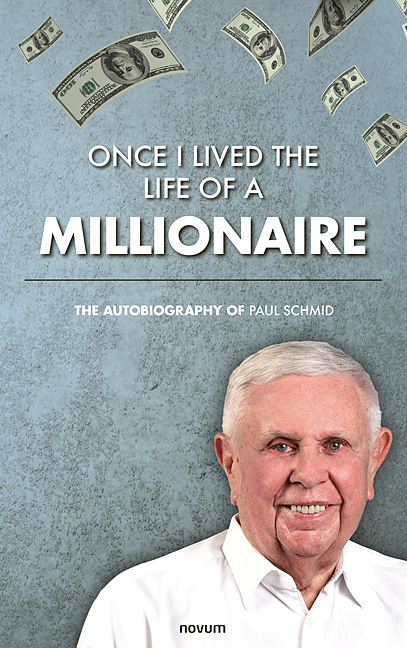
Once I lived the life of a millionaire
The autobiography of Paul Schmid
USD 36,99
Format: 13.5 21.5 cm
Number of Pages: 252
ISBN: 978-3-99130-729-7
Release Date: 18.02.2025
Being an entrepreneur always involves dizzying heights and the darkest lows. The difference between them is a narrow one. Paul Schmid shows us just how narrow in his autobiography, "Once I lived the life of a millionaire."
My mother, Berta Schmid-Bürgi, grew up with her two older brothers Karl and Paul in Gachnang, Switzerland. “Berteli” Bürgi was a cheerful girl, well known to everyone in the small farming village.
Her parents’ house, located at what was once the exit from the village, still stands to this day. The former country road led right past the house and immediately afterwards up the mountain via Oberwil to Frauenfeld. If you take the path by foot, you’ll get to Frauenfeld in just under an hour. A classic farmer’s garden adorned the old half-timber construction, and behind it, the view opened out onto a magnificent garden of over seventy high-trunk fruit trees. In the barn were fifteen cows and a few oxen. Her father, Karl Bürgi, traded the oxen in addition to his business in fruit and dairy products. He bought the young animals, taught them to work, and sold them on for a small profit.
The water of the well rippled day and night beneath the window of Berteli’s small room, and the same pairs of swallows would nestle in the room year after year.
Life on the farm was far from idyllic, though. Berteli’s mother passed away when she was just seven years old. One Anna-Maria Lampert, an attractive twenty-three-year-old, came all the way from Grisons to work on the farm as a maid, bringing two illegitimate children with her. The widower soon married the maid, twenty-eight years younger than him, and the number of children on the farm grew from five to seven.
Berteli loved going to school; she found learning easy. Ninety children were taught in one schoolroom by a single teacher. The older, stronger students had to help teach their younger classmates to read, count, and write. Berteli’s academic achievements were easily sufficient to go onto secondary school, but her father refused to let her. He seemed to value her help on the farm more. Berteli never forgave him for this harsh decision.
She was only seventeen years old when her father died of pneumonia. Her older brother Paul took up the mantle of head of the family after being appointed as guardian to Berteli, even though she was just four years his junior.
The enterprising stepmother and widow Anna-Maria, only thirty-four years old, did not find it difficult to find a new pair of hands to man the farm. The new marriage soon produced two more children, breathing more life into the beautiful half-timber building.
Berti told herself: “Why ask lots of questions about money and property if I’m happy?” (Johannes Martin Müller, 1750–1814). She left all the household effects bequeathed to her by her brother Paul to the farm’s numerous residents and set up her own family at the age of twenty-one, far away from her parents’ old home. The scene: The grand St. Ursen Cathedral in Solothurn. The only souls present were the bridal couple, their witnesses, and the pastor.
The lucky man she chose was named Konrad Schmid. He spent his early youth with very old parents and in poverty. He was reluctant to look back on his youth as an indentured child, but he was delighted to talk about the first job he chose for himself, electrifying railway lines as a trained overhead line technician. He’d proudly ride his BSA to work in 1925, stopping off on the way home at the stocking collection points that his young wife had set up to earn a little money toward the household’s budget by repairing stockings.
In 1932, my father moved to Zurich’s state electricity plant—the EKZ—in the district of Winterthur as an overhead line mechanic. In the Great Depression and subsequent war years, young men absent due to military service found their professional development stunted, especially those who were at the start of their working lives and the bottom of the career ladder. In the economic upturn after the war ended, the EKZ entrusted more demanding tasks to my father, which was reflected in the fact that his salary was no longer a worker’s but an employee’s, and it rose steadily albeit slowly. The couple used these funds to fulfill their greatest dream, which was to give their two sons a better start in life with a good education.
***
My brother Konrad was born on March 2, 1931, a good two years before me. He was my parents’ favorite, especially whenever we brought home our school reports. His last elementary-school report, top grades all around, included just one five-and-a-half out of six.
Konrad combined his many talents and outstanding intelligence with great ambition, which ensured they didn’t go unexploited. He learned to play the piano from a teacher of classical music, and later a well-known entertainment and jazz pianist in Zurich taught him “underground music”. After two years of grammar school, he switched to a vocational high school, where he and some of his classmates founded the Eleonora Jazz Society. The name was not inspired by a pretty singer, but by the street where a popular community jazz cellar was located. He bought one of the first Revox tape recorders to record his music, a Dynavox with two heads and two motors. After studying the device, Konrad built an even better one with three heads and three motors. He also added an amplifier and other electronic devices for personal use. Konrad devoured technical literature as avidly as other boys gobbled up detective stories. This curiosity for all kinds of advances in technology remained unabated for the rest of his life.
With a diploma as an electrical engineer from the Federal Institute of Technology in his pocket, Konrad took up his first job at the RCA laboratory on Hardturmstrasse in Zurich in January 1957. To introduce him to his role, Konrad spent several months in the RCA’s famous laboratories in the U.S. This was when his admiration for Americans’ technical prowess in the field of electronics—as well as their gift of forming lasting friendships—began. In the evenings, he enjoyed the music of legendary pianists like Teddy Wilson in the jazz bars of New York.
Konrad then worked around Europe helping radio and television factories use RCA patents: he spent the incredible summer of 1960 in a factory by the sea just north of Stockholm. Assuming Sweden was always this nice, he left his parents’ apartment on his thirtieth birthday—a deadline that had been set for him a long time before—and drove his MG TF up to Gothenburg, where an assistant position was waiting for him at Chalmers University of Technology. His research was aimed at improving electronic medical devices.
He rented his first apartment in Gothenburg and used what little money he had left over to buy first a bed and second a grand piano. After a few years, Konrad was allowed to give his own lectures. To his students’ amazement, he would transfer his manuscripts to the blackboard in English while lecturing in Swedish. At the same time, he worked toward his doctorate in technical sciences at Chalmers University of Technology.
A concert by Hazy Osterwald thrilled Konrad so much that he invited the whole band—along with some pretty blonde Swedes—back to his place. He liked one of the blondes, Bodil Ericsson, so much in her traditional dress that on May 5, 1967, an unforgettable wedding party took place at her parents’ home on a rocky outcrop above the fjord.
Konrad and Bodil went on to spend more than two decades of their summer vacations in a seaside vacation home in Lysekil that belonged to Bodil’s parents. Konrad enjoyed sailing in the archipelago with Bodil’s many cousins, swimming in the cold sea, and hauling the net out of the sea at dawn to release fish, crabs, and even lobsters from their agony for that night’s dinner. If the catch was worthy of an exuberant celebration, he had no trouble keeping up. He loved to dance all night long, even though he was well aware that he would have to stand knee-deep in cold water for a while before going to bed to relieve the pain in his varicose veins.
***
On May 6, 1933, I, Paul Schmid, first saw the light of day—blessed by fate—born to parents who never put their marital bliss at risk, who loved their children above all else, demonstrated endless patience, and were always there for us when we needed them.
Even as a young boy, I liked to chase after my thoughts, preferred to be alone or at most one on one to organized group activities like scouting expeditions, avoided fights, absolutely abhorred gym class, had no idea what to do with a ball, and was probably considered something of a nerd by my peers. Instead of playing out in the street with them, I crept around the neighboring sheds and garage. The truck, a Saurer diesel, could turn up at any time, though in those years it ran on wood gas. My timely opening of the gate and other helping hands occasionally prompted the driver to invite me on short—and sometimes long—trips.
My parents realized early on that, after a first push with “Heidi” by Johanna Spyri, they need not give me a second children’s book, but a subscription to the Automobil Revue. The weekly magazine explained all the latest technology in great detail, putting me on a completely different level from my classmates—who only collected glossy brochures—when it came to talking about motor vehicles… I couldn’t even talk to them about cars.
Thanks to my father’s promotion, we now lived in an official apartment in a building belonging to the EKZ’s Winterthur District Directorate. Half a dozen cars by different manufacturers lined the forecourt. After school, I’d toss my backpack under the ramp and start tending to the cars pulling in. They not only required all manner of cleaning, but also, since they were pre-war models, frequently checking their coolant, oil, and air. Once my work was done, I’d carefully drive the cars into their bays. My father’s staff laughed when they found me with a pillow under my arm: it gave me the precision I needed to operate the steering wheel. I could pull off all the maneuvers required without ever causing even the slightest damage, though. The freedom that I enjoyed from the age of thirteen through fifteen also undoubtedly owed in part to the high esteem my father enjoyed among his co-workers.
Now, after this single highlight of my day, I would have to buckle down to my schoolwork and sit at the piano. What I tried to play did not enthuse my piano teacher, and I wasn’t so keen on what she had me practice either. I paid no attention to her notes in my music booklets; I could play all the pieces by heart thanks to my musical memory. After two years, my efforts came to an end. My brother Konrad displayed much more motivation at the piano too. It was through him that I discovered the marvelous music of American pianists—most of them Black—like Fats Waller, James P. Johnson, and Teddy Wilson. I’d practice the left hand—which forms the basis of the stride style—for hours and hours.
My receptivity knew hardly any limits for everything I was interested in; French and Latin were not among them. After a little over a year of grammar school, this led to a succinct conclusion in my report: “Sent back to first grade.” That wasn’t especially encouraging. So, after the summer vacation, I headed off to the public middle school. With no formalities, which still amazes me to this day, within a few minutes I was already in second grade, right in front of my former class tutor and Latin teacher’s pretty daughter. That gave me the certainty that, again without a single formality, I’d be struck from the grammar school attendance list in the afternoon.
In mid-July 1948 my father’s employer, the EKZ, asked him to take on an even more demanding task at the company’s headquarters as soon as possible. The move from an official residence in Winterthur to one in Zurich took less than three weeks. After the summer vacation, I again found myself in a new class, this time in the third grade of middle school in the Zurich neighborhood of Wiedikon, again without so much as a chance to say goodbye to my old classmates. I wasn’t particularly interested in my remaining time at middle school. I focused all my energy on getting my father to find me an apprenticeship as a mechanic. This hurt him a great deal because it had taken him years to grow out of his working-class roots. Finally, though, he made my wish come true.
In the spring of 1949, I started my apprenticeship in the Triemligarage under the tutelage of Emil Horber. It was six-day, fifty-four-hour week, and I earned five francs a week in the first year of apprenticeship, then ten francs in the second. The garage did not have its own salespeople. We repaired all brands of cars except VW, Mercedes, and Citroen, plus trucks and even tractors. My theoretical knowledge was beyond that of many trained mechanics, so I was allowed to work with relative freedom. I was particularly enthused to be able to carry out a small refurbishment of a CT1D engine in a Saurer diesel truck belonging to Hürlimann Brewery—I knew that the CT1D, which went into production in 1935, had proven to be groundbreaking in engine construction, thanks to promising innovations like direct injection, double-swirl chambers integrated into the pistons, four valves per cylinder, and wet bushings. After covering up the engine, I was able to admire the strong bolts with the tapered shaft modeled on the power line flow: top-notch mechanics!
In the very first year of my apprenticeship, I asked my father for a small loan to buy a Ford Anglia that was no longer roadworthy: the side-mounted camshaft had seized up. Back then, long-stroke engines weren’t up to great mileage, so once an engine had been removed, it made sense to completely refurbish it. My parents’ apartment had a vegetable cellar that was perfectly suited as a workshop. It never smelled of engine grease, just Grafensteiner, Berner Rose, and bell apples and pastor pears from my step-grandmother’s farm.
I used a shoot from all the potatoes—too many potatoes, if you asked me—for the only job that requires a certain level precision when putting together an engine: adjusting the camshaft. One wrong move and the almost one-liter, four-cylinder engine would not have reached its rated output, 24 hp at 4000 rpm and 4 mkg at 2300 rpm, and then the 1,650-pound vehicle would not have reached its maximum speed of 52 mph. At the time, Plymouth Savoy 19 CV could manage 75 mph at most, consuming double the amount of gas.
Friends helped me to get the body of the Anglia in shape too. It took several hands at the same time to put together a new headliner. These friends, all old classmates of my brother, graciously accepted me into their circle as a little outsider. They enjoyed coming to watch me at jam sessions while the jazz cellar was being expanded, but I was also made a member of the Eleonora Jazz Society, who had a vacancy for a slide trombonist. I loved the weekly jam sessions at the jazz cellar and our occasional performances in the student dorm, plus an appearance at the Federal Institute of Technology’s annual ball, the crowning moment of my musical career.
After a few excursions with my parents, I sold the Ford Anglia for a modest amount. I began to search for another car to fix, I came across a Citroën 11 Légère that jumped out of gear when driving downhill. The Citroën’s gearbox landed in the vegetable cellar just like the Anglia’s engine. To my great surprise, I had to build and borrow special tools beforehand to master its unconventional construction. I was very impressed by how the French engineers had broken away from orthodox constructions and taken a revolutionary new direction.
My day-to-day environment didn’t give me the same feeling. The vocational school expanded on middle-school students’ intellectual capabilities. At first I was simply bored, but in the end, I felt like I was in the wrong place. After two years, my parents allowed me to set a new course: I broke off my apprenticeship and enrolled at the Tschulok, a school to prepare for the high-school leaving certificate. My Citroën 11 Légère was running nicely and even looked good too. My mother sewed new upholstery covers to really put the cherry on top. It soon found a buyer, and the proceeds served to supplement my school fees, which were hefty for my parents. Friends kept entrusting me with their wheels for excursions as well as for all kinds of repair work, and my love for the legendary Citroën 11 stayed with me for a long time.
My road to school took me along Rämistrasse and past Café Morocco, which we called Marökkli. Musical philistines came here to search in vain for a Wurlitzer jukebox, but the waitress, Doris, was still in charge of choosing the LPs, from New Orleans jazz to swing. The regulars were mainly jazz fans. We’d often sit in a tight circle of ten or twelve around the small brass tables and listen to the newly bought records we’d recommended....
Her parents’ house, located at what was once the exit from the village, still stands to this day. The former country road led right past the house and immediately afterwards up the mountain via Oberwil to Frauenfeld. If you take the path by foot, you’ll get to Frauenfeld in just under an hour. A classic farmer’s garden adorned the old half-timber construction, and behind it, the view opened out onto a magnificent garden of over seventy high-trunk fruit trees. In the barn were fifteen cows and a few oxen. Her father, Karl Bürgi, traded the oxen in addition to his business in fruit and dairy products. He bought the young animals, taught them to work, and sold them on for a small profit.
The water of the well rippled day and night beneath the window of Berteli’s small room, and the same pairs of swallows would nestle in the room year after year.
Life on the farm was far from idyllic, though. Berteli’s mother passed away when she was just seven years old. One Anna-Maria Lampert, an attractive twenty-three-year-old, came all the way from Grisons to work on the farm as a maid, bringing two illegitimate children with her. The widower soon married the maid, twenty-eight years younger than him, and the number of children on the farm grew from five to seven.
Berteli loved going to school; she found learning easy. Ninety children were taught in one schoolroom by a single teacher. The older, stronger students had to help teach their younger classmates to read, count, and write. Berteli’s academic achievements were easily sufficient to go onto secondary school, but her father refused to let her. He seemed to value her help on the farm more. Berteli never forgave him for this harsh decision.
She was only seventeen years old when her father died of pneumonia. Her older brother Paul took up the mantle of head of the family after being appointed as guardian to Berteli, even though she was just four years his junior.
The enterprising stepmother and widow Anna-Maria, only thirty-four years old, did not find it difficult to find a new pair of hands to man the farm. The new marriage soon produced two more children, breathing more life into the beautiful half-timber building.
Berti told herself: “Why ask lots of questions about money and property if I’m happy?” (Johannes Martin Müller, 1750–1814). She left all the household effects bequeathed to her by her brother Paul to the farm’s numerous residents and set up her own family at the age of twenty-one, far away from her parents’ old home. The scene: The grand St. Ursen Cathedral in Solothurn. The only souls present were the bridal couple, their witnesses, and the pastor.
The lucky man she chose was named Konrad Schmid. He spent his early youth with very old parents and in poverty. He was reluctant to look back on his youth as an indentured child, but he was delighted to talk about the first job he chose for himself, electrifying railway lines as a trained overhead line technician. He’d proudly ride his BSA to work in 1925, stopping off on the way home at the stocking collection points that his young wife had set up to earn a little money toward the household’s budget by repairing stockings.
In 1932, my father moved to Zurich’s state electricity plant—the EKZ—in the district of Winterthur as an overhead line mechanic. In the Great Depression and subsequent war years, young men absent due to military service found their professional development stunted, especially those who were at the start of their working lives and the bottom of the career ladder. In the economic upturn after the war ended, the EKZ entrusted more demanding tasks to my father, which was reflected in the fact that his salary was no longer a worker’s but an employee’s, and it rose steadily albeit slowly. The couple used these funds to fulfill their greatest dream, which was to give their two sons a better start in life with a good education.
***
My brother Konrad was born on March 2, 1931, a good two years before me. He was my parents’ favorite, especially whenever we brought home our school reports. His last elementary-school report, top grades all around, included just one five-and-a-half out of six.
Konrad combined his many talents and outstanding intelligence with great ambition, which ensured they didn’t go unexploited. He learned to play the piano from a teacher of classical music, and later a well-known entertainment and jazz pianist in Zurich taught him “underground music”. After two years of grammar school, he switched to a vocational high school, where he and some of his classmates founded the Eleonora Jazz Society. The name was not inspired by a pretty singer, but by the street where a popular community jazz cellar was located. He bought one of the first Revox tape recorders to record his music, a Dynavox with two heads and two motors. After studying the device, Konrad built an even better one with three heads and three motors. He also added an amplifier and other electronic devices for personal use. Konrad devoured technical literature as avidly as other boys gobbled up detective stories. This curiosity for all kinds of advances in technology remained unabated for the rest of his life.
With a diploma as an electrical engineer from the Federal Institute of Technology in his pocket, Konrad took up his first job at the RCA laboratory on Hardturmstrasse in Zurich in January 1957. To introduce him to his role, Konrad spent several months in the RCA’s famous laboratories in the U.S. This was when his admiration for Americans’ technical prowess in the field of electronics—as well as their gift of forming lasting friendships—began. In the evenings, he enjoyed the music of legendary pianists like Teddy Wilson in the jazz bars of New York.
Konrad then worked around Europe helping radio and television factories use RCA patents: he spent the incredible summer of 1960 in a factory by the sea just north of Stockholm. Assuming Sweden was always this nice, he left his parents’ apartment on his thirtieth birthday—a deadline that had been set for him a long time before—and drove his MG TF up to Gothenburg, where an assistant position was waiting for him at Chalmers University of Technology. His research was aimed at improving electronic medical devices.
He rented his first apartment in Gothenburg and used what little money he had left over to buy first a bed and second a grand piano. After a few years, Konrad was allowed to give his own lectures. To his students’ amazement, he would transfer his manuscripts to the blackboard in English while lecturing in Swedish. At the same time, he worked toward his doctorate in technical sciences at Chalmers University of Technology.
A concert by Hazy Osterwald thrilled Konrad so much that he invited the whole band—along with some pretty blonde Swedes—back to his place. He liked one of the blondes, Bodil Ericsson, so much in her traditional dress that on May 5, 1967, an unforgettable wedding party took place at her parents’ home on a rocky outcrop above the fjord.
Konrad and Bodil went on to spend more than two decades of their summer vacations in a seaside vacation home in Lysekil that belonged to Bodil’s parents. Konrad enjoyed sailing in the archipelago with Bodil’s many cousins, swimming in the cold sea, and hauling the net out of the sea at dawn to release fish, crabs, and even lobsters from their agony for that night’s dinner. If the catch was worthy of an exuberant celebration, he had no trouble keeping up. He loved to dance all night long, even though he was well aware that he would have to stand knee-deep in cold water for a while before going to bed to relieve the pain in his varicose veins.
***
On May 6, 1933, I, Paul Schmid, first saw the light of day—blessed by fate—born to parents who never put their marital bliss at risk, who loved their children above all else, demonstrated endless patience, and were always there for us when we needed them.
Even as a young boy, I liked to chase after my thoughts, preferred to be alone or at most one on one to organized group activities like scouting expeditions, avoided fights, absolutely abhorred gym class, had no idea what to do with a ball, and was probably considered something of a nerd by my peers. Instead of playing out in the street with them, I crept around the neighboring sheds and garage. The truck, a Saurer diesel, could turn up at any time, though in those years it ran on wood gas. My timely opening of the gate and other helping hands occasionally prompted the driver to invite me on short—and sometimes long—trips.
My parents realized early on that, after a first push with “Heidi” by Johanna Spyri, they need not give me a second children’s book, but a subscription to the Automobil Revue. The weekly magazine explained all the latest technology in great detail, putting me on a completely different level from my classmates—who only collected glossy brochures—when it came to talking about motor vehicles… I couldn’t even talk to them about cars.
Thanks to my father’s promotion, we now lived in an official apartment in a building belonging to the EKZ’s Winterthur District Directorate. Half a dozen cars by different manufacturers lined the forecourt. After school, I’d toss my backpack under the ramp and start tending to the cars pulling in. They not only required all manner of cleaning, but also, since they were pre-war models, frequently checking their coolant, oil, and air. Once my work was done, I’d carefully drive the cars into their bays. My father’s staff laughed when they found me with a pillow under my arm: it gave me the precision I needed to operate the steering wheel. I could pull off all the maneuvers required without ever causing even the slightest damage, though. The freedom that I enjoyed from the age of thirteen through fifteen also undoubtedly owed in part to the high esteem my father enjoyed among his co-workers.
Now, after this single highlight of my day, I would have to buckle down to my schoolwork and sit at the piano. What I tried to play did not enthuse my piano teacher, and I wasn’t so keen on what she had me practice either. I paid no attention to her notes in my music booklets; I could play all the pieces by heart thanks to my musical memory. After two years, my efforts came to an end. My brother Konrad displayed much more motivation at the piano too. It was through him that I discovered the marvelous music of American pianists—most of them Black—like Fats Waller, James P. Johnson, and Teddy Wilson. I’d practice the left hand—which forms the basis of the stride style—for hours and hours.
My receptivity knew hardly any limits for everything I was interested in; French and Latin were not among them. After a little over a year of grammar school, this led to a succinct conclusion in my report: “Sent back to first grade.” That wasn’t especially encouraging. So, after the summer vacation, I headed off to the public middle school. With no formalities, which still amazes me to this day, within a few minutes I was already in second grade, right in front of my former class tutor and Latin teacher’s pretty daughter. That gave me the certainty that, again without a single formality, I’d be struck from the grammar school attendance list in the afternoon.
In mid-July 1948 my father’s employer, the EKZ, asked him to take on an even more demanding task at the company’s headquarters as soon as possible. The move from an official residence in Winterthur to one in Zurich took less than three weeks. After the summer vacation, I again found myself in a new class, this time in the third grade of middle school in the Zurich neighborhood of Wiedikon, again without so much as a chance to say goodbye to my old classmates. I wasn’t particularly interested in my remaining time at middle school. I focused all my energy on getting my father to find me an apprenticeship as a mechanic. This hurt him a great deal because it had taken him years to grow out of his working-class roots. Finally, though, he made my wish come true.
In the spring of 1949, I started my apprenticeship in the Triemligarage under the tutelage of Emil Horber. It was six-day, fifty-four-hour week, and I earned five francs a week in the first year of apprenticeship, then ten francs in the second. The garage did not have its own salespeople. We repaired all brands of cars except VW, Mercedes, and Citroen, plus trucks and even tractors. My theoretical knowledge was beyond that of many trained mechanics, so I was allowed to work with relative freedom. I was particularly enthused to be able to carry out a small refurbishment of a CT1D engine in a Saurer diesel truck belonging to Hürlimann Brewery—I knew that the CT1D, which went into production in 1935, had proven to be groundbreaking in engine construction, thanks to promising innovations like direct injection, double-swirl chambers integrated into the pistons, four valves per cylinder, and wet bushings. After covering up the engine, I was able to admire the strong bolts with the tapered shaft modeled on the power line flow: top-notch mechanics!
In the very first year of my apprenticeship, I asked my father for a small loan to buy a Ford Anglia that was no longer roadworthy: the side-mounted camshaft had seized up. Back then, long-stroke engines weren’t up to great mileage, so once an engine had been removed, it made sense to completely refurbish it. My parents’ apartment had a vegetable cellar that was perfectly suited as a workshop. It never smelled of engine grease, just Grafensteiner, Berner Rose, and bell apples and pastor pears from my step-grandmother’s farm.
I used a shoot from all the potatoes—too many potatoes, if you asked me—for the only job that requires a certain level precision when putting together an engine: adjusting the camshaft. One wrong move and the almost one-liter, four-cylinder engine would not have reached its rated output, 24 hp at 4000 rpm and 4 mkg at 2300 rpm, and then the 1,650-pound vehicle would not have reached its maximum speed of 52 mph. At the time, Plymouth Savoy 19 CV could manage 75 mph at most, consuming double the amount of gas.
Friends helped me to get the body of the Anglia in shape too. It took several hands at the same time to put together a new headliner. These friends, all old classmates of my brother, graciously accepted me into their circle as a little outsider. They enjoyed coming to watch me at jam sessions while the jazz cellar was being expanded, but I was also made a member of the Eleonora Jazz Society, who had a vacancy for a slide trombonist. I loved the weekly jam sessions at the jazz cellar and our occasional performances in the student dorm, plus an appearance at the Federal Institute of Technology’s annual ball, the crowning moment of my musical career.
After a few excursions with my parents, I sold the Ford Anglia for a modest amount. I began to search for another car to fix, I came across a Citroën 11 Légère that jumped out of gear when driving downhill. The Citroën’s gearbox landed in the vegetable cellar just like the Anglia’s engine. To my great surprise, I had to build and borrow special tools beforehand to master its unconventional construction. I was very impressed by how the French engineers had broken away from orthodox constructions and taken a revolutionary new direction.
My day-to-day environment didn’t give me the same feeling. The vocational school expanded on middle-school students’ intellectual capabilities. At first I was simply bored, but in the end, I felt like I was in the wrong place. After two years, my parents allowed me to set a new course: I broke off my apprenticeship and enrolled at the Tschulok, a school to prepare for the high-school leaving certificate. My Citroën 11 Légère was running nicely and even looked good too. My mother sewed new upholstery covers to really put the cherry on top. It soon found a buyer, and the proceeds served to supplement my school fees, which were hefty for my parents. Friends kept entrusting me with their wheels for excursions as well as for all kinds of repair work, and my love for the legendary Citroën 11 stayed with me for a long time.
My road to school took me along Rämistrasse and past Café Morocco, which we called Marökkli. Musical philistines came here to search in vain for a Wurlitzer jukebox, but the waitress, Doris, was still in charge of choosing the LPs, from New Orleans jazz to swing. The regulars were mainly jazz fans. We’d often sit in a tight circle of ten or twelve around the small brass tables and listen to the newly bought records we’d recommended....

Saludos desde cuba ciego de avila bendiciones
You might like this too :
